Exposed and unprotected for forty years, harboring potentially among the greatest archaeological and historical artifacts, it is time to chance a full excavation of the alleged Joshua’s Altar, the origin of the Mt. Ebal Curse Tablet.
My name is Ernie Valllery. I am a mostly retired Louisiana attorney living now in South Coast Massachusetts.
This is the first of a series of posts arguing that the proposed Joshua’s Altar and the Mt. Ebal Curse Tablet deserve a chance to prove what they might be. To read a compilation of all posts on this topic click here.
Otherwise, continue reading here.
In 2019 an archaeological team found this tiny piece of lead in northern Judea / Samaria.
Today In academic circles that minuscule object causes great consternation. Owing to the magnitude of its challenge to world history, some scholars declare it the archaeological find of the 21st Century. Others say: “There is nothing to see here!”
This debate I do not seek to definitively resolve.
Instead, I argue for something less, yet exceedingly important.
It is that Joshua’s Altar and the Curse Tablet deserve a chance to prove what they might be.
In other words, the exigent evidence, I find ,warrants:
Immediate international protection of the proposed Altar; and
Public and governmental support for its thorough archaeological excavation.
This argument raises necessary questions that I should at the beginning address. Before launching into the matter’s heart, I thus present these three other prefacing posts:
Why Write This?;
Why the Fuss?;and
Why Me?
Two introductory posts follow. The first seeks to arm readers for the 3500 year journey that this matter invokes. The second attempts to wet enthusiasm for that trip.
It seems a lot! But do not be intimidated. Really, it is just a matter of hanging with the story. Do that and tackling this consequential topic you should find easy, much like witnessing a cascade of dominoes!
Now a question for you. Can you think of other historical issues of comparable consequence to that which this memorandum explores? Let me know below in “comments”.
Thank you for reading!
If you appreciate this type of analysis, please “subscribe”, “like”, and “share”.
If you wish to support this work, you can do so in the donation section below. Such really encourages!
For one, by this story I am enthralled. Few could not be!
Hello, I am Ernie Vallery, a retired Louisiana attorney living now in South Coast Massachusetts.
This is my second post of a memorandum about the Mt. Ebal Curse Tablet. The full version contends for promptly excavating historical treasures of the proposed Joshua’s Altar of northern Judea Samaria. Here I explain why I wrote this memorandum.
To start the journey from its beginning and read through to its conclusion, click here.
Otherwise, proceed with this post.
While it is set in this galaxy, even this planet, this adventure starts a long, long time ago, far before Caesar, Hannibal, or Alexander. Consider that ghostly Homer spun his supernatural laced tales of a time a half millennium before his days. Yet, our saga begins a century, if not three, before Achilles’ epic feats, the Battle of Troy, and Odysseus’ journey home.
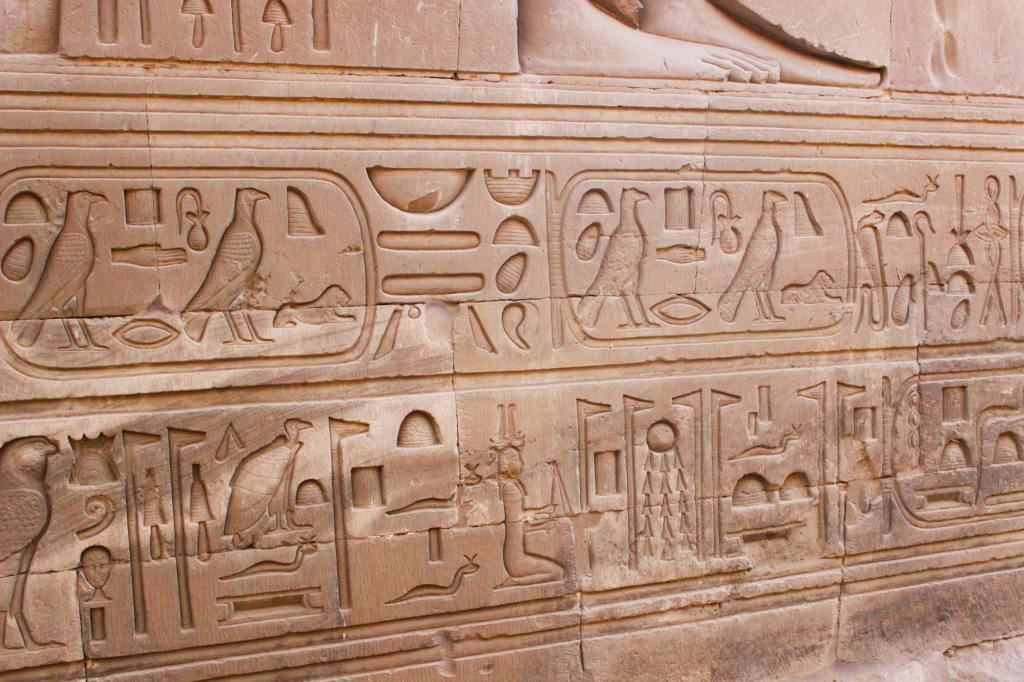
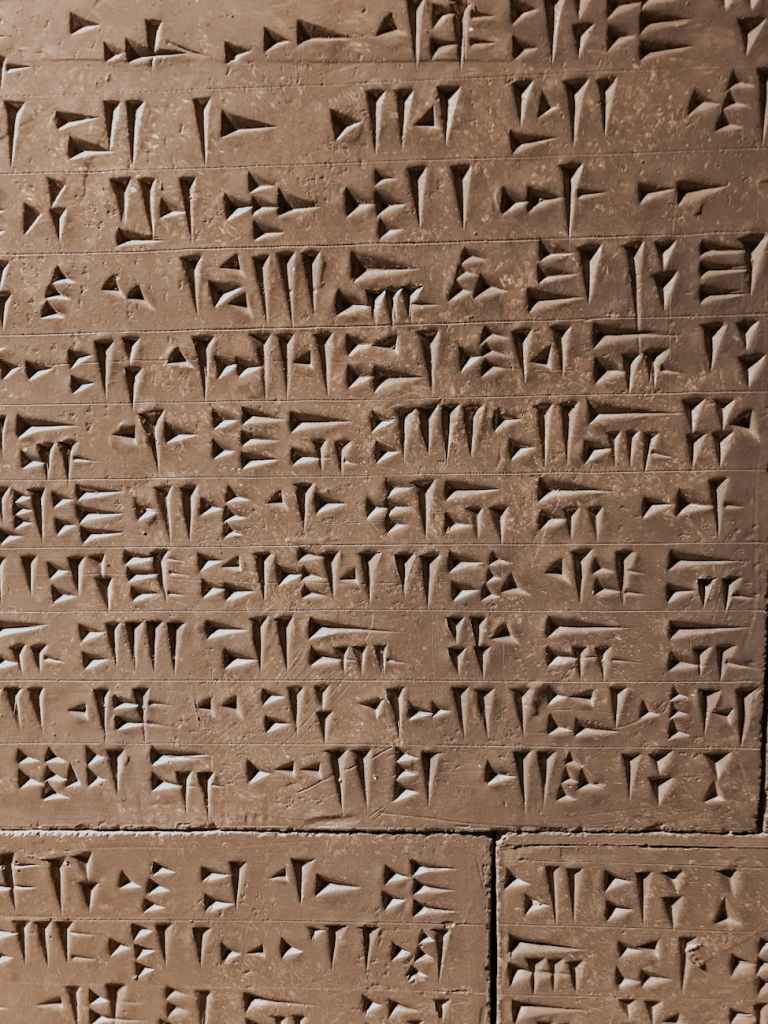
Plus, it is a story about writing by a people reckoned as unable to do so. By that I mean unable to write in a way that you or I would find understandable without extensive scholarly training in things like hieroglyphics or cuneiform. No, this is writing that after only a short alphabet and vocabulary lesson you can read—read as if it was a news feed on whatever device from which you usually get such.
Egyptian hieroglyphs
Photo by Luisa Castillo Osorio on Pexels.com Cuneiform
Photo by Bilge u015eeyma Ku00fctu00fckou011flu on Pexels.com
Well, I have to walk that back a bit. We would have to account for the boustrophedon track. Some ambiguities that adds to the message but without necessarily blurring its gist. This I will explain later.
Nevertheless, this story is about us actually reading the thoughts recorded by the hand of someone who lived around 3500 years ago.
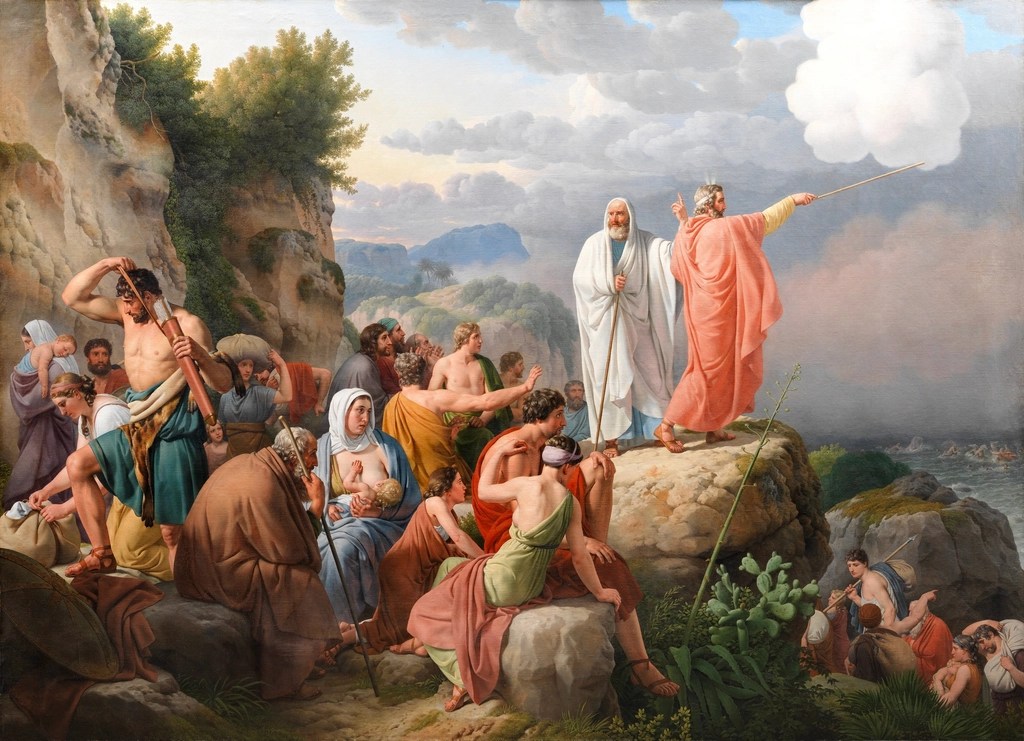
But it goes beyond that. Fantastically, the thoughts related seem to detail of events and personages we know, ones believed by many the stuff of mythology, that is,Moses, Joshua, and the Hebrews of the Conquest.
Moses closes the Red Sea
Yet, beyond its interesting nature there is another more compelling reason for my writing.
It is this: A tragedy impends. Of such I needed to alert and offer aid at avoiding.
A fuller forecast of this danger I discuss later.
In the next post, however, I give a nutshell version.
For now, I summarize with this: I wrote this to avert jeopardy to a great story.
Now a question: To you how cool is a possible physical link to the thoughts of someone of around thirty-five hundred years ago? Let me know in your comments.
Thank you for reading!
If you appreciate this type of analysis, please “subscribe”, “like”, and “share”.
If you wish to support this work, you can do so in the donation block below. Such really encourages!
Why such a fuss over an artifact no bigger than a business card folded in half?
Hi, I am Ernie Vallery, a retired Louisiana attorney living now in South Coast Massachusetts.
This is the third post of my memorandum about the Curse Tablet. In this preface section I explain why excavating promptly a particular archaeological sight in Judea / Samaria is so important.
To read my memorandum from its beginning through to its conclusion, click here. Otherwise, continue below.
The reason for the fuss is this: Artifacts from this site could impact tsunami like upon man’s philosophical and spiritual bearings. Additionally, it could reorder our historical, archaeological, epigraphical, and even political understandings.
Hence there is much at stake.
A fuller explanation of this I discuss later.
Here, however, is a nutshell version:
Some claim that this so called “Curse Tablet” together with yet to be excavated clues from Mt. Ebal’s “Joshua’s Altar” may solve a thorny ancient riddle, that is, “Who wrote the Torah?”
Others say, “Not hardly!”
Many in the first camp believe that delaying further excavation could result in a catastrophic scenario–the forever loss of opportunities for discovery.
Regardless, most recognize that excavation could impede peace in a war torn region.
Authorities thus must decide:
Are the phenomenal claims about the curse tablet supported by sufficient evidence?;
Might there be other evidence at Joshua’s Altar of profound importance to mankind’s understanding of history?;
How urgently important is further excavation at Joshua’s Altar?; and
How might further excavation at Mt. Ebal be accomplished without igniting regional tensions or upsetting the international rule based order?
This memorandum explains my take on the first three of these questions.
The fourth, however, I do not here wrestle to a conclusion. How to excavate on Mt. Ebal without igniting regional and international tension, I keep mostly beyond this memorandum’s scope. Other than a few speculative hunches in my conclusion this question I largely avoid.
Why? It involves diplomatic intricacies to which I am not privy.
Nevertheless, answering the first three greatly clears the way for those with behind the scene, non-public capabilities. They then can concentrate on resolving the remaining hurdle.
The problem of the Curse Tablet, Joshua’s Altar, and Mt. Ebal thus represents a figurative multi-locked door. To get through, one must negotiate each.
Others then can better focus on the remaining, that is, how to clear the diplomatic path for further excavations.
With you, however, likely a separate important question has already arisen. Legitimately you might inquire: “Why should I, an American civilian, address this matter?”
This I discuss in the next post.
Now a question for you: How might resolving the question “Who wrote the Torah?” impact your life or others around you?
Respond in the comment section below.
Thank you for following!
If you appreciate this type of analysis, please “subscribe”, “like”, and “share”.
If you wish to support this work, you can do so in the donation section below. Such really encourages!
Why should I attempt to tackle Ebal’s enigmas? The short answer is that I have experience with an appropriate tool for the issue at hand. That tool is summary judgment.
Hello, my name is Ernie Vallery. I am a retired Louisiana attorney living now in South Coast Massachusetts.
This is my fourth prefacing post of a memorandum arguing this: The proposed Joshua’s Altar warrants posthaste excavation, otherwise, historical evidence of incalculable value risks generational inscrutability or destructive ruin. This post tells why I deserve your attention on this matter.
If you wish to read without interruption my entire memorandum from its beginning through to its conclusion, click here.
For a definitive opinion on this matter one would likely at first blush consider a panel of archaeologists, epigraphers, and experts in tomography, computer science, and photography–not an attorney!
If the question was: “What is the ultimate truth about Mt. Ebal, Joshua’s Altar and the Curse Tablet?”, I might agree. In that case I would likely say,”Yes, the experts should receive considerable latitude.”
But that is not the current question. Instead, it is ultimately whether to excavate now or not!
To answer this question requires another element beyond these experts’ opinions. It needs an agreed upon objective standard for decision making. One that can lead to a relatively expedited, yet well reasoned decision.
Archaeologist, epigraphers, and similar experts are not necessarily equipped at negotiating this.
Consider for example an observation of Agatha Christie, the famous suspense novelist. She advised of the vehement interactions of her husband, himself a famous archaeologist, with others on archaeological issues. This she characterized as, “Blood on the carpet!”
Actual “blood on the carpet” may indeed resolve issues quickly, but likely not the non literal sense Christie intended.
Nor will it necessarily precipitate the best immediate resolutions. Instead, it may settle with the side that speaks loudest, oftenest, or worse yet today the side that best manipulates social media.
This matter is too important, too urgent for such a result.
So why me?
I possess none of the expertise of the panel listed above.
Instead, I am a combat infantry veteran of Iraq and Afghanistan. Also, I am an attorney, a mostly retired member of the Louisiana bar.
But on the questions at issue I am well qualified to make this case.
First, I have keenly learned ideas about operating in a combat zone. Particularly, I have experienced scenes of civil tranquility that in a moment, often the least expected, erupt into chaotic bloodshed.
The area of Mt. Ebal can become the eye of such. Periodically, it is at least within its penumbra.
Decisions about archaeological exploration and preservation here must bear this in mind.
Additionally, another aspect of military experience is of value. Fully understanding the issues presented here requires a journey across an eon of time, one that encounters battles of ideas about truth.
For this journey one needs preparatory information.
In the U. S. Army such comes in an operation order. Anyone who has ever served knows “Sergeant Major eats sugar cookies!”—situation, mission, execution, sustainment, command and signal—the anachronism for the elements of an operation order. To equip you for this adventure the most relevant of these I detail in my next post.
My being an attorney, however, provides the most salient reason for “Why me?”. It informs of a rule of law for a situation analogous to this matter’s. It is U. S. Code of Civil Procedure Rule 56–“Summary Judgment”. This applies an authoritative objective measure, one yielding an expedited decision with more than a modicum of logic.
In this matter the public and those in authority need this type of decision making clarity.
Presently, much public confusion reigns over the issues surrounding Mt. Ebal.
About these some have already fixed notions largely derived as one might pick a favorite football team. They have decided that they prefer the red team or the blue team, the gold or the purple. Logic may not run much deeper.
About this matter the appropriate political authorities and the public who can influence them need to make up their minds quickly but after serious thought.
Why? There are immense consequences for a wrong or late response.
Delay could lead to the loss of riddle answers for another decade, another century, maybe another thirty-five hundred years. Who knows?
On the other hand, acting without deft forethought could upset the delicate political balance of a potential war zone.
The decision making process that I espouse in this memorandum offers the opportunity for an expedited, logical deliberation that this matter mandates.
In sum, stick with me for this excursion. Together we can reach our destination. We can digest the academic evidence. We can apply an objective measure. Also, on the following questions we can render expedited yet considered decisions:
Does satisfactory evidence support the fantastic claims about the Curse Tablet?; and
Should we advocate for posthaste, but careful and thorough, excavation of Mt. Ebal’s alleged Joshua’s Altar, the origin of the Curse Tablet?
Again, come along! We can do this!
But first let us make sure we have our journey essentials.
That we review in our next post.
Now a question: What may be the consequences of further generational inscrutability of what the Curse tablet might be?
Let me know in the comment section below.
Thank you for reading!
If you appreciate this type of analysis, please “subscribe”, “like”, and “share”.
If you wish to support this work, you can do so in the donation section below. Such really encourages!
Understanding the enigmas of the Curse Tablet requires a journey across an eon of time. For this we need preparation.
Hello, I am Ernie Vallery, a retired Louisiana attorney living now in South Coast Massachusetts.
This is my fifth post on this matter, the first introductory one after four prefacing posts.
My entire memorandum argues that the proposed Joshua’s Altar and the Mt. Ebal Curse Tablet deserve a chance to prove what they might be. Yet, understanding this requires a voyage across a vast gulf of time. This post attempts to prepare you for that trip.
If you wish to read without interruption my entire memorandum from its beginning through to its conclusion, click here.
Otherwise, read on.
An operation order for our journey thus follows:
Situation:
Geography
Where is Mt. Ebal?
It rises in the northern third of Samaria / Judea adjacent to its slightly smaller sister–Mt. Gerazim, flanking on the south. Between the two runs a pass where one sees modern Nablus on a western neck. The location of ancient Shechem lies nearby a little eastward.
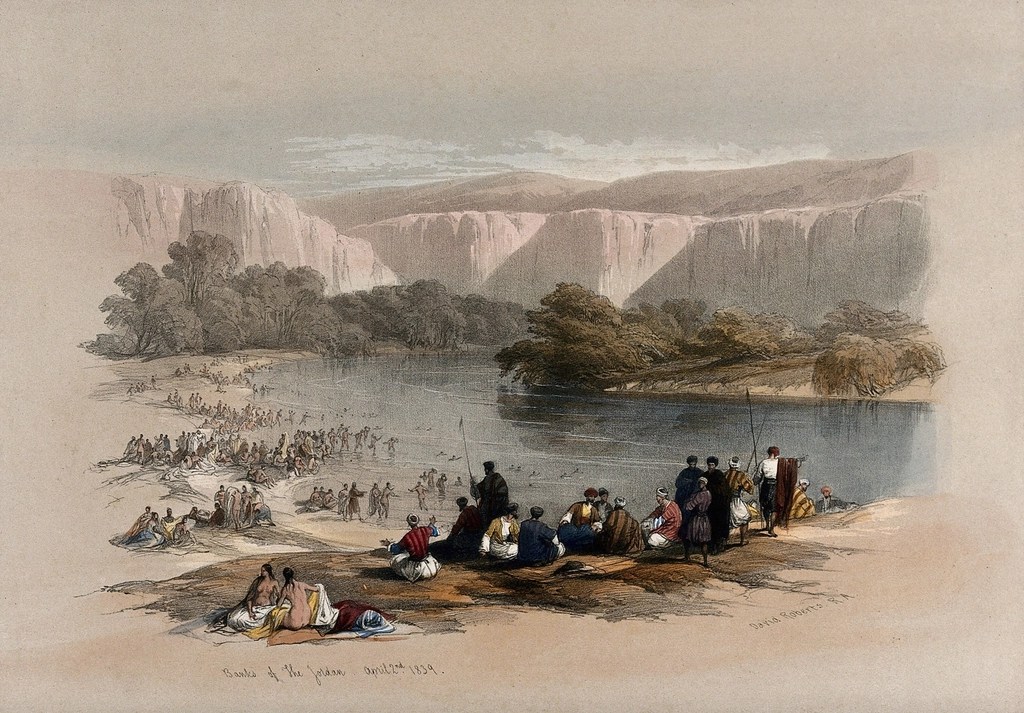
Through this passage people have accessed since antiquity the Jordan Valley on the east and the Plain of Sharon and the Mediterranean on the west.
Bathers on the banks of the Jordan
A sweeping view to the North reveals the uplands of Galilee where you can glimpse the outline of Nazareth. Adjusting east one sees across the Jordan to Hermon’s whited pinnacle. Farther south the view traverses the Dead Sea to the region of Moab. Finally due south arise the heights of Jerusalem.1
A nearer view reveals a valley between the two mountains into which many springs flow. These irrigate lush vineyards, orchards, and groves yielding abundant grapes, figs and olives. But higher up near Mt. Ebal’s summit, rocky outcrops, “ubiquitous thistles and prickly shrubs” abound.2
History Preview:
Among this high setting Adam Zertal, an Israeli archaeologist, arrived in the 1980’s on a government survey mission. There he found what ultimately he came to believe was an ancient Hebrew altar.
Yet, this notion ran contrary to scholarly understanding. It was thus ultimately largely dismissed, even scoffed at.
Some forty years later an archaeological team, headed by Dr. Scott Stripling, moved some of Zertal’s dump piles off site. To that material they applied a perfected wet sifting technique. Many small, previously missed artifacts they found as a result.
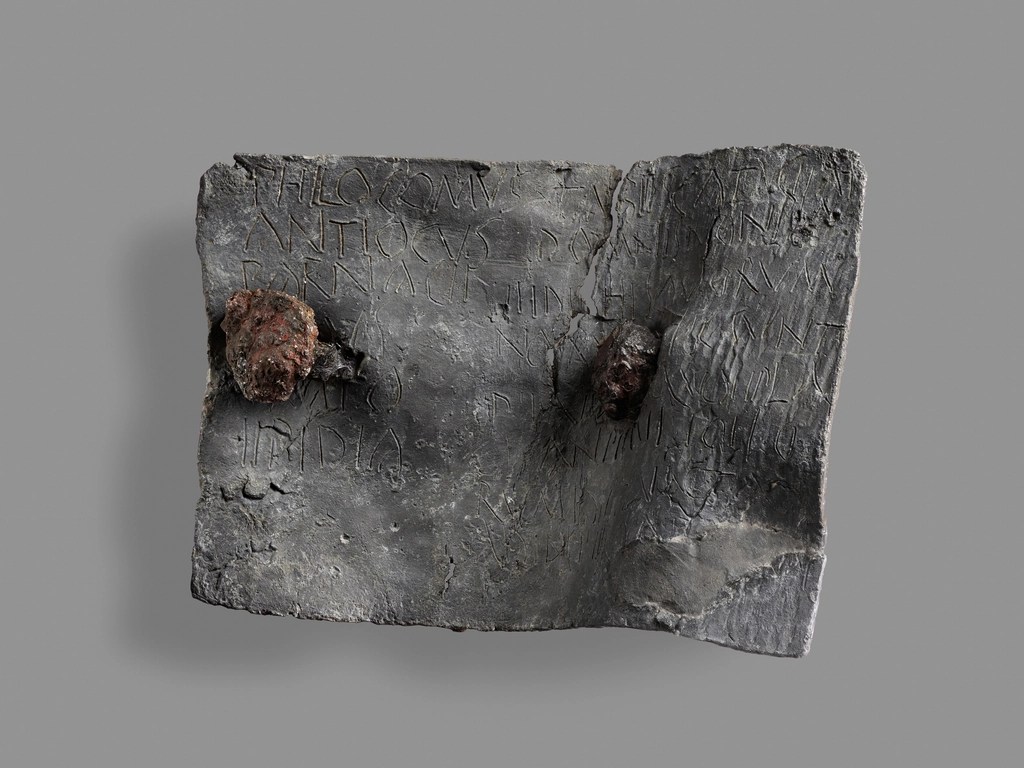
One particularly intrigued. The tiny lead object they thought a defixio, a curse tablet.
Having had significant previous experience with such, they anticipated inside an inscribed curse.
When, however, they attempted to open it, a small corner crumbled. That endeavor they ceased.
Fortunately, tomographic slice imaging enabled scans of what lay within.
Heritage Science published their report about the resulting photos.
These startled much of the world. Allegedly inscribed there were proto-alphabetic letters pronouncing God’s Hebrew name–“Yahweh”, and the word “ARWR” meaning “cursed!” Furthermore, the words and provenance recalled a ceremony recorded in scripture.
After public release of the scans, eminent scholars disputed these claims.
Recently, Heritage Science published another peer reviewed essay about the tablet. In it Mark S. Haughwout , a prominent Hebrew scholar, gives his views. He also largely summarized the qualms of others scholars.
The article boldly concludes, “The only substantiated claim that Stripling et al. can make at this time is that they have found a very old, small piece of folded lead on Mt. Ebal using wet sifting.”
In other words, Haughwout determined that there is nothing to see here!
Meanwhile, the potential destruction of the Mt. Ebal archaeological site looms. This I explain later.
Mission:
This memorandum argues that government authorized excavation of Joshua’s Altar should occur posthaste. The reasons are that:
Sufficient evidence supports the fantastic claims about the Curse Tablet;
The probability of Mt. Ebal revealing other important evidence is significant; and
The chance for that evidence being destroyed is real.
Execution:
In support of these positions I argue that Haughwout failed in his “refutation”, i. e., disproval, efforts.
In doing so I apply an objective measure derived from a prominent authority well accustomed at resolving issues of this nature, that is, the U. S. Supreme Court.
The High Court’s Rule 56 of its U. S. Code of Civil Procedure mandates how lower courts decide motions for summary judgment.
Summary judgment, I argue, closely resemble our matter. Thus, for it a standard similar to that of Rule 56 should operate appropriately.
My applying an objective measure to these facts frees you to competently make up your own mind about the issues confronted. Resultantly, you can decide yourself whether my adjudication is fair and reasonable.
Service and Support:
Embedded as lagniappe I provide links to materials–written, audio, and video. These reflect the tensions associated with this topic. Adversarial material I attempt to display.
Music snippets I add for ambiance.
The last post supplies supplemental materials. This includes letters to my U. S. congressional delegation.
Command and Signal:
As co-founder of captivatingtwists.com, I authored the thirty posts about this matter. As my audience I welcome anyone interested in the issues presented.
Peer review articles of Dr. Stripling and Mr. Haughwout I extensively review in this memorandum.
Ultimately, the conclusions and recommendations herein are entirely my own.
Fasten your seat belt! Prepare not only to traverse three and a half millenniums of history. Brace also to referee a joust between competing views about human reality.
The next post, the last of my introduction, teases curiosity about the journey ahead.
Here is a question: What, if any, of this “operation order” did you find helpful before delving into this subject? If so, how?
Thank you for reading!
If you appreciate this type of analysis, please “subscribe”, “like”, and “share”.
If you wish to support this work, you can do so in the donation section below. Such really encourages!
In 2019 the team of Scott Stripling, professor of biblical archaeology and church history at the Bible Seminary in Katy, Texas,1 found a small lead object measuring about 2 x 2 centimeters (.8 x .8 inch).2
Because of this tiny artifact millions of people worldwide soon focused anew on Mt. Ebal.
Hello, my name is Ernie Vallery. I am a mostly retired Louisiana attorney living now in South Coast Massachusetts.
This is the tenth post of my memorandum maintaining that the proposed Joshua’s Altar and the Mt. Ebal Curse Tablet deserve a chance to prove what they might be. It is also the forth of ten posts detailing the history of the altar and the tablet.
If you wish to read without interruption the entire work from its beginning through to its conclusion, click here.
Otherwise, continue below.
This part of our story ensued after Stripling obtained a permit to re-sift Zertal’s Mt. Ebal’s dump piles, 3 lying long dormant since well before Zertal’s death.
His purpose was to assess the usefulness of a relatively unheralded technique called wet sifting,4 a process by which previously dry sifted remains are washed to reveal small missed artifacts.
Specifically, he sought to determine an approximate percentage of evidence archaeologist miss by only dry sifting.5
On-site work, however, at Mt. Ebal presented geopolitical headaches.
A workaround, nonetheless, Stripling achieved.
Authorities permitted the transport of some of the altar dump material to a location away from the mountain for processing.6
There Stripling’s team then re-dry sifted. This they followed with wet sifting.7
At this process combining standard dry sifting with a more modern and refined wet sifting technique, Stripling expected to find little more than mundane archaeological objects–maybe additional bullae, scarabs, or diagnostic pottery fragments, not archaeological pay dirt.
Yet, in the wet sifting process the team’s small finds expert, Frankie Snyder, discovered in her wet-sifting tray something she immediately recognized.8
At this she announced in effect, “Scott, you want to see this!”9
For Stripling the sensation on viewing was as if his heart had leaped to his throat. Instinctively he cautioned, something like: “Whoa! Let’s not get ahead of ourselves here!”10
Sean McDowell, Oldest Hebrew Writing? Mt. Ebal Curse Tablet (Revisited), m.youtube.com>watch, (03:39), 11 May 2023; Steve Law, patternsofevidence.com, Ancient Hebrew Writing on Tablet Discovered at Joshua’s Altar, paragraph 14 and 15, February 4, 2022; and Special Update: The Mount Ebal Curse Tablet (Ep1 of 3), Youtube: Patterns of Evidence, youtube.com/watch?v=YX3TH_nfgLo, Episode One at (19:10), May 21, 2024. ↩︎
What landed in Snyder’s tray she quickly identified as a defixio, an ancient curse tablet.1
Hello, my name is Ernie Vallery. I am a mostly retired Louisiana attorney living now in South Coast Massachusetts.
This is the eleventh post of my memorandum maintaining that the proposed Joshua’s Altar and the Mt. Ebal Curse Tablet deserve a chance to prove what they might be. It is also the fifth of ten posts detailing the history of the altar and the tablet.
If you wish to read without interruption the entire work from its beginning through to its conclusion, click here.
Otherwise, continue below.
In Snyder’s analysis Stripling and many of their experienced associates concurred. Why? These they had often seen. From the Greco-Roman world they are relatively common archaeological finds.2
Nevertheless, they also recognized the irony of finding one on Deuteronomy’s “Mountain of Curses.”
Stripling immediately recognized too that at this site a defixio posed a problem. Zertal had dated the altar site from 1400 to 1250 B.C. This he had concluded from careful pottery analysis. Contrarily, Stripling knew that defixios commonly dated to the Greek and Roman eras, primarily fourth and third centuries B. C. forward. A defixio seemed inappropriate by around a millennium.3
He, however, was aware of a possible precedent.
The Book of Job speaks of Job’s desire to write on lead with an iron pen (Job 19:24).
That book many scholars peg as the oldest biblical text. One reason is that it does not allude to the Law of Moses.4
Although Stripling realized that glyphs adorned the tablet’s outside, he was most intrigued by what may lie within. There as with other defixios someone likely inscribed a curse.
Hello, my name is Ernie Vallery. I am a mostly retired Louisiana attorney living now in South Coast Massachusetts.
This is the twelfh post of my memorandum maintaining that the proposed Joshua’s Altar and the Mt. Ebal Curse Tablet deserve a chance to prove what they might be. It is also the sixth of ten posts detailing the history of the altar and the tablet.
If you wish to read without interruption the entire work from its beginning through to its conclusion, click here.
Otherwise, continue below.
Usually, this curse was of a trivial nature, often something like, “She stole my boyfriend, may all of her hair fall out!”1
Stripling and a colleague therefore gingerly attempted to open it. The lead of one corner, brittle with age, however, crumbled. Further efforts they thus ceased.
Fortunately, the lead fragments Hebrew University in Tel Aviv successfully analyzed. The determination was that the lead originated from a mine in Lavrion, Greece.2
About that mine historians and archaeologist have arrived at an accepted position. It is that it exported to the Middle East from before the Late Bronze Age well into Roman times.
Here a curious historical anomaly deserves consideration.
In the Mediterranean world around the 12th century B. C. a dark age ensued. Then effectively Late Bronze Age civilization mysteriously imploded. Ancient exports plunged. Ostensibly European / Asian economic and cultural sophistication wilted. Among those civilizations disappearing or massively squelched include the Hittite, Ugarite, Minoan, Mycenaean, Trojan, and Babylonian.3 A definitive explanation for why alludes scholars to this date.4
From this dark age understanding Stripling deduced a probability.
He proposed that likely someone imported the lead tablet in the thirteenth, fourteenth, or earlier centuries B. C. Zertal dated pottery at the site between 1250 B. C. and 1400 B. C. Given the twelfth century’s mysterious economic and cultural collapse, someone, he surmised, likely imported the lead tablet in previous centuries, namely, before the ancient dark age of 1200 to 1150 B. C.
The metallurgical analysis, therefore, strengthened Stripling’s idea about the tablet’s date. Although not concrete, likely, the defixio dated from early in the late bronze age.
Nevertheless, Stripling perceived that he had exhausted the tablet’s plausible investigative analysis. It was time for greater focus on his many other administrative, scholarly, and archaeological pursuits.
Thinking thus, he sent an email to a colleague attaching a tablet photo. Subsequently, among archaeological circles this began to circulate.
Then afterwards an unexpected opportunity for further investigation materialized.
Stripling read of a technological advancement. The ability to peer into lead to discern written content had been demonstrated. Also, he learned that the Institute of Theoretical and Applied Mechanics in Telč (Czech Republic) excelled at the process.
Arrangements were made. Israeli authorities gave a colleague a license to courier the “defixio” to Prague.5
Time passed. The Institute at Telč, 152 km. from the capital, finished its analysis and forwarded the results, scientific and epigraphical.
Amazingly the Telč team indeed perceived something within. An epigraphic expert there suggested proto-alphabetic letters, that is, ancient letters representing sounds rather than complete thoughts.
These initial revelations alone had profound meaning for Stripling. Now he had his most conclusive evidence for the date of the tablet. It had to be Late Bronze Age or Early Iron Age I, that is, from as early as 1400 to as late as 1250 B.C.6
Why? Such was the epigraphically and archaeologically accepted period for use of proto-alphabetic script.
No longer did the tablet present an anachronistic dilemma. It now definitively matched Zertal’s pottery dates.
What else could this new evidence portend?
This I probe further in my next post!
But now some questions: What do you think likely caused the Late Bronze Age civilizational collapse? In Mark Twain parlance how might that rhyme with subsequent history? How might it rhyme in the future?
Let me know in the comments below.
Thank you for reading!
If you appreciate this type of analysis, please “subscribe”, “like”, and “share”.
If you wish to support this work, you can do so in the donation section below. Such really encourages!
Next post: “Staking a Claim”
Sean McDowell, Oldest Hebrew Writing? Mt. Ebal Curse Tablet (Revisited) m.youtube.com>watch, (8:51), 11 May 2023. ↩︎
Special Update: The Mount Ebal Curse Tablet (Ep1 of 3), Youtube: Patterns of Evidence, youtube.com/watch?v=YX3TH_nfgLo, Episode One at (26:12), May 21, 2024. ↩︎
Matti Friedman, “An Archaeological Dig reignites the Debate Over the Old Testament’s Historical Accuracy”, mattiefriedman.com, paragraph 21. December 12, 2021. ↩︎
Breaking News “Mt Ebal Curse Tablet Peer Review Complete”, Appian Media, In Roads, youtube.com/watch?v=_15tYO4hqJS, (27:30), May 12, 2023. ↩︎
The Czech Institute’s data continued to prove a font of revelation.
From the tomographic scans Stripling’s epigraphers quickly discerned not just letters, but words.
I am Ernie Vallery, a retired Louisiana attorney living now in South Coast Massachusetts.
This is my thirteenth post asserting that the proposed Joshua’s Altar and the Mt. Ebal Curse Tablet deserve a chance to prove what they might be. To start the journey from its beginning click here. Otherwise, drive on.
These tomographic revealed words included “Yahweh” and “cursed”, both apparently recalling Joshua’s ceremony of blessings and curses on Mts. Gerizim and Ebal. One epigrapher, Dr. Gershon Galil, of the University of Haifa, additionally decoded a sophisticated parallelism, a chiasmus.
This literary device one finds throughout the Old and New Testaments. Consider for example Luke 4:16b-20 “The Favorable Year of the Lord”. Note below the parallel and inverse wordings with a central focus:
14 And Jesus returned to Galilee in the power of the Spirit, and news about Him spread through all the surrounding district. 15 And He began teaching in their synagogues and was praised by all. 16 And He came to Nazareth, where He had been brought up, and as was His custom,
He entered the synagogue on the Sabbath,
and stood up to read,
17 And the book of the prophet
Isaiah was handed to Him,
And He opened the book and
found the place
where it was written,
18 “The Spirit of the Lord is upon Me
Because He anointed Me to
preach the gospel to the poor.
He has sent Me to proclaim
release / to the captives,
And recovery of sight tothe blind,
To set free / those who
are oppressed,
19 To proclaim the
favorable year of the Lord”
20 And He closed the book,
gave it back to the attendant
and sat down
and the eyes of all in the synagogue were fixed on Him.
21 And He began to say to them, “Today this Scripture has been fulfilled in your hearing.”1
Nevertheless, as a professional he was certainly aware that a find of this magnitude required cautious, meticulous handling.
He was a renowned archaeologist with decades of Holy Land field experience at preeminent sites.
The profound nature of this find earmarked it. Surely it would cause an immense stir. On multiple levels intense international scrutiny lay on the horizon journalistically, scholarly, and politically.
But life threw Stripling a curve ball mandating a different approach.
Concurrently, speculation circulated about the tablet photo that Stripling had earlier emailed to an associate. Forwarded recipients began generating noise online. Some pondered the outer tablet’s glyphs. Could they be some sort of script?
Alarmed that others might lay academic claim to the tablet’s message, Stripling deemed it necessary to go public quickly. Otherwise, he risked forfeiting his scholarly stake as the tablet’s lead discovering archaeologist.2
A press conference ensued in March 2022. At it Stripling and his team announced the following:
The lead defixio found by his team contained archaic proto-alphabetic script;
From around forty letters present, the Hebrew name for God appears twice and the word “cursed” ten times;
The late bronze age dating of the tablet makes it two to four hundred years older than any other known Hebrew text.
A possible reading relates a chiasmus, a literary form employed extensively in both the Old and New Testaments.
That proposed reading was:
Cursed, cursed, cursed-cursed by the God YHW You will die cursed. Cursed you will surely die. Cursed by YHW-cursed, cursed, cursed!
(Mt. Ebal “Curse Tablet” Full Press Conference, YouTube, Appian Media, March 29, 2022)
Afterwards, public elation and scorn followed.
Why scorn?
This our next post addresses.
Thank you for reading!
If you appreciate this type of analysis, please “subscribe”, “like”, and “share”.
If you wish to support this work, you can do so in the donation section below. Such really encourages!






























 captivatingtwists.com