The Czech Institute’s data continued to prove a font of revelation.
From the tomographic scans Stripling’s epigraphers quickly discerned not just letters, but words. These included “Yahweh” and “cursed”, both apparently recalling Joshua’s ceremony of blessings and curses on Mts. Gerizim and Ebal. One epigrapher, Dr. Gershon Galil, of the University of Haifa, additionally decoded a sophisticated parallelism, a chiasmus.
This literary device one finds throughout the Old and New Testaments. Consider for example Luke 4:16b-20 “The Favorable Year of the Lord”. Note below the parallel and inverse wordings with a central focus:
14 And Jesus returned to Galilee in the power of the Spirit, and news about Him spread through all the surrounding district. 15 And He began teaching in their synagogues and was praised by all. 16 And He came to Nazareth, where He had been brought up, and as was His custom,
He entered the synagogue on the Sabbath,
and stood up to read,
17 And the book of the prophet
Isaiah was handed to Him,
And He opened the book and
found the place
where it was written,
18 “The Spirit of the Lord is upon Me
Because He anointed Me to
preach the gospel to the poor.
He has sent Me to proclaim
release / to the captives,
And recovery of sight tothe blind,
To set free / those who
are oppressed,
19 To proclaim the
favorable year of the Lord”
20 And He closed the book,
gave it back to the attendant
and sat down
and the eyes of all in the synagogue were fixed on Him.
21 And He began to say to them, “Today this Scripture has been fulfilled in your hearing.”1
Nevertheless, as a professional he was certainly aware that a find of this magnitude required cautious, meticulous handling.
He was a renowned archaeologist with decades of Holy Land field experience at preeminent sites.
The profound nature of this find earmarked it. Surely it would cause an immense stir. On multiple levels intense international scrutiny lay on the horizon journalistically, scholarly, and politically.
But life threw Stripling a curve ball mandating a different approach.
Concurrently, speculation circulated about the tablet photo that Stripling had earlier emailed to an associate. Forwarded recipients began generating noise online. Some pondered the outer tablet’s glyphs. Could they be some sort of script?
Alarmed that others might lay academic claim to the tablet’s message, Stripling deemed it necessary to go public quickly. Otherwise, he risked forfeiting his scholarly stake as the tablet’s lead discovering archaeologist.2
A press conference ensued in March 2022. At it Stripling and his team announced the following:
The lead defixio found by his team contained archaic proto-alphabetic script;
From around forty letters present, the Hebrew name for God appears twice and the word “cursed” ten times;
The late bronze age dating of the tablet makes it two to four hundred years older than any other known Hebrew text.
A possible reading relates a chiasmus, a literary form employed extensively in both the Old and New Testaments.
That proposed reading was:
Cursed, cursed, cursed-cursed by the God YHW You will die cursed. Cursed you will surely die. Cursed by YHW-cursed, cursed, cursed!
(Mt. Ebal “Curse Tablet” Full Press Conference, YouTube, Appian Media, March 29, 2022)
As already noted Heritage Science finally published the Stripling team’s peer reviewed article on 12 May 2023. That is twelve months after the press conference and almost three and a half years after the tablet’s discovery.
Much of the world, of course, breathlessly anticipated one feature.
Likely you also think, “Show us the photos, please!”
Before I do, however, there are four important observations to make.
Observation One
The article’s conclusion states the core of the Stripling team’s argument about the Curse Tablet. With it they poise a stake into the heart of much scholarly accepted history including that associated with the documentary hypothesis.
The other parts of the article’s body state facts and ideas considered. Only with the concluding core, however, does Stripling dig in his boots. It is there that he states what about the tablet emphatically belies the idea that Moses could not have authored the Torah.
The Stripling article, for example, credits team member Professor Gershon Galil, Director of the Institute of Biblical and Ancient History at the University of Haifa, with deciphering most of the interior tablet. His premises it fully elucidates.
Yet, note this crucial point.
The Stripling article’s conclusion leaves many, if not most, of Galil’s premises orphaned. His accounting of the number of inner tablet letters is neither adopted nor rejected. The same applies for his full chiasmus interpretation.
The article acknowledge many of Galil’s premises. It cites his increased letter count of forty declared at the press conference to forty-eight at publication. Consequently, it also acknowledges his slightly modified chiasmus interpretation.
Despite this, the article’s conclusion does not embrace these premises.
Instead, it concludes that the tablet’s inscription challenges history for greatly truncated reasons. Those reasons include these:
The tablet displays in proto-alphabetic script the word “YHW”, the name of the Hebrew God;
From this we know that a Hebrew inscribed the tablet sometime before 1250 B. C.;
Additionally, the tablet contains the word “ARWR” or “cursed”;
These tablet words recall events described in Deuteronomy and The Book of Joshua;
Resultantly, this artifact challenges long standing historical paradigm.1
The note immediately following the conclusion is telling. It addresses Galil’s allegiance to his premises. It announces that, in effect, he desires to “plant his intellectual flag” on those.2
A more conservative approach, however, Stripling’s conclusion adopted.
Following publication, Galil and Stripling amicably ended their team affiliation.
What are the consequences for our study?
For us Stripling has simplified our original question, “Is there anything to see here?”
Stripling’s team answers with a resounding, “Yes, see the two words on the inside of this artifact–the ancient Hebrew equivalents of “cursed” and “Yahweh”. They alone with the tablet’s ambiance challenge world history!”
Consequentially, that makes our photo study easier.
From Stripling’s perspective we can focus primarily on photos relevant to two words. The other words of Galil’s chiasmus while important are not crucial to Stripling’s conclusion.
Observation Two
Our purpose is not only to review the Stripling article and its photos. We seek also to study an allegedly refuting article.
That article considers closely the alleged Hebrew words for “cursed” and “Yahweh”.
Additionally, it makes relevant arguments involving two individual tablet characters and the Hebrew word for “You will die!” These I also include in our study.
Observation Three
In the proto-alphabetic era writing often traced a boustrophedon path. Then there was no standardized script order. Instead, letters tracked as oxen plow. They follow left to right, up to down, diagonally, etc. Another example may be the various paths that an inexperienced pre-teen might push a lawnmower over your yard or maybe someone much older quite inebriated.
Stripling, S., Galil, G., Kumpova, I. et al. “You are Cursed by the God YHW:” an early Hebrew inscription from Mt. Ebal. Herit Sci11, 105 (2023), paragraph 71. https://doi.org/10.1186/s40494-023-00920-9↩︎
We test here the first part of Haughwout’s material fact. That is whether the tablet contains proto-alphabetic letters.
To evaluate this I take these steps:
First I outline Haughwout’s position. Find this below the magenta banner.
Against it, I give push back. This you find below the yellow.
Lastly, I announce my findings below the purple banner.
No Letters
When Haughwout began to study the photos of Stripling’s article, he had an initial favorable impression. The top right corner indeed seemed to show several proto-alphabetic characters. Namely these were Teh, Meh, He, Teh and Aleph–five in total, respectively #’s 18, 19, 12, 20, and 21 of Figure 7.
For him the most impressive was Aleph #21. Best he felt it displayed the appropriate proto-alphabetic characteristics.
His opinion, however, soon changed.
On close review he noticed a number of crack lines commencing from the tablet’s edge to intersect with the character.
Prominent were the two cracks that he deduced had over time created the “Ox’s” horns. (See here.)
Resultantly, this Aleph’s favorable status crumbled. He deduced it only the chance product of crack lines. No longer was it an exquisite inscription. It now presented a coincidental aberration with grotesquely proportioned horns. This disqualified it as a man-made proto-alphabetic letter.1
Disillusionment followed also for the other four likely script candidates. All he concluded as being mere happenstance cracks, scratches, and dents in the lead.
Some of the primary reasons for this were these:
First, he realized how small these characters were, ranging form .01 to .05 mm. The minimalist crack, scratch, or dent could replicate them; and
Photos of bulges on the tablet’s bottom (Table 10) failed to impress Haughwout. These Stripling had presented as negative proofs of inside characters. They too, Haughwout concluded, likely resulted from cracks, scratches and dents.
Haughwout thus finally surmised that his most favored of the tablet’s characters presented major existential problems. Doubly so this applied to the remainder.
Pushback on Haughwout’s Improbable Letters
I. Lovely Aleph
Haughwout notes that initially “Aleph, ” Figure 7, # 21 presented for him as a gorgeous proto-alphabetic inscription.
On this I agree.
Note its beauty! It satisfies the eye as an elegant calligraphy beginning a chapter of a medieval manuscript.
Haughwout, however, finds what he considers a fatal flaw–crack lines intersecting the horns.
These he concludes reveal the inscription to be nothing more than happenstance cracks, scratches, and dents. (See again Haughwout’s illustration.)
But Dr. Pieter van der Veens of Johannes Gutenberg University Mainz, one of Stripling’s team epigraphers and an expert in ancient Near Eastern languages and inscriptions, gives a plausible explanation. He suggests that yes there are crack lines emanating from the tablet’s edge. But likely the force of the stylus so close to that edge caused this.
In fact, along the tablet’s top this “Aleph” is among the closest.2
Note too that Haughwout’s drawing appears on a photo that poorly focuses this Aleph.”
On this clearer image you can see that the cracks do not intersect the horn tips smoothly and directly. On both horns there is a transition from the points where the aesthetically pleasing horns end and the apparent cracks intersect.
Both of the aesthetic horns are darker, wider and likely deeper.
Plus, at the intersection points the direction of the cracks deviate on both, but on one more pronounced than the other.
The above emphasizes the likelihood of an author having beautifully crafted his letter only to have time mar it with the imperfectly connecting cracks.
II. Tiny Letters
Haughwout also complains about many of the letters’ small sizes. Here the simple explanation is that the author had a small space with which to work. Plus, in that small space he had a serious message to convey–one not intended for human eyes but only for God.
Fortunately, though, they are indeed visible to man.
III. Bottom Bulges
Further, Haughwout apparently scoffs at the idea of negatives on the tablet’s bottom , “Outer B”, replicating inner tablet letters.
This evidence surely deserves less flippant appraisal.
Consider these examples:
Compare “He” of Figure 7’s, #3 and Table 3, (4 a and b) with Table 10, photo #2. This image I have designated “Dancing ‘He’”. Why? Notice that his arms and legs, seemingly in motion, occupy different levels. Nevertheless, the positive of the inner tablet and the negative of the tablet’s bottom mirror.
See, the first “Resh” in the word “ARWR”, at Figure 7’s #26 and Table 8, (2a & b). Compare it with the bottom bulge shown at Table 10, #8. Notice how they coincide. The positive inner image slants right.The bulge mirrors to the left.
Yet even faint mirroring reflections have an important ramification, one that Haughwout recognizes. He notes,”The reality is a dent on one side of a 0.4 mm thick piece of lead will of course appear on the opposite side.” Further he continues that this proves that the marks “on the inside are indeed there and are not x-ray anomalies.” In other words even where the mirroring images are faint, they prove that what is faintly depicted is indeed there. It is not some fluke produced by x-ray or photographic lightings or shadows.3
Several factors limit the possibility of these being the result of mere happenstance cracks, scratches, or dents.
Note that of the three, a dent seems most likely. Usually such one associates with sufficient downward force to cause an opposing bulge.
Nevertheless, Haughwout’s contention that a happenstance dent as opposed to a purposeful one caused by an inscriber’s stylus must account for the following:
First, the tablet was closed thus protecting the inner tablet from further damage.
Second, the tablet’s top,” Outer A,” does not have marks corresponding to these negatives. Only our inner tablet marks do.
Third, therefore, the force, possibly by a stylus, was likely applied before the tablet was closed.
Fourth, this closing likely occurred during the Late Bronze Age to Iron Age II– the era of proto-alphabetic writing.
Fifth, the act of closing was likely done purposefully by a human. Likely too that was done to conceal and protect a message hidden within.
All of the above amount to justifications for a reasonable person genuinely disputing this portion of the material fact addressed here. That is that the tablet does not reveals proto-alphabetic script.
This portion of Haughwout’s material fact thus fails to support his refutation claim.
Improbable Letter Finding
The evidence shows that there is a genuine dispute about Haughwout’s proposition here. In other words, a reasonable person can genuinely dispute the claim that there are no proto-alphabetic letters on the tablet.
Despite conceding that Figure 7’s #’s 18, 19, 12, 20, and 21 represent proto-alphabetic forms, Haughwout nevertheless concludes that only coincidental cracks and dents formed them.
Yet, a reasonable person could genuinely counter that:
“Lovely Aleph”, Figure 7, # 21, is likely a scribe’s work marred somewhat by incongruous intersecting cracks radiating from the nearby tablet edge.
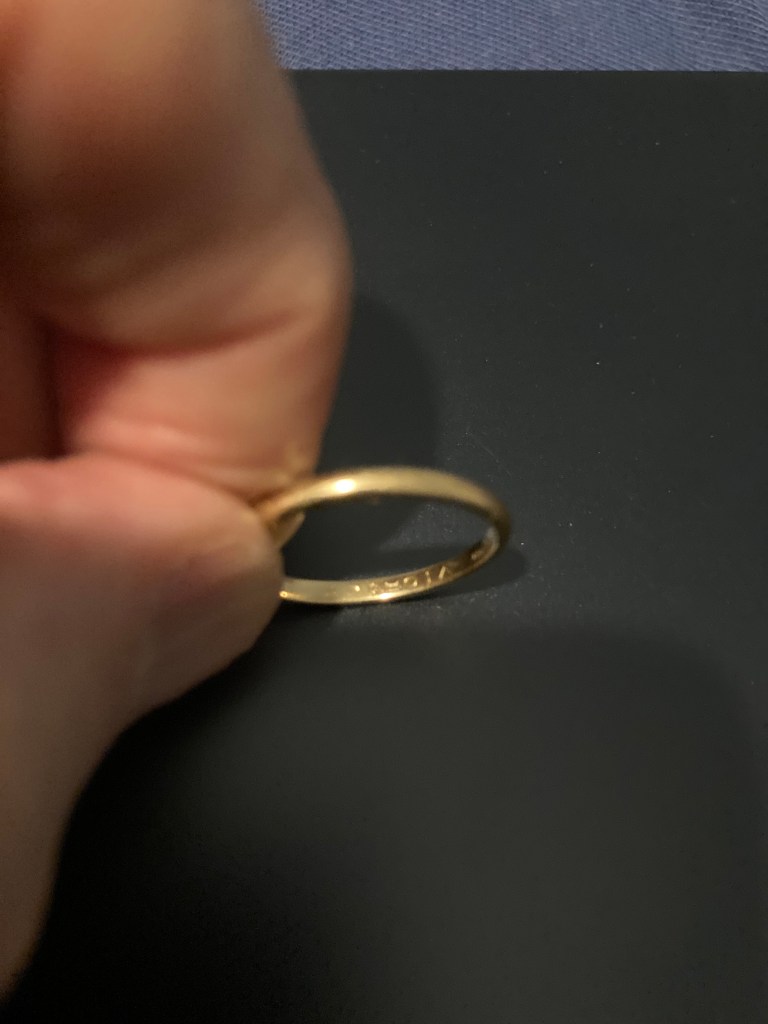
The fact that the letters are small is of little consequence. My wedding band has my wife’s name etched inside it. They are comparably as tiny but no less visible, real and meaningful.
The bottom negatives legitimately argue of man-made proto-alphabetic script inside the tablet.
Therefore, Haughwout’s improbable letter arguments do not support his “refutation” claim. Against this part of Stripling’s first material fact he has failed to satisfy our objective test. That is that a reasonable person could not genuinely dispute the absence of proto-alphabetic letters on the tablet.
Might another of his arguments fare better? Next up we will examine the first of his “Improbable word” criticisms. That is against “ARWR”–“You are Cursed!”
Next post: “ARWR?”
Haughwoout, M. S. Mt. Ebal curse tablet? A refutation of the claims regarding the so called Mt. Ebal curse tablet, Herit Sci 12, 70 (2024). htts://doi.org/101186/s40494-023-01130-z, paragraph 16. ↩︎