This is a story about two archaeology discoveries, both of which have potential dizzying impact on our understanding of biblical and world history.
Hello, my name is Ernie Vallery. I am a mostly retired Louisiana attorney living now in South Coast Massachusetts.
This is the seventh post of my memorandum maintaining that the proposed Joshua’s Altar and the Mt. Ebal Curse Tablet deserve a chance to prove what they might be. It is also the first of ten posts detailing the history of the altar and the tablet.
If you wish to read without interruption the entire work from its beginning through to its conclusion, click here.
Otherwise, continue below.
Closely identified, having come from the same location, these finds are well separated in time of discovery. The first became known about 40 years ago. Identification of the latter occurred within the last six.1
Yet, they poise a piercing assault on a long understood, entrenched, scholarly paradigm—one considered by many virtually unassailable.
What is that? It is that Moses did not write, and, in fact, could not have written, the first five books of the Bible, that is, the Torah or Pentateuch.2 This the paradigm holds despite other Old Testament sources, as well as Jesus of the New, having affirmed or implied Mosaic authorship.
If not Moses who lived allegedly around the Twelfth to Fifteenth Century B. C., then who? In short, the theory holds that a collection of authors mostly from the Ninth to the Third Century B. C. wrote the Torah’s accounts.3 These late date writers aimed at manufacturing for the Hebrew people a shared identity—one fortifying moral cohesion and reverence for mythological heroes.4
This idea permeates more than the ivory towers of elite universities. It holds sway over heartlands worldwide. Since the late 19th century, the idea has schooled generations of priests and preachers as well as waves of college students enrolled in scholastic biblical studies.5
This paradigm against Mosaic authorship has a name. It is the documentary hypothesis.6
Now, let us examine these two discoveries challenging it.
But before doing so, here is a question: When did you first encounter the documentary hypothesis and what effect did that have on you?
Let me know in the comment section below.
Thank you for reading!
If you appreciate this type of analysis, please “subscribe”, “like”, and “share”.
If you wish to support this work, you can do so in the donation section below. Such really encourages!
Greg A. King, The Documentary Hypothesis, Journal of the Adventist Theological Society, pp. 22-30, p. 25, paragraph 7, December, 2001; and Special Update: The Mount Ebal Curse Tablet (Ep1 of 3), Youtube: Patterns of Evidence, youtube.com/watch?v=YX3TH_nfgLo, Episode One at (29:45), May 21, 2024. ↩︎
Associates for Biblical Research, Cursed! The Mount Ebal Curse Tablet (Part Three, Digging for Truth Episode 200), YouTube, (06:45), May 1, 2023; Breaking News “Mt Ebal Curse Tablet Peer Review Complete”, Appian Media, In Roads, youtube.com/watch?v=_15tYO4hqJS, (22:30 and 24:40), May 12, 2023; and Greg A. King, The Documentary Hypothesis, Journal of the Adventist Theological Society, 12/ 2001, pp. 22-30, p. 22, paragraph 2. ↩︎
Id.; and Sean McDowell, Oldest Hebrew Writing? Mt. Ebal Curse Tablet (Revisited) m.youtube.com>watch, (20:00 & 33:49), 11 May 2023. ↩︎
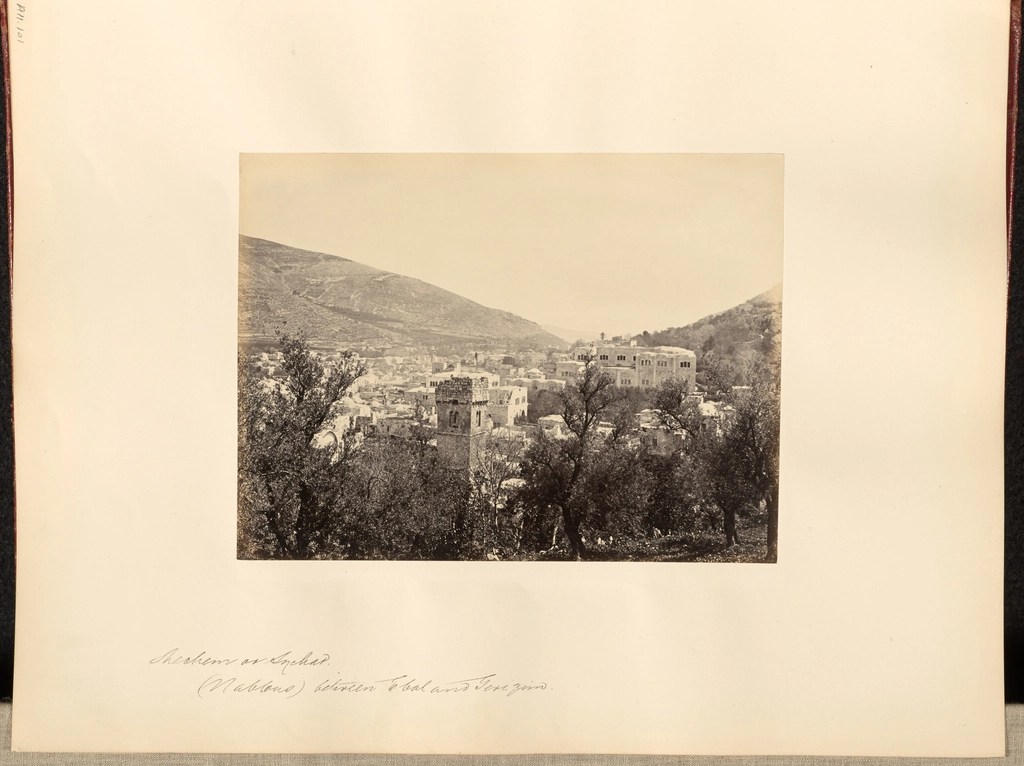
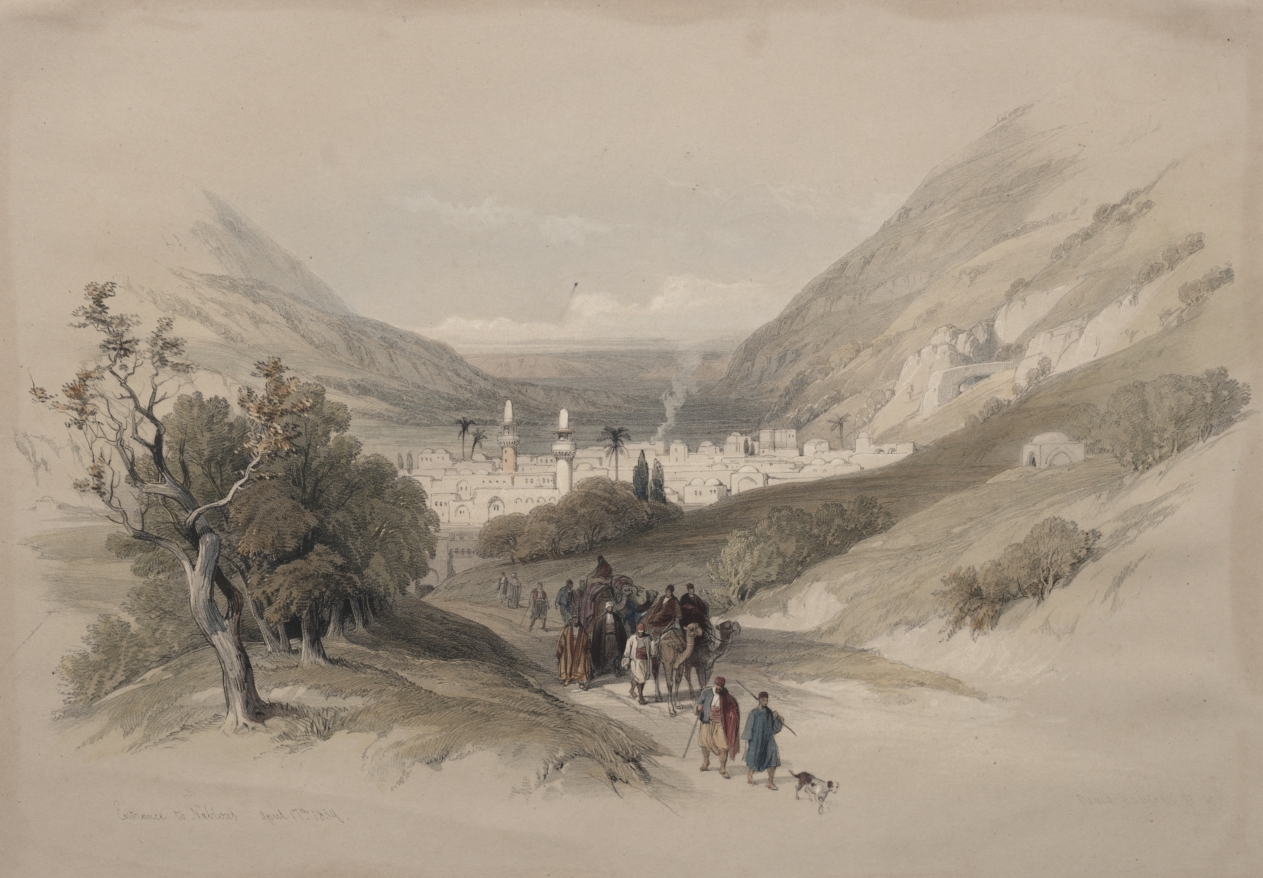
The area Zertal surveyed drips with serious biblical relevance including, for example,—the site of the Abrahamic covenant, 2 Jacob’s well, Joseph’s burial site, Jesus’ interactions with the Woman at the well, and an incident most relevant to our story.
Hello, my name is Ernie Vallery. I am a mostly retired Louisiana attorney living now in South Coast Massachusetts.
This is the eighth post of my memorandum maintaining that the proposed Joshua’s Altar and the Mt. Ebal Curse Tablet deserve a chance to prove what they might be. It is also the second of ten posts detailing the history of the altar and the tablet.
If you wish to read without interruption the entire work from its beginning through to its conclusion, click here.
Otherwise, continue below.
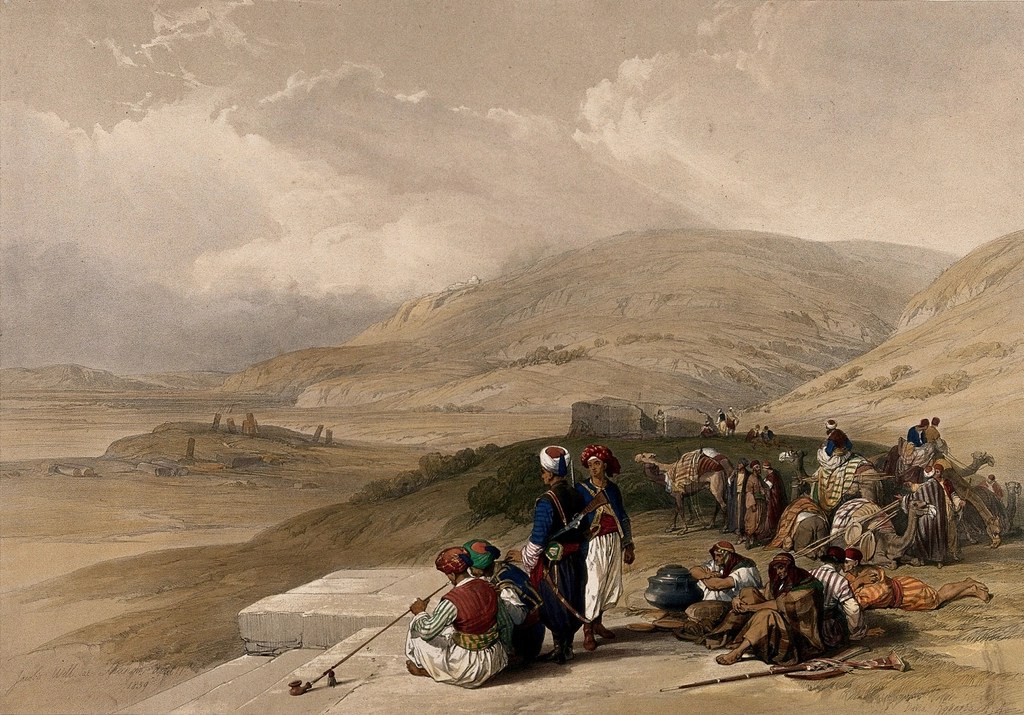
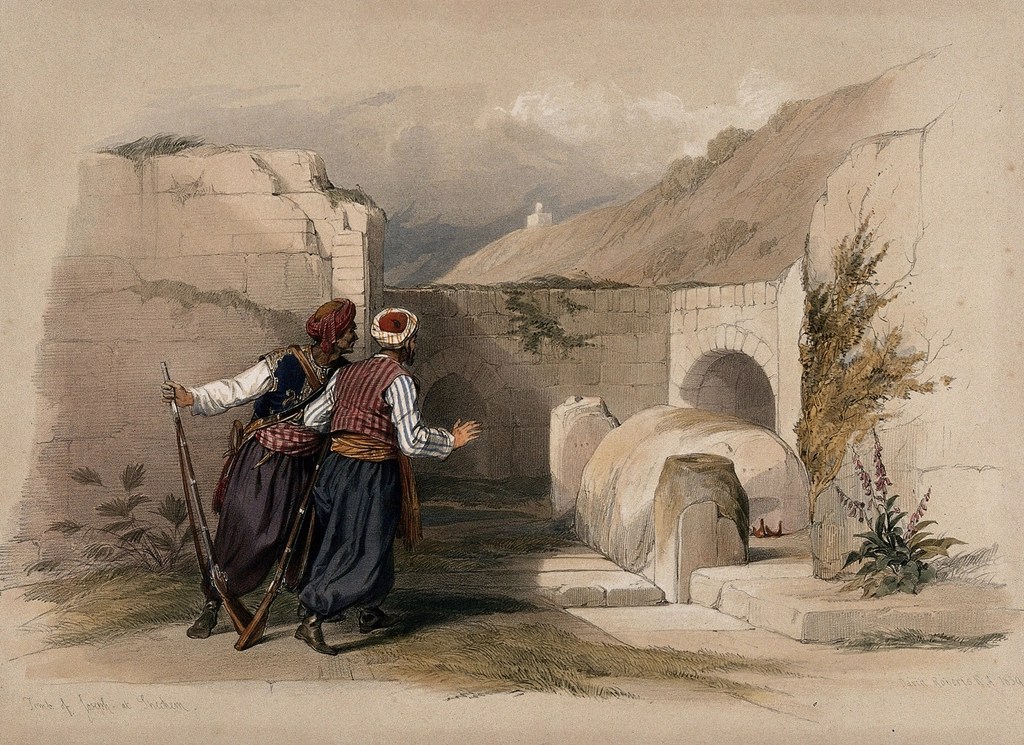
Travelers resting at Jacob’s Well
Early 19th century painting by David Roberts Visitors at Joseph’s tomb
Of that most relevant incident Deuteronomy 11:29 and 27:12 to 28:68 tell. These verses detail Moses’ directions for a rather odd ceremony–the Ceremony of Curses and Blessings on Mounts Gerizim and Ebal. 3
That event unfolds something like this:
Because Moses could not enter the Promise Land, he directs Joshua, his successor as leader of the people of Israel, in effect: “Once you have sufficiently conquered a foothold in the land, go to Mt. Gerizim and Mt. Ebal. Set up stones brought from Jericho. Plaster them and write thereon the words of the law. Position half of the tribes on one mountain and half on the other. Announce blessing from Gerizim and curses from Ebal. On Ebal build an altar of non-hewn stones. To the God of Israel sacrifice the blood of innocent animals to cover the sins of the guilty.”
Joshua’s accomplishing these directives one finds in Joshua 24:1, 25-26, and 32. 4
Of this relevance, however, Zertal had little inkling. Descended from East European immigrants who had lived under Soviet domination, he had grown up on a kibbutz. To him and many of his kin biblical connections had almost no resonance. Spiritually he was agnostic. Despite being an esteemed scholar and warrior—he had been seriously wounded in combat and walked with a cane much of his later life—about scripture he was almost clueless. His academic training had only cemented his conviction that the Bible was mostly mythology.5
That was about to change.
Exploring the backside of the mountain he observed a peculiar mound. He did a quick survey. From this he concluded that the place deserved serious investigation.
Subsequently, his team removed a substantial covering of stones revealing a baffling structure. What is this? Nothing about it resembled anything of Zertal’s experience.
After a period of head scratching wonder, an under-associate informed Zertal of a possible explanation.
The gist of this was: “This mountain people of a biblical slant scoured for decades looking for a particular structure. For it they focused on the side of Mt. Ebal facing its twin mountain, Mt. Gerizim. Convinced that it must be there, they ignored the back side where this site lays on a lip just over the summit.”
“Could this be what had confounded many?”, the understudy postulated. “Could this be Joshua’s Altar, the one that Moses in Deuteronomy 27 and 28 had commanded him to build!?”6
Of this, over time Zertal, the agnostic, eventually became convinced.7
At this point I stop the Harrison Ford type narrative and suffice for brevity with a simple listing of the things that eventually supported his conviction. They are:
The location of the site offered a largely unfettered view of the eastern horizon, something essential to the tabernacle’s and later the Temple’s orientations. Such was not readily available from the side of Mt. Ebal facing Mt. Gerazim. Both Exodus 27:13 and 2 Chronicles 5: 11-12 imply that the entrance of the Tabernacle and later the Temple faced eastward.
A huge enclosure made of stones surrounds the altar site. Bizarrely, it resembles a footprint, not more than three feet in height but over three football fields in length.8 Within it was another “footprint” about a 100 meters in length. (About six such structures one finds leading up the Jordan Valley culminating at Mt. Ebal.9 Some theorize that the Hebrews of the conquest constructed these. Supposedly, they were to symbolize God’s Mosaic promise to give them all the land within the parameters of the Promised Land on which their feet trod.)10
A long ramp rose to an altar site.11 Stairs Moses’ instructions forbid.
The altar site consisted only of non-hewed stones, that is, field stones untouched by any iron tool. This Moses had directed.12
Excavations revealed two potential altars, one larger rectangular one encompassing a smaller circular one beneath at its center, both containing bones of almost exclusively kosher animals. (A small percentage of bones belonged to creatures that may have climbed among the rocks and died such as turtles or snakes.)13
Pottery fragments there dated only to Iron Age One and Bronze Age Two, both consistent with competing theories for the date of the Exodus and the Conquest.14
Another scholar on seeing a photo of the Ebal site noted to Zertal in effect, “That uncannily corresponds to an ancient drawing depicting Jerusalem’s second temple altar.”
These verisimilitudes convinced Zertal.
On publicly announcing his findings, a tremor rumbled through the archaeological and theological worlds.
Yet, as we will see in the next post, it was only a tremor, not the epic seismic event evidently necessary to shake the illiterate or mythological Moses parordine.15
Now a question: What other evidence might have elevated Zertal’s altar hypothesis?
Let me know in the comment section below.
Thank you for reading!
If you appreciate this type of analysis, please “subscribe”, “like”, and “share”.
If you wish to support this work, you can do so in the donation section below. Such really encourages!
Sean McDowell, Oldest Hebrew Writing? Mt. Ebal Curse Tablet (Revisited) m.youtube.com>watch, (5: 26-44), 11 May 2023. And Associates for Biblical Research, Cursed! The Mount Ebal Curse Tablet (Part One, Digging for Truth Episode 200), YouTube, (04:29; 05:21), May 1, 2023. ↩︎
Steve Law, patternsofevidence.com, Ancient Hebrew Writing on Tablet Discovered at Joshua’s Altar, paragraph 5, February 4, 2022 And Associates for Biblical Research, Cursed! The Mount Ebal Curse Tablet (Part One, Digging for Truth Episode 200), YouTube, (10:29), May 1, 2023. ↩︎
Associates for Biblical Research, Cursed! The Mount Ebal Curse Tablet (Part One, Digging for Truth Episode 200), YouTube, (12:08), May 1, 2023. And Adam Eliyahu Berkowitz, Skeptics of Ebal Curse Tablet Accuse Christian Researchers of “Seeing the Face of Jesus in a Grilled Cheese Sandwich”, israel365news.com, Archeology, paragraph 3, December 6, 2023. ↩︎
Steve Law, patternsofevidence.com, Ancient Hebrew Writing on Tablet Discovered at Joshua’s Altar, paragraph 23, February 4, 2022. ↩︎
Associates for Biblical Research, “ABR Researchers Discover the Oldest Known Proto-Hebrew Inscription Ever Found”, biblicarchaeology.org/current-events-list/, Youtube, (15:32), March 24, 2022. and Associates for Biblical Research, Cursed! The Mount Ebal Curse Tablet (Part Four, Digging for Truth Episode 200), YouTube, (11:25 and 12:48), May 1, 2023. ↩︎
Steve Law, patternsofevidence.com, Ancient Hebrew Writing on Tablet Discovered at Joshua’s Altar, paragraph 23, February 4, 2022. And (Deuteronomy 11:23-24); And (Joshua 1:3) ↩︎
Associates for Biblical Research, “ABR Researchers Discover the Oldest Known Proto-Hebrew Inscription Ever Found”, biblicarchaeology.org/current-events-list/, Youtube, (15:02), March 24, 2022. ↩︎
We test here the first part of Haughwout’s material fact, that is whether the tablet contains proto-alphabetic letters.
To evaluate this I take these steps:
First I outline Haughwout’s position. Find this below the magenta banner.
Against it, I give push back. This you find below the yellow.
Lastly, I announce my findings below the purple banner.
I am Ernie Vallery, a retired Louisiana attorney living now in South Coast Massachusetts.
This is my twenty-fourth post insisting that the proposed Joshua’s Altar and the Mt. Ebal Curse Tablet deserve a chance to prove what they might be. To start the journey from its beginning click here. Otherwise, drive on.
No Letters
When Haughwout began to study the photos of Stripling’s article, he had an initial favorable impression. The top right corner indeed seemed to show several proto-alphabetic characters. Namely these were Teh, Meh, He, Teh and Aleph–five in total, respectively #’s 18, 19, 12, 20, and 21 of Figure 7.
For him the most impressive was Aleph #21. Best he felt it displayed the appropriate proto-alphabetic characteristics.
His opinion, however, soon changed.
On close review he noticed a number of crack lines commencing from the tablet’s edge to intersect with the character.
Is there an “Aleph”?
Photo by Jesu00fas Esteban San Josu00e9 on Pexels.com
Prominent were the two cracks that he deduced had over time created the “Ox’s” horns. (See here.)
Resultantly, this Aleph’s favorable status crumbled. He deduced it only the chance product of crack lines. No longer was it an exquisite inscription. It now presented a coincidental aberration with grotesquely proportioned horns. This disqualified it as a man-made proto-alphabetic letter.1
Disillusionment followed also for the other four likely script candidates. All he concluded as being mere happenstance cracks, scratches, and dents in the lead.
Some of the primary reasons for this were these:
First, he realized how small these characters were, ranging form .01 to .05 mm. The minimalist crack, scratch, or dent could replicate them; and
Photos of bulges on the tablet’s bottom (Table 10) failed to impress Haughwout. These Stripling had presented as negative proofs of inside characters. They too, Haughwout concluded, likely resulted from cracks, scratches and dents.
Haughwout thus finally surmised that his most favored of the tablet’s characters presented major existential problems. Doubly so this applied to the remainder.
Pushback on Haughwout’s Improbable Letters
I. Lovely Aleph
Haughwout notes that initially “Aleph, ” Figure 7, # 21 presented for him as a gorgeous proto-alphabetic inscription.
On this I agree.
Note its beauty! It satisfies the eye as an elegant calligraphy beginning a chapter of a medieval manuscript.
Haughwout, however, finds what he considers a fatal flaw–crack lines intersecting the horns.
These he concludes reveal the inscription to be nothing more than happenstance cracks, scratches, and dents. (See again Haughwout’s illustration.)
But Dr. Pieter van der Veens of Johannes Gutenberg University Mainz, one of Stripling’s team epigraphers and an expert in ancient Near Eastern languages and inscriptions, gives a plausible explanation. He suggests that yes there are crack lines emanating from the tablet’s edge. But likely the force of the stylus so close to that edge caused this.
In fact, along the tablet’s top this “Aleph” is among the closest.2
Note too that Haughwout’s drawing appears on a photo that poorly focuses this Aleph.”
On this clearer image you can see that the cracks do not intersect the horn tips smoothly and directly. On both horns there is a transition from the points where the aesthetically pleasing horns end and the apparent cracks intersect.
Both of the aesthetic horns are darker, wider and likely deeper.
Plus, at the intersection points the direction of the cracks deviate on both, but on one more pronounced than the other.
The above emphasizes the likelihood of an author having beautifully crafted his letter only to have time mar it with the imperfectly connecting cracks.
II. Tiny Letters
Haughwout also complains about many of the letters’ small sizes. Here the simple explanation is that the author had a small space with which to work. Plus, in that small space he had a serious message to convey–one not intended for human eyes but only for God.
Fortunately, though, they are indeed visible to man.
III. Bottom Bulges
Further, Haughwout apparently scoffs at the idea of negatives on the tablet’s bottom , “Outer B”, replicating inner tablet letters.
This evidence surely deserves less flippant appraisal.
Consider these examples:
Compare “He” of Figure 7’s, #3 and Table 3, (4 a and b) with Table 10, photo #2. This image I have designated “Dancing ‘He’”. Why? Notice that his arms and legs, seemingly in motion, occupy different levels. Nevertheless, the positive of the inner tablet and the negative of the tablet’s bottom mirror.
See, the first “Resh” in the word “ARWR”, at Figure 7’s #26 and Table 8, (2a & b). Compare it with the bottom bulge shown at Table 10, #8. Notice how they coincide. The positive inner image slants right.The bulge mirrors to the left.
Yet even faint mirroring reflections have an important ramification, one that Haughwout recognizes. He notes,”The reality is a dent on one side of a 0.4 mm thick piece of lead will of course appear on the opposite side.” Further he continues that this proves that the marks “on the inside are indeed there and are not x-ray anomalies.” In other words even where the mirroring images are faint, they prove that what is faintly depicted is indeed there. It is not some fluke produced by x-ray or photographic lightings or shadows.3
Several factors limit the possibility of these being the result of mere happenstance cracks, scratches, or dents.
Note that of the three, a dent seems most likely. Usually such one associates with sufficient downward force to cause an opposing bulge.
Nevertheless, Haughwout’s contention that a happenstance dent as opposed to a purposeful one caused by an inscriber’s stylus must account for the following:
First, the tablet was closed thus protecting the inner tablet from further damage.
Second, the tablet’s top,” Outer A,” does not have marks corresponding to these negatives. Only our inner tablet marks do.
Third, therefore, the force, possibly by a stylus, was likely applied before the tablet was closed.
Fourth, this closing likely occurred during the Late Bronze Age to Iron Age II– the era of proto-alphabetic writing.
Fifth, the act of closing was likely done purposefully by a human. Likely too that was done to conceal and protect a message hidden within.
All of the above amount to justifications for a reasonable person genuinely disputing this portion of the material fact addressed here, namely, that the tablet does not reveals proto-alphabetic script.
This portion of Haughwout’s material fact thus fails to support his refutation claim.
Improbable Letter Finding
The evidence shows that there is a genuine dispute about Haughwout’s proposition here. In other words, a reasonable person can genuinely dispute the claim that there are no proto-alphabetic letters on the tablet.
Despite conceding that Figure 7’s #’s 18, 19, 12, 20, and 21 represent proto-alphabetic forms, Haughwout nevertheless concludes that only coincidental cracks and dents formed them.
Yet, a reasonable person could genuinely counter that:
“Lovely Aleph”, Figure 7, # 21, is likely a scribe’s work marred somewhat by incongruous intersecting cracks radiating from the nearby tablet edge.
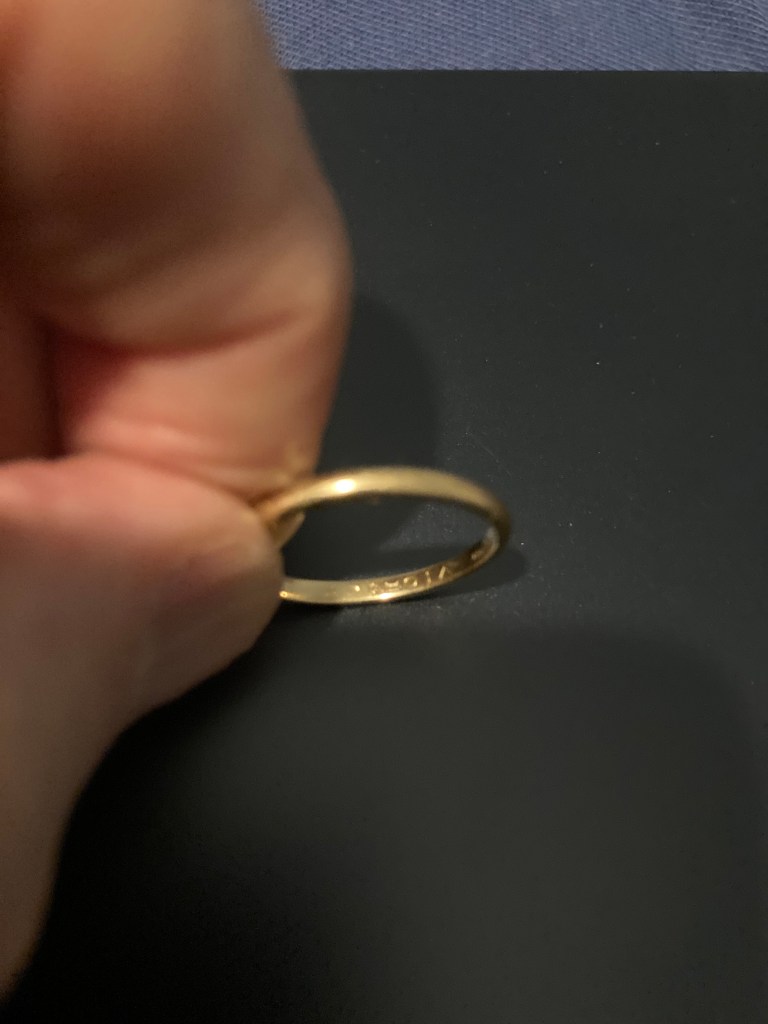
The fact that the letters are small is of little consequence. My wedding band has my wife’s name etched inside it. They are comparably as tiny but no less visible, real and meaningful.
The bottom negatives legitimately argue of man-made proto-alphabetic script inside the tablet.
Therefore, Haughwout’s improbable letter arguments do not support his “refutation” claim. Against this part of Stripling’s first material fact he has failed to satisfy our objective test, that is, that a reasonable person could not genuinely dispute the absence of proto-alphabetic letters on the tablet.
Might another of his arguments fare better? Next up we will examine the first of his “Improbable word” criticisms, namely, against “ARWR”–“You are Cursed!”
Thank you for reading!
If you appreciate this type of analysis, please “subscribe”, “like”, and “share”.
If you wish to support this work, you can do so in the donation section below. Such really encourages!
Next post: “ARWR?”
Haughwoout, M. S. Mt. Ebal curse tablet? A refutation of the claims regarding the so called Mt. Ebal curse tablet, Herit Sci 12, 70 (2024). htts://doi.org/101186/s40494-023-01130-z, paragraph 16. ↩︎








 captivatingtwists.com