Tag: proto-alphabetic

  • Journey Essentials

    Journey Essentials

    Introduction I

    [Ebal’s Plea, five of thirty-two]

    This journey’s operation order reads:

    Situation:

    • Geography

    Where is Mt. Ebal?

    It rises in the northern third of Samaria / Judea adjacent to its slightly smaller sister–Mt. Gerazim, flanking on the south. Between the two runs a pass where one sees modern Nablus on a western neck. The location of ancient Shechem lies nearby a little eastward.

    Nabus,-Ancient-Shechem

    Nablus, Ancient Shechem

    Nablus Ancient Shechem by David Roberts (Scottish, 1796)u20131864

    Licensed under CC-CC0 1.0

    Through this passage people have accessed since antiquity the Jordan Valley on the east and the Plain of Sharon and the Mediterranean on the west.
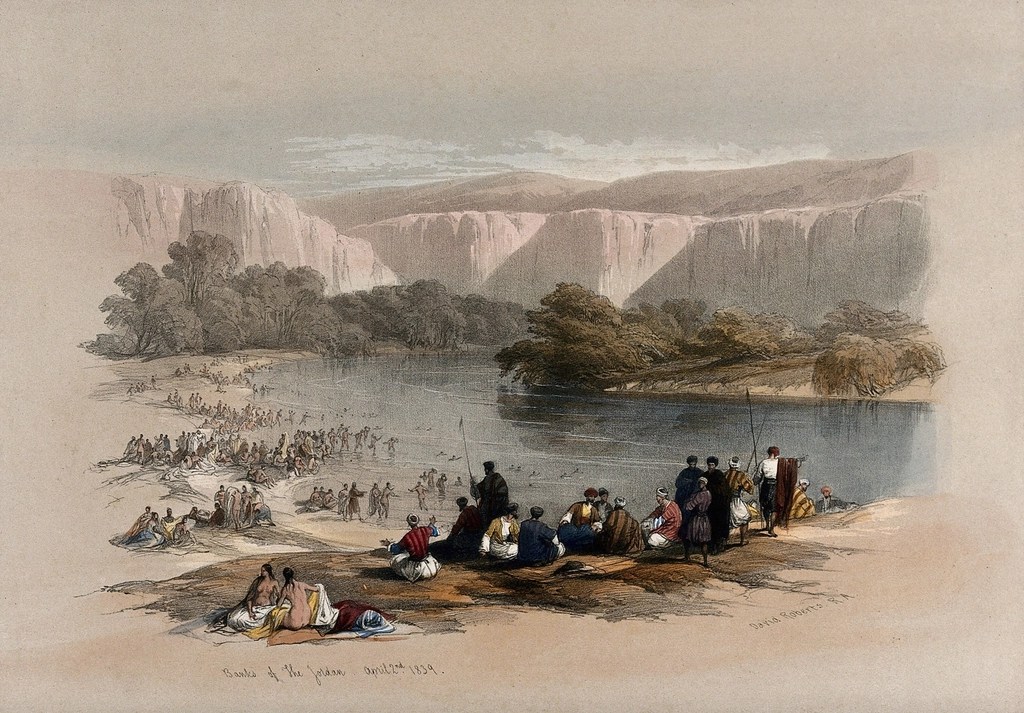
    Bathers-on-the-banks-of-the-Jordan-River

    Bathers on the banks of the Jordan

    A sweeping view to the North reveals the uplands of Galilee where you can glimpse the outline of Nazareth. Adjusting east one sees across the Jordan to Hermon’s whited pinnacle. Farther south the view traverses the Dead Sea to the region of Moab. Finally due south arise the heights of Jerusalem.1

    A nearer view reveals a valley between the two mountains into which many springs flow. These irrigate lush vineyards, orchards, and groves yielding abundant grapes, figs and olives. But higher up near Mt. Ebal’s summit, rocky outcrops, “ubiquitous thistles and prickly shrubs” abound.2

    • History Preview:

    Among this high setting Adam Zertal, an Israeli archaeologist, arrived in the 1980’s on a government survey mission. There he found what ultimately he came to believe was an ancient Hebrew altar.
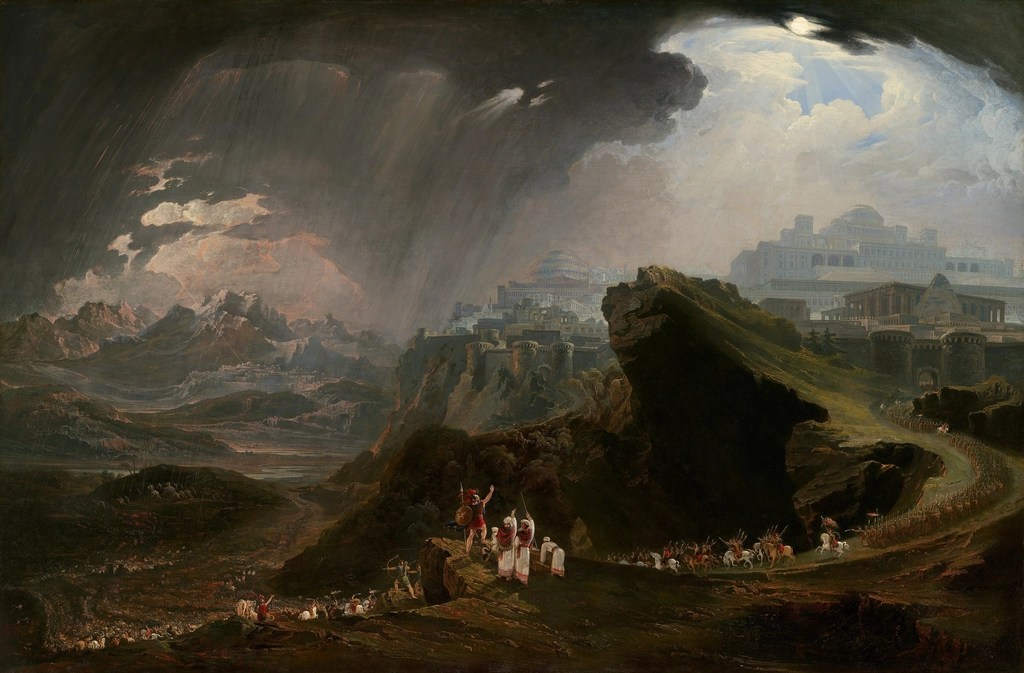

    Joshua Commanding Sun Stand Still


    National Gallery of Art

    Licensed under CC-CC0 1.0

    This claim paralleled biblically attested events of Deuteronomy and the Book of Joshua. Unsurprisingly, the announcement spawned a worldwide stir.

    The-Torah-or-Pentateuch

    Photo by cottonbro studio on Pexels.com

    Yet, this notion ran contrary to scholarly understanding. It was thus ultimately largely dismissed, even scoffed at.

    Some forty years later an archaeological team, headed by Dr. Stripling, moved some of Zertal’s dump piles off site. To that material they applied a perfected wet sifting technique. Many small, previously missed artifacts they found as a result.

    One particularly intrigued. The tiny lead object they thought a defixio, a curse tablet.

    Having had significant previous experience with such, they anticipated inside an inscribed curse.

    When, however, they attempted to open it, a small corner crumbled. That endeavor they ceased.

    Fortunately, tomographic slice imaging enabled scans of what lay within.

    Their report about the resulting photos startled much of the world. Allegedly inscribed there were proto-alphabetic letters pronouncing God’s Hebrew name–“Yahweh”, and the word “ARWR” meaning “cursed!” Furthermore, the words and provenance recalled a ceremony recorded in scripture.

    After public release of the scans, eminent scholars disputed these claims.

    Recently, Heritage Science published another peer reviewed essay about the tablet. In it Mark S. Haughwout , a prominent Hebrew scholar, gives his views. He also largely summarized the qualms of others scholars.

    The article boldly concludes, “The only substantiated claim that Stripling et al. can make at this time is that they have found a very old, small piece of folded lead on Mt. Ebal using wet sifting.”

    In other words, Haughwout determined that there is nothing to see here!

    Meanwhile, the potential destruction of the Mt. Ebal archaeological site looms. This I explain later.

    Mission:

    This memorandum argues that government authorized excavation of Joshua’s Altar should occur posthaste. The reasons are that:

    • Sufficient evidence supports the fantastic claims about the Curse Tablet; and
    • The chance of Mt. Ebal revealing other important evidence is significant?

    Execution:

    In support of these positions I argue that Haughwout failed in his “refutation”, i. e., disproval, efforts.

    Inside-the- U.S.-Supreme-Court

    Interior United States Supreme Court

    by Carol M Highsmith

    Licensed under CC-CC0 1.0

    In doing so I apply an objective measure derived from a prominent authority well accustomed at resolving issues of this nature. That is the U. S. Supreme Court.

    The High Court’s Rule 56 of its U. S. Code of Civil Procedure mandates how lower courts decide motions for summary judgment.

    Summary judgment, I argue, closely resemble our matter. Thus for it a standard similar to that of Rule 56 should operate appropriately.

    My applying an objective measure to these facts frees you to competently make up your own mind about the issues confronted. Resultantly, you can decide yourself whether my adjudication is fair and reasonable.

    Service and Support:

    Embedded as lagniappe with the flowers displayed at the end of each post, I provide links to materials–written, audio, and video. These reflect the tensions associated with this topic. Adversarial material I attempt to display.

    Music snippets I add for ambiance.

    The last post supplies supplemental materials. This includes letters to my U. S. congressional delegation.

    Command and Signal:

    As co-founder of captivatingtwists.com, I authored the thirty-two posts about this matter. As my audience I welcome anyone interested in the issues presented.

    Dr. Stripling and Mr. Haughwout whose peer review articles I extensively review in this memorandum are the authors of the primary sources of expert information used here.

    Ultimately, this memorandum’s conclusions and recommendations are entirely my own.

    The Mt. Ebal topic is one of several within Captivating Twists’ stable of subjects.

    Brace-for-the-Joust!

    The joust!

    Photo by jordan besson on Pexels.com

    Forewarning:

    Fasten your seat belt! Prepare not only to traverse three and a half millenniums of history. Brace also to referee a joust between competing views about human reality.

    The next post, the last of my introduction, teases curiosity about the journey ahead.

    Next post: ” A Mysterious Tease”

    One-Time
    Monthly
    Yearly

    Make a one-time donation

    Make a monthly donation

    Make a yearly donation

    Choose an amount

    $5.00
    $15.00
    $100.00
    $5.00
    $15.00
    $100.00
    $5.00
    $15.00
    $100.00

    Or enter a custom amount

    $

    Your contribution is appreciated.

    Your contribution is appreciated.

    Your contribution is appreciated.

    DonateDonate monthlyDonate yearly
    1. W. Ewing, Bible Hub, Atlas, Mt. Ebal, 2025, https://bibleatlas.org/mount_ebal.htm, paragraph 2. ↩︎
    2. Id., paragraph 1. ↩︎
    Dinner-bouquet-option

    Lagniappe Curse Tablet link /
    Dr. Bob Cargil, “Sagan Standard”
  • Stripling’s Article

    Stripling’s Article

    Photo Study I

    [Ebal’s Plea, seventeen of thirty-two]

    As already noted Heritage Science finally published the Stripling team’s peer reviewed article on 12 May 2023. That is twelve months after the press conference and almost three and a half years after the tablet’s discovery.

    Much of the world, of course, breathlessly anticipated one feature.


    Photo by Annushka Ahuja on Pexels.com

    Likely you also think, “Show us the photos, please!”

    Before I do, however, there are four important observations to make.

    Observation One

    The article’s conclusion states the core of the Stripling team’s argument about the Curse Tablet. With it they poise a stake into the heart of much scholarly accepted history including that associated with the documentary hypothesis.


    Licensed under CC-CC0 1.0

    The other parts of the article’s body state facts and ideas considered. Only with the concluding core, however, does Stripling dig in his boots. It is there that he states what about the tablet emphatically belies the idea that Moses could not have authored the Torah.

    The Stripling article, for example, credits team member Professor Gershon Galil, Director of the Institute of Biblical and Ancient History at the University of Haifa, with deciphering most of the interior tablet. His premises it fully elucidates.

    Yet, note this crucial point.

    The Stripling article’s conclusion leaves many, if not most, of Galil’s premises orphaned. His accounting of the number of inner tablet letters is neither adopted nor rejected. The same applies for his full chiasmus interpretation.

    The article acknowledge many of Galil’s premises. It cites his increased letter count of forty declared at the press conference to forty-eight at publication. Consequently, it also acknowledges his slightly modified chiasmus interpretation.

    Despite this, the article’s conclusion does not embrace these premises.

    Instead, it concludes that the tablet’s inscription challenges history for greatly truncated reasons. Those reasons include these:

    • The tablet displays in proto-alphabetic script the word “YHW”, the name of the Hebrew God;
    • From this we know that a Hebrew inscribed the tablet sometime before 1250 B. C.;
    • Additionally, the tablet contains the word “ARWR” or “cursed”;
    • These tablet words recall events described in Deuteronomy and The Book of Joshua;
    • Resultantly, this artifact challenges long standing historical paradigm.1

    The note immediately following the conclusion is telling. It addresses Galil’s allegiance to his premises. It announces that, in effect, he desires to “plant his intellectual flag” on those.2

    A more conservative approach, however, Stripling’s conclusion adopted.

    Following publication, Galil and Stripling amicably ended their team affiliation.

    What are the consequences for our study?

    For us Stripling has simplified our original question, “Is there anything to see here?”

    Stripling’s team answers with a resounding, “Yes, see the two words on the inside of this artifact–the ancient Hebrew equivalents of “cursed” and “Yahweh”. They alone with the tablet’s ambiance challenge world history!”

    Consequentially, that makes our photo study easier.

    From Stripling’s perspective we can focus primarily on photos relevant to two words. The other words of Galil’s chiasmus while important are not crucial to Stripling’s conclusion.

    Observation Two

    Our purpose is not only to review the Stripling article and its photos. We seek also to study an allegedly refuting article.

    That article considers closely the alleged Hebrew words for “cursed” and “Yahweh”.

    Additionally, it makes relevant arguments involving two individual tablet characters and the Hebrew word for “You will die!” These I also include in our study.

    Observation Three

    In the proto-alphabetic era writing often traced a boustrophedon path. Then there was no standardized script order. Instead, letters tracked as oxen plow. They follow left to right, up to down, diagonally, etc. Another example may be the various paths that an inexperienced pre-teen might push a lawnmower over your yard or maybe someone much older quite inebriated.

    Photo by Mehmet Turgut Kirkgoz on Pexels.com

    Observation Four

    Many of these inscriptions are quite small. How small? Some could fit inside of a wedding band or even on the side of a penny.

    Some-tablet-letters-would-fit inside-a-wedding-band

    A wedding band could house tablet letters.

    Photo by Ku00e1ssia Melo on Pexels.com

    Photos!

    Ready now for some photos?

    “Cursed! “, our next post declares.

    Still ready?

    Next post: “ARWR,” Cursed!

    1. Stripling, S., Galil, G., Kumpova, I. et al. “You are Cursed by the God YHW:” an early Hebrew inscription from Mt. Ebal. Herit Sci 11, 105 (2023), paragraph 71. https://doi.org/10.1186/s40494-023-00920-9 ↩︎
    2. Id. at paragraph 72. ↩︎
    One-Time
    Monthly
    Yearly

    Make a one-time donation

    Make a monthly donation

    Make a yearly donation

    Choose an amount

    $5.00
    $15.00
    $100.00
    $5.00
    $15.00
    $100.00
    $5.00
    $15.00
    $100.00

    Or enter a custom amount

    $

    Your contribution is appreciated.

    Your contribution is appreciated.

    Your contribution is appreciated.

    DonateDonate monthlyDonate yearly

    Dinner-bouquet-option

    Lagniappe link / Mt. Ebal amulet
    Dinner-bouquet-option

    Lagniappe link / Joshua’s Shechem Stone
  • “ARWR,” CURSED!

    “ARWR,” CURSED!

    Photo Study II

    [Ebal’s Plea eighteen of thirty-two]

    Our photo study begins.

    From tomographic scans revealing an inside face of the tablet, we first assess the presence of an intimidating word. That is “ARWR” or “cursed”, one of the two words fundamental to Stripling’s conclusions.

    In the Scientific Heritage article Gershon Galil identified this word six times on the inner tablet. Of these we will, for brevity, focus on only one.

    The article’s Figure 7 shows Galil’s drawings of the tablet’s inner symbols. (Henceforth, click on underscored items to see referenced material.)

    You see our word on the right annotated drawing. It is numbers 25 through 28.

    “ARWR’s” proto-alphabetic spelling is “Aleph”, Resh”, “Wah”, and “Resh”.

    Here is what they look like:


    “Aleph”

    Photo by Steward Masweneng on Pexels.com
    "Resh" with a tail resembles a kite

    “‘Resh” with a tail resembles a kite..

    by Nilo Velez is licensed under CC-CC0 1.0
    • “Aleph” looks like an ox’s skull;
    • “Resh” often resembles a rhombus. Sometimes, though, it has a tail making it resemble a kite.
    • “Waw” and “Resh” can be easily confused. But “Waw” replicates a mace, an ancient weapon consisting of a heavy object fastened to a handle used to bash an enemy’s skull, bones, and armor.

    Warrior armed with a mace, the symbol for “Waw”

    Photo by MikeGz on Pexels.com

    Tables 2 through 9 show tomographic scans of all of the tablet’s letters. Beside each appears the Stripling team’s drawing replicating it.

    To study our “ARWR” do as follows:

    Importantly note one thing about the photos and drawings of Tables 2-9. These mirror the drawings of Figure 7. In other words, one must be viewed in a mirror to correspond with the other’s alignment. Otherwise they appear backwards.

    Now see Table 10. It reveals several photos of the tablet’s “Outer B”, that is, the tablet’s bottom.

    Photo # 8 of Table 10 shows a bottom protrusion. It Stripling’s team identifies as a negative of our first “Resh”–Figure 7 #26 and Table 8 (2 a and b).

    Do you agree?

    Note that the photo of our “resh” slants right and the photo of the negative slants left. Is not this what one would expect of a negative?

    Guess what?

    This concludes my presentation regarding our first word, “ARWR”/”Cursed”.

    Surely you found it easy enough.

    Nevertheless, ponder this post closely.

    Read it several times while also viewing the linked photos and drawings. Let all of it sink in!

    In our next post, we turn to the supreme name, that of the Hebrew God.

    Next post: “YHW,” Yahweh

    One-Time
    Monthly
    Yearly

    Make a one-time donation

    Make a monthly donation

    Make a yearly donation

    Choose an amount

    $5.00
    $15.00
    $100.00
    $5.00
    $15.00
    $100.00
    $5.00
    $15.00
    $100.00

    Or enter a custom amount

    $

    Your contribution is appreciated.

    Your contribution is appreciated.

    Your contribution is appreciated.

    DonateDonate monthlyDonate yearly
    Dinner-bouquet-option

    Lagniappe link / Pattern of Evidence Ebal Curse audio
    Dinner-bouquet-option

    Lagniappe link/ Appian Media on Mt. Ebal
  • “YHW,” Yahweh

    “YHW,” Yahweh

    Photo Study III

    [Ebal’s Plea, nineteen of thirty-two]

    “ARWR”, that is “cursed,” I reviewed in my last post.

    I turn now to the divine name–“Yahweh”.

    Galil alleges that this appears twice inside the tablet.

    For simplicity only one of those I discuss here. That one I call “Upper Yahweh” simply because lies near the tablet’s top.

    Galil’s annotated Table 7 drawing labels it as #’s: 11, 12, and 13.

    The phonetic spelling is thus “Yod,” “He,” “Waw”.

    M- beach-towel's-Egyptian-hieroglyphic-immulates-proto-alphabetic-"Yod".

    My beach towel’s Egyptian hieroglyphic immulates proto-alphabetic “Yod”.
    Photo by Pixabay on Pexels.com

    Here is what they look like:

    The photos of “He”, Figure 7’s #12 at Table 3, (1a & b), and “Waw”, Figure 7’s #13 at Table 4 (1a & b), are distinct.

    “Yod”, Figure 7’s #11 at Table 5 (1a & b), however, is faint.

    Other views include:

    • Stripling’s Figure 4 showing:
      • the hand lies under the hips of “Heh”;
      • the thumb is under and intertwined with “Taw”;
      • the wrist and forearm run below the left leg of “Heh”; and
      • the upper arm extends at a right angle from “Heh’s” left ankle”.
    • Haughwout’s Figure 5 gives a mirrored view.

    Importantly, study, too,Table 10, photo # 3. The Stripling team argues that this depicts the bottom bulge of this “Yod”.

    Do you agree?

    If you do, this has major consequences–ones to which even Haughwout, the sceptic, agrees. It is this: mirror bulges on the bottom reflect something actually existing on the inner surface of the tablet. The object does not result from a photographic lighting or shading issue. It also nullifies the object resulting from a computer glitch.

    That finishes my review of the two words which Stripling declares compel his conclusions–“ARWR” and “YHW.”

    What did I tell you? That was not hard.

    However, again, read these sections a couple of times. Let the photos really sink in.

    With the following post I complete an initial dive into the tablet’s photos. There I look at a word and two other letters relevant to Haughwout’s arguments.

    Later, however, l tread deeper into the words and symbols mentioned above as I evaluate Haughwout’s analysis.

    Next post: “You Will Die!”

    One-Time
    Monthly
    Yearly

    Make a one-time donation

    Make a monthly donation

    Make a yearly donation

    Choose an amount

    $5.00
    $15.00
    $100.00
    $5.00
    $15.00
    $100.00
    $5.00
    $15.00
    $100.00

    Or enter a custom amount

    $

    Your contribution is appreciated.

    Your contribution is appreciated.

    Your contribution is appreciated.

    DonateDonate monthlyDonate yearly
    Dinner-bouquet-option /

    Lagniappe link / Refuting the critics
    Dinner-bouquet-option

    Lagniappe link / The Christian Atheist, Ebal contiued
  • You will Die!

    You will Die!

    Photo Study IV

    [Ebal’s Plea, twenty of thirty-two]

    We look now at a new word and two solo letters relevant to a critic’s arguments.

    Here I introduce them somewhat superficially. Later, I delve deeper when I discuss that scholar’s views.

    Our new word is “TMT”, meaning “You will die!”

    Galil depicts it in Figure 7 as #’s: 18, 19, and 20.

    The phonetic spelling is “Taw”, “Mem”, “Taw.”

    Here is how they look:

    • “Taw” looks like an “X” or a cross and with small tick marks it resembles crossed hockey sticks or swords.; and
    • “Mem” looks like our “M”, wavy lines, or rolling waves.

    Photo by Alexander Nadrilyanski on Pexels.com

    Photo by David Cruz asenjo on Pexels.com

    To see photos and drawings of each click:

    This concludes our proto-alphabetic vocabulary survey.

    Our lexicon now includes YHW, ARUR, and TMT, three easy words–three heavy notions.

    I now turn to our survey’s two solo letters. For simplicity these I consider independent from the words they help form.

    The first I call “Lovely Aleph”. See it as Figure 7’s #21 and as Table 2’s (3a & b).

    All I will say currently is, “What a beauty!”.

    The second letter I call “Dancing He” because it appears to exude rhythmic motion on the lower tablet.

    View it as Figure 7’s #3 and in Table 3 (4a & b).

    See a remarkable negative of it in Table 10, #2.

    We can now declare a wrap on our initial alphabet and word canvas.

    Consider our script count comprises only seven unique letters–“Aleph”, “He”, “Mem”, “Resh”, “Taw”, “Waw”, and “Yod”.

    At first tackling ancient inscriptions of thirty-five hundred years ago possibly intimidated. In retrospect you likely see them as relatively straight forward.

    As an aside, consider that in short order first graders learn all 26 letters of our script. Plus they quickly master a corral of words from their readers. What a wonder!


    Photo by Pixabay on Pexels.com

    Nevertheless, rather than taxing, I trust that you found our exercise enlightening and maybe fun.

    But we are not yet done. We still must review the substance of voices opposing Stripling’s claims.

    This too I will attempt to keep sufferable, if not entertaining.

    Let us get started!

    Next post: “A Refutation?”

    One-Time
    Monthly
    Yearly

    Make a one-time donation

    Make a monthly donation

    Make a yearly donation

    Choose an amount

    $5.00
    $15.00
    $100.00
    $5.00
    $15.00
    $100.00
    $5.00
    $15.00
    $100.00

    Or enter a custom amount

    $

    Your contribution is appreciated.

    Your contribution is appreciated.

    Your contribution is appreciated.

    DonateDonate monthlyDonate yearly
    Dinner-bouquet-option
    Dinner bouquet option /
    Dinner-bouquet-option
    Dinner bouquet option / Digging for Truth, One
  • The Plan

    The Plan

    Objective Analysis I

    [Ebal’s Plea, twenty-five of thirty-two]

    In the last post we returned from the hypothetical to the real world.

    Yet, I have decided to embrace SCOS Code Provision 56. It I will apply for resolving our Stripling v. Haughwout issues.

    But this is important! I am not suggesting that the scientific community adopt a similar Scholarandrian governmental rule. Without other safeguards such might be subject to abuse by an authoritarian regime. Of this legislative drafters must remain always cognizant. Particularly now they must consider any rule in the hands of Donald Trump and his obsequiously corrupt MAGA acolytes.

    What I am suggesting is that the general public use this rule as consumers of scientific and academic information. The scientific and journalistic communities may declare that debate on a topic with issues similar to here has reached its culmination. The general public can then apply this standard to better determine if that is warranted.

    I therefore use Provision 56 of the Scholarandrian Code in that spirit. Has the debate over the Curse Table reached a pinnacle? Does the end result rest with scholars such as Haughwout determining that there is nothing to see here?

    Applying our standard can help us decide.

    Accordingly, I first need to determine the material fact(s) of Haughwout’s claim’s. What are his contested, indispensable ones?

    Is-there-an-"Aleph"?

    Is there an “Aleph”?

    Photo by Jesu00fas Esteban San Josu00e9 on Pexels.com

    Such I determine to be as follows:

    Haughwout insists that at least one of the following statements are true:

    • The tablet does not contain proto-alphabetic script denoting the words “ARWR”–“cursed” and “YHW”–“Yahweh”, the Hebrew name for God; or
    • A Hebrew of before 1250 B. C. did not inscribed the tablet.
    Is-there-a-"He"?

    Is there a “He”?

    Photo by Kulbir on Pexels.com

    To decide in Haughwout’s favor I must find that a reasonable person could not genuinely dispute the above.

    I must deny the “disproval / refutation”, if I find otherwise.

    The next posts divide this material fact into four discussions.

    • Does the tablet contains proto-alphabetic letters?;
    • Does it display the word “ARWR”?;
    • Does it reveal “YHW” as the name of God?; and
    • Did a Hebrew of prior to 1250 B. C. inscribe the tablet?

    After those discussions, I give my preliminary judgment on whether Haughwout has achieved his “refutation”.

    My conclusion of this memorandum follows that.

    Let us get after it.

    Next post: “Letters?”

    One-Time
    Monthly
    Yearly

    Make a one-time donation

    Make a monthly donation

    Make a yearly donation

    Choose an amount

    $5.00
    $15.00
    $100.00
    $5.00
    $15.00
    $100.00
    $5.00
    $15.00
    $100.00

    Or enter a custom amount

    $

    Your contribution is appreciated.

    Your contribution is appreciated.

    Your contribution is appreciated.

    DonateDonate monthlyDonate yearly
    Dinner-bouquet-option


    Mt. Ebal lagniappe / Nehemia’s Wall, Stripling
    Dinner-bouquet-option


    Joshua’s Altar Lagniappe / Cargill Excerpt
  • ARWR?

    ARWR?

    Objective Analysis III

    [Ebal’s Plea, twenty-seven of thirty-two]

    Here we consider the second part of the Haughwout’s material fact. It is that the tablet does not contain the proto-alphabetic word “ARWR”.

    There must be no genuine dispute about this. Otherwise, this portion of Haughwout’s arguments cannot contribute to the success of his position. It cannot support his “refutation”.

    I ponder this again in these steps:

    • First, I outline Haughwout’s position. Find this below the magenta banner.
    • Against that I give push back. This you find below the yellow.
    • Lastly, I announce my findings below the purple banner.

    “ARWR” Is Not a Word

    Haughwout announces that one of the best ways to distinguish a coincidental mark resulting from cracks, scratches, or dents from an actual letter is this: A letter will usually coalesce with other letters to form a word. Coincidental marks likely will not.

    Six times on the inner tablet Galil identified “ARWR”, the alleged ancient equivalent of the modern Hebrew word pronounced “ARUR” meaning “cursed”.

    Haughwout counters that “ARWR” is not a word that a Hebrew of before 1250 B. C. would have written.

    Why? Ancient Hebrew had no vowel indicators, he declares. Thus “ARR” would have been the proper spelling, not “ARWR”.

    Much later, around the ninth century B. C., Hebrew writers began using occasional consonants to replicate vowels. Particularly this was rare within a word rather at the end until the eight century B. C.

    This use of “Waw” to mimic the “U” vowel inside of “ARWR” is thus inappropriate. It is an anachronism of four to six hundred years.

    One therefore cannot reasonably argue for “ARWR” forming a word. One should consider that combination as happenstance cracks, scratches, or dents.

    “ARWR” Pushback

    For simplicity we examine here only one of the six “ARWR” iterations that Galil identified. It is Figure 7’s #25-28. It also is the “ARWR” which we earlier discussed in Post #13.

    Haughwout avers that happenstance dents caused our “ARWR” and the rest of the inner tablet characters.

    For this he states a main reason, one underlying his disillusionment with the tablet almost from the beginning. It is this: That one should not accept marks as human writing unless they coalesce with other characters to form words. “ARWR” is not a Hebrew word that a person of the proto-alphabetic era would have written, he concludes. Therefore, those marks do not qualify as letters.

    In essence, the reason that Haughwout declares that “ARWR” is not a word of the thirteenth century B. C. is that it has too many letters. As explained above, he insists, that the proper spelling is “ARR”. A Hebrew of that time, he continues, would not have substituted the consonant “W” for the understood “U” vowel sound within a word until four to six hundred years later.

    The next section offers contradictory observations.:

    A reasonable person can genuinely dispute that “ARWR” is not proto-alphabetic Hebrew..

    Here are several reasons why:

    • Sparse Corpus

    Arguing in his article a point about syntax, Haughwout declares:

    “However, we do not currently have a large enough corpus of second millennium texts from the land of Canaan for comparison.”

    What is a take away? It is that currently you can only put limited faith in assumptions about the proto-alphabetic corpus. We just have too few examples.

    Rules for both syntax and vowel markers should be deemed speculative and tenuous at best.

    • Exceptions litter languages

    While this hardly needs illustration, it does merit remembering.

    Exceptions are normal in language. The same should be expected of ancient proto-alphabetic.

    • Phonetic Sense

    Modern Hebrew pronounces the word for “cursed” as “ARUR”. Likely the ancients spoke it similarly.

    So, imagine an ancient inscriber faced with spelling the word he knew sounded like “ARUR”. Could he have reasoned, “I hear something else in that word? What about adding the consonant “W”? “ARWR” sounds a little closer to “ARUR” than does “ARR”,–the spelling Haughwout would saddle him with.

    Would someone back then have pulled out a grammar book and said, “You cannot do that!”?

    The answer is not likely.


    Photo by Leeloo The First on Pexels.com

    More likely the inscriber would have said, “I like this. I am going to stick with it.”

    Maybe they did not decided to do this with other words. Maybe they did not realize that this is something that they could do with other words.

    They just decide to go with “ARWR” as a better way to sound out their word for “cursed”.

    • “ARWR”, a Time Traveler? (The strongest reply!)

    What could better evidence that the “ARWR” spelling traveled from the remote proto-alphabetic era through to a subsequent age?

    Obvious evidence would include similar examples in both epochs.

    Our tablet provides evidence for the proto-alphabetic era’s “ARWR” spelling.

    Compare this with a Jerusalem stone inscription allegedly marking the tomb of Shebnayahu, King Hezekiah’s royal steward about whom Isaiah prophesied. That eight century B. C. inscriber similarly used a consonant to represent the “U” vowel sound of the Hebrew “cursed”.

    On both the spelling is essentially the same. Each uses four letters with a consonant substituting for the “U” sound.


    Miniature Relief of the Hebrew Prophet Isaiah

    See Isaiah 22:15-25 for Isaiah’s prophesy about Shebnayahu’s tomb

    The Metropolitan Museum of Art

    Licensed under CC-CC0 1.0

    Evidently between our tablet and the Shebnayahu stone no other Hebrew variant other than our “AR(consonant)R” is known. Specifically, in the interim between these two examples there is no example of “ARR” having been written for the word “cursed”.

    Nevertheless, Haughwout insists that a “book spelling” of “ARR” would have constrained our inscriber.

    On what grounds do I suggest that there are no examples of the “ARR” spelling for the word cursed between the Late Bronze Age and the eighth century B.C.? The reason is that Haughwout does not cite such. Surely he would have to support his argument had he known of one.

    It thus remains reasonable for a person to determine that the “AR(consonant)R” spelling remained constant between the two ages.

    Therefore, for this reason and the others above, a reasonable person could genuinely dispute that the tablet does not exhibit the Hebrew word for “cursed”–“ARWR”.

    Therefore this second part of the Haughwput’s material fact fails to support his refutation” claim.

    The evidence shows that there is a genuine dispute about the material fact portion scrutinized here. In other words, a reasonable person could genuinely dispute that the ancient proto-alphabetic word for “cursed” does not appears on the tablet.

    These are the reasons:

    • Bookish grammatical and use norms for our proto-alphabetic text one should deem speculative and tenuous. The corpus of Hebrew late Bronze Age literature is just too sparse.
    • Further, the “AR(consonant)R” spelling of the tablet matches the spelling of an eight century B. C. example. Haughwout, on the other hand, produces no intervening examples of the Hebrew for “cursed” being spelled “ARR”.

    This material fact portion thus fails to support Haughwout’s refutation claim.

    Next up we consider Haughwout’s arguments regarding the alleged Supreme name, “YHW”.

    Next post: “YHW?”

    One-Time
    Monthly
    Yearly

    Make a one-time donation

    Make a monthly donation

    Make a yearly donation

    Choose an amount

    $5.00
    $15.00
    $100.00
    $5.00
    $15.00
    $100.00
    $5.00
    $15.00
    $100.00

    Or enter a custom amount

    $

    Your contribution is appreciated.

    Your contribution is appreciated.

    Your contribution is appreciated.

    DonateDonate monthlyDonate yearly
    Dinner-bouquet-option
    Curse Tablet lagniappe / Audio
    Dinner-bouquet-option

    Joshua’s Altar lagniappe / Shebnayahu Tomb
  • YHW?

    YHW?

    Objective Analysis IV

    [Ebal’s Plea, twenty-eight of thirty-two]

    The third discussion of Haughwout’s material fact ensues here.The question is this: Does the tablet contain, “YHW”–the holy name?

    Haughwout declares, “No”.

    About this a reasonable person can not genuinely dispute. Otherwise, this fact portion does not support his “refutation”.

    This issue I examine in these steps:

    As before, I first outline Haughwout’s position. Find this below the magenta banner.

    Against that I give push back below the yellow.

    Lastly, I announce my findings beneath the purple banner.

    “YHW” Is Not a Word

    Twice on the inner tablet Galil finds the name for the Hebrew God.

    For simplicity, I concentrate only on the Upper Yahweh of Figure 7’s #’s 11, 12, and 13.

    With Upper Yahweh Haughwout perceives two primary problems. He disputes the letter count. He also disparages visibility.

    These problems, Haughwout concludes, disqualify this “YHW”as either a word or as proto-alphabetic letters.

    • Letter Count

    For “Yahweh”, three letters are inadequate. The earliest otherwise recognized Hebrew spelling comes from the ninth century. It uses four letters–“YHWH”.

    Such vacillation among scribes on the name of God raises red flags.

    "He"-raises-a-red-flag!

    “He” raises a red flag!

    Stripling counters that three letters conform with an Egyptian spelling of the Hebrew name. There one finds a contemporary Late Bronze Age Egyptian inscription. It uses what some scholars contend is a three letter form.

    Haughwout minimizes the Egyptian case. First, some scholars allege that the three Egyptian letters actually correspond to the four phonetic letters of “YHWA”. Further, he notes, translating from Egyptian to Hebrew is problematic.

    Haughwout thus surmises that only a four letter rendition of the name is appropriate.

    • Visibilty

    Nevertheless, two of the letters which Galil purports for “YHW” present other problems.

    The first letter “Yod”, Figure 7’s # 11, he maintains is simply not there.

    Additionally, the last letter “Waw”, Figure 7’s # 13, is “highly speculative”.

    • Haughwout’s Conclusion

    As previously discussed, one of the best ways to distinguish coincidental marks from actual letters is this: The later will coalesce to form a word but not the former.

    “YHW” has an insufficient number of proposed letters to form the name of God.

    Additionally, some of its proposed letters are indistinguishable.

    Consequently, the above problems disqualify “YHW” from being a word or even proto-alphabetic letters.

    “YHW” Pushback

    Haughwout raises two objections. First, he objects to Yahweh’s three letter spelling. Second, he observes that one of its proposed letters, the “Yod”, is invisible while another, the “Waw”, is speculative.

    Separately below I address these.

    Yahweh of Three Letters?

    There is a reasonable explanation for the three or four letter conundrum.

    In the proto-alphabetic era as previously discussed, the written script was largely consonantal. In other words, vowels were usually not designated.

    Thus a proto-alphabetic scribe would have written “YHW” even though a vowel sound, likely an “eh” or an “ah” followed the “Waw”. This was simply understood without any designation.

    At a later time scribes added an “H” to the end of words to capture the previously understood vowel sound.1

    The “H” sound remained largely silent. Only the vowel, likely an “eh” or “ah” was voiced.2

    Thus, the later scribes did not altar the name of God. They simply modified the spelling by adding the letter “H” to act as a vowel at the end of the name. This thereby ensured the capture of the originally intended but previously only understood pronunciation.

    This explanation harmonizes the ancient three letters with the subsequent four.

    Absent “Yod”?

    Haughwout, who is not an epigrapher, alleges that an important letter does not exist. That is the initial “Yod” of our “YHW” set.

    Galil and van der Veen, both esteemed epigraphers, declare its presence.

    I agree with Galil and Pieter Girt van der Veen. The “Yod,” is indeed faint. Yet, in the composite photos of Figure 4 I nevertheless distinguish it under “Taw” and above the leg of “He.”

    See also Table 9, photo 2(a).

    Look, additionally, at Table 10, photo # 3. This hints of this letter’s negative bulge.

    Speculative “Waw”?

    While Haughwout concedes our “YHW’s” stickman “He” (See Table 3 [1 a & b]), the “Waw” he characterizes as “highly speculative.”

    Again, Galil and van Der Veen, the esteemed epigraphers, see it.

    Yet, honestly, could Picasso himself have drawn a more convincing mace? (See Table 4, 1 (a and b)!)


    Pablo Picasso

    by Beaton, Cecil

    Licensed under CC-BY-NC-ND 4.0

    A reasonable person could genuinely dispute Haughwout’s contention that the tablet does not display God’s name. Justifications include:

    • There is a reasonable explanation for why the proto-alphabetic era’s “YHW” equates with subsequent era’s “YHWH”. It is that later scribes added the “H” at the end of many words to ensure that previously understood vowel sounds were not lost. Those vowel sounds were endings of “ah” and “eh” with the “H” sound largely silent.
    • The “Yod” of our “YHW” is faint, but distinguishable. Further, the bottom bulge reinforces the presence of this letter.
    • A child would recognize this “Yahweh’s” “He”;
    • Picasso would embrace its “Waw”.

    The third portion of Haughwout’s material fact thus fails.

    Thus far we have determined this: That a reasonable person could genuinely dispute the absence of proto-alphabetic letters and the words “ARWR” and “YHW”. Therefore these portions of Haughwout’s material fact do not support his “refutation” claim.

    Our next post considers the remaining material fact portion. There I discuss whether the tablet’s inscriber was a Hebrew of before 1250 B. C.

    Let us get to it!

    Next post: “Pre-1250 B.C. Hebrew?”

    1. Hebrew Alphabet Made Easy, Hei, Lesson Three, Line 16, https://www.hebrewpod101.com/lesson/hebrew-alphabet-made-easy-3-hei; and
      Lobliner, Jacob, The Story of H, paragraph 36, 2008, http://faculty.ce.berkeley.edu/coby/essays/h.htm ↩︎
    2. Vowels in Hebrew, Lilmod Aleph Beth, https://lilmod-aleph-beth.com/vowels-in-hebrew/, The Mater Lectionis are consonants that function as vowels. paragraph five ↩︎
    One-Time
    Monthly
    Yearly

    Make a one-time donation

    Make a monthly donation

    Make a yearly donation

    Choose an amount

    $5.00
    $15.00
    $100.00
    $5.00
    $15.00
    $100.00
    $5.00
    $15.00
    $100.00

    Or enter a custom amount

    $

    Your contribution is appreciated.

    Your contribution is appreciated.

    Your contribution is appreciated.

    DonateDonate monthlyDonate yearly
    Dinner-bouquet-option

    Joshua’s Altar Lagniappe / Tablet Deciphered
    Dinner-bouquet-option

    Mt. Ebal Lagniappe / Joshua’s Altar
  • My Adjudication

    My Adjudication

    Objective Analysis V

    [Ebal”s Plea, thirty of thirty-two]

    Has Haughwout refuted Stripling’s claims? Here’s my decision!

    Photo by Coco Championship on Pexels.com

    Haughwout entitled his article “A Refutation.”

    On that he doubles down in his conclusion. There he states,

    “The only substantiate claim that Stripling et al can make at this time is that they have found a very old, small piece of folded lead on Mt. Ebal using wet sifting.”

    Thus Haughwout emphatically declares that he disproved, Stripling’s contentions.

    This evaluation,I have measured against a standard.

    It was this: To decide in favor of Haughwout, I must find that a reasonable person could not genuinely dispute his claim’s material fact. I must deny Haughwout’s “disproval” if I find otherwise.

    Further, I determined that Haughwout’s material fact–the contested, indispensable one–is that:

    At least one of the following statements is true:

    • The tablet does not contain proto-alphabetic script, that denotes the words “ARWR”–“cursed” and “YHW”–“Yahweh”, the Hebrew name for God; or
    • A Hebrew of before 1250 B. C. did not inscribe the tablet.

    I find that a reasonable person could genuinely dispute this.

    Haughwout thus failed in his endeavor.

    Here is a list of points which I deem support my adjudication:

    • The difference between three and four letter Yahweh has a reasonable explanation. Later, scribes added the “Heh” to capture the previously understood vowel ending, in this case an “eh” sound.
    • Use of “Wah” in place of the vowel in “ARWR” is reasonably attributable to a smart scribe.
      • The substitution makes phonetic sense.
      • Besides evidence suggests that this Late Bronze Age spelling persisted through to the eight century B. C. Tomb of Shebnayahu and beyond.
    • The crack lines of Aleph, Figure 7, #25 and Table 2, (3 a and b) do not intersect directly with the horns. Thus it is reasonable to deduce that the cracks intersect with a well drawn figure.
    • Affiliating the artifact with the scriptural Mountain of Curses seems reasonable.
      • This is especially so when compared with proposed options classifying it as a net sinker, hair adornment, or theatre ticket.
      • The scriptural attribution better fits the provenance and location.
    • A reasonable person can see both the “Yah” and the “Wah” of Upper Yahweh. The “He” a child can see.
    • Further, that person could consider tiny letters consequential.
      • This they could relate with other tiny inscriptions.
      • One example could be wedding ring inscriptions.
    • A reasonable person could determine the tablets boustrophedon track appropriate.
      • They could presume that the tablet message may have only been meant for the eyes of God.
      • But, neverthless, its track also makes basic sense even to men.
    • A reasonable person also could determine that the tablet’s bottom bulges evidence interior proto-alphabetic letters.
    • Furthermore, part of, Haughwout’s criticisms do more to strengthen rather than negate Stripling’s baseline conclusions.
      • Again, he acknowledges that the presence of proto-alphabetic letters signal a Late Bronze Age to Early Iron Age date, i.e. 1400 to 1200 B. C.
      • Later, he acknowledges that “TMT”, Figure 7 #’s 18, 19 and 20 , comprise a proto-alphabetic word.

    Despite the above, I conclude that Haughwouts criticisms significantly advance scholarly debate about the Mt. Ebal Curse Tablet. That includes the conclusions on which I argue that he errs. Why? Such clearly stated, academically advanced reasonings as his engender a healthy scientific and scholarly quest for truth.

    The stark exception is the claim of a “refutation”.

    Why? To science and scholarship his “refutation” pronouncement potentially causes harm. It can dishearten further investigation, quench pools of funding, block excavation permits, and slacken safety concerns for potential exigent evidence.

    Such an announcement that falls short of an appropriate procedural standard I perceive as a hinderance rather than an advance of the quest for truth.

    As such my decision is to deny Haughwout’s “refutation” claim.


    Photo by Pixabay on Pexels.com

    Stripling’s article I therefore declare “Safe!” from Haughwout’s refutation attempt.

    Next, I proclaim this memorandum’s conclusion!

    Next post: “Curse Tablet Conclusion”

    One-Time
    Monthly
    Yearly

    Make a one-time donation

    Make a monthly donation

    Make a yearly donation

    Choose an amount

    $5.00
    $15.00
    $100.00
    $5.00
    $15.00
    $100.00
    $5.00
    $15.00
    $100.00

    Or enter a custom amount

    $

    Your contribution is appreciated.

    Your contribution is appreciated.

    Your contribution is appreciated.

    DonateDonate monthlyDonate yearly
    Dinner-bouquet-option
    Mt. Ebal lagniappe / Cargill explains
    Dinner-bouquet-option
    Joshua’s Altar lagniappe/ Hidden Valley Response