We should give Moses, Joshua, and the Hebrews of the Conquest a chance to prove who they are! Advocate for excavating “Joshua’s Altar,” the origin of the Mt. Ebal Curse Tablet!
My name is Ernie Vallery. I am a retired Louisiana attorney living in South Coast, Massachusetts.
Claims about the Curse Tablet counter an entrenched historical premise. Generations of scholars have said that Moses could not have written the Torah. Scripture attests otherwise. So may the tablet.
Our problem is how to resolve this tension, in part.
My answer is that we apply a legal standard, such as the one used in federal courts for summary judgment.
My plea results. Regional and international actors must stir. They should finish excavations at Joshua’s Altar. They should spend the necessary financial, political, and other resources.
Joshua’s Altar and the Curse Tablet deserve a chance to prove their identity. Are they a consequence of the words and actions of the Hebrews of the Conquest? Humankind deserves to know!
The exigent evidence demands:
Immediate international protection of the proposed altar; and
Corporate and governmental support for its thorough archaeological excavation.
This argument raises necessary questions, which I should address at the outset. Before launching into the matter’s heart, I include these three prefatory posts:
It seems like a lot! But do not let it intimidate you. Persevere! Then this consequential topic becomes easy, much like witnessing a cascade of dominoes.
Here is a question. What present historical issues compare to those explored in this memorandum? Let me know in the “comments”.
While the setting is in this galaxy, even on this planet, the adventure starts a long, long time ago. It is far before Caesar and Hannibal. Imagine three hundred years before Alexander and Bucephalus. There you find the mysterious Homer. He spins his supernatural-laced tales of half a millennium before his time. Still, our saga begins a century, if not three, before those storied events. That is before Achilles’ epic feats, the Battle of Troy, and Odysseus’ journey home.
Alexander and Bucephalus, Battle of Issus, 333 B.C.
Plus, it is a story about writing by people considered unable to do so. By that, I mean unable to write in a way that you or I would find understandable. Without extensive training in things like hieroglyphics or cuneiform, that is. No, you can read this after only a quick lesson in the alphabet and vocabulary. You can imagine it almost like a news feed on your phone.
Egyptian hieroglyphs
Photo by Luisa Castillo Osorio on Pexels.com Cuneiform
Photo by Bilge u015eeyma Ku00fctu00fckou011flu on Pexels.com
Well, I have to walk that back a bit. We would have to account for the boustrophedon track. Some ambiguity that adds to the message without blurring its gist. I will explain this later.
Still, this is about us reading the thoughts of someone thirty-five hundred years ago.
But it goes beyond that. The inscription seems to detail events and personages we know. Many believed that these were the stuff of mythology. They are Moses, Joshua, and the Hebrews of the Conquest.
Moses closes the Red Sea
Further, this involves a fascinating epigraphic puzzle with challenging questions like:
Are marks on the tablet coincidental glyphs or human-inscribed symbols?
Do the symbols constitute writing?
Could they be phonetic letters?
What people, time, and language do they belong to?
What sequence should we read them in?
Do the letters coalesce into words?
If so, in what sequence should we interpret them? and
What is the message?
The solution to this puzzle rivals other famous puzzles. Those include the Seven Bridges of Königsberg, the Enigma Machine, and the Navajo Code Talkers.
Why fuss over an artifact no bigger than a business card folded in half?
This question differs from that in my last post. It captured the reasons for interest in the Curse Tablet. In political terms, I addressed a candidate’s hair, smile, and social grace. Here, I turn to substance. Politically, the gist is more like economics, crime, and foreign policy.
Thus, three reasons for the fuss are:
A Thought Tsunami
This artifact could trigger a tsunami of thought! From it, massive philosophical changes could ensue. It could alter historical, archaeological, epigraphic, and even political understandings.
Why should I attempt to tackle Mt. Ebal’s enigmas? The reason is this: I have experience with an appropriate tool. That is summary judgment.
For a definitive opinion on this matter, one would likely, at first blush, look elsewhere. You might consider a panel. That would include archaeologists, epigraphers, and experts in tomography, computer science, and photography. But not a soldier or an attorney!
If the question was: “What is the ultimate truth about Mt. Ebal, Joshua’s Altar, and the Curse Tablet?”, I would agree. In that case, I would likely say,” Yes, the experts should receive considerable latitude.”
But that is not the current question. Instead, it is whether to excavate now!
Answering this question requires another element. That is an expedited, well-reasoned decision.
How is this achieved?
Usually, archaeologists, epigraphers, and similar experts are not best equipped to negotiate this.
Consider Agatha Christie. She described her husband, an esteemed archaeologist, conferring with colleagues. This, she said, was “Blood on the carpet!”
Real “blood” may achieve a quick resolution. But likely not in the non-literal sense Christie intended.
Often, too, it may not precipitate the best immediate resolution. Instead, it may settle with the side that speaks loudest. Worse, today, it may be with the one who best manipulates social media.
This matter is too important, too urgent for such a result.
So why me?
I am not an expert in archaeology, epigraphy, or tomography.
Instead, I am a combat infantry veteran of Iraq and Afghanistan. Also, I am a retired member of the Louisiana Bar.
But on the questions at issue, I can make this case.
Experience as a combat infantryman helps a bit.
First, I have ideas about operating in a combat zone. Particularly, I have experienced scenes of tranquility. Then, in a moment, they erupt into chaotic bloodshed.
The area of Mt. Ebal can become the eye of such.
This, decision-makers should remember.
Additionally, another aspect of military experience is of value. Understanding the issues presented here requires a journey across an eon of time. There, one encounters battles about truth.
For this journey, one needs preparatory information
In the U.S. Army, such comes in an operation order. Anyone who has ever served knows: “Sergeant Major eats sugar cookies!” This is the anachronism for the elements of an operation order. That is: situation, mission, execution, sustainment, and command and signal.
To equip you for this adventure, I will detail the most relevant of these in my next post.
My being a retired attorney, however, provides the most salient reason for “Why me?”
I also have experience with a rule of law analogous to this matter. It is U.S. Code of Civil Procedure Rule 56, “Summary Judgment”. This states an authoritative measure. Plus, it yields an expedited decision with more than a modicum of logic.
This matter demands clear directions.
Much public confusion now reigns over the issues surrounding Mt. Ebal.
Some people have ingrained notions.
Many deduce them, as one might choose a favorite football team. They prefer the red team or the blue team, the gold or the purple. Logic may not run much deeper.
Political authorities and the public who can influence them need to make up their minds. They must do this soon. But after serious thought.
Why? There are immense consequences for a wrong or late response.
Delay could lead to the loss of riddle answers. This could be for another decade, another century, or another thirty-five hundred years. Who knows?
But acting without due forethought could upset a war zone’s delicate political balance.
This memorandum offers a solution. It presents an expedited, logical way to deliberate this matter.
Stick with me on this excursion. Together, we can reach our destination. We can digest the academic evidence. We can apply a fair measure. Also, on the following questions, we can render expedited yet considered decisions:
Does satisfactory evidence support the fantastic claims about the Curse Tablet? and
Should we advocate for posthaste excavation of the alleged Joshua’s Altat?
Again, come along! We can do this!
But first, let us make sure we have what we need for our time travel.
We will review this in our next post.
Now, here is a question. So what if future generations fail to discern the Curse Tablet’s true character?
A minimal understanding of the Curse Tablet requires a journey across eons. For this, we need preparation.
An operational order for our journey thus follows:
Situation
Geography
Where is Mt. Ebal?
It rises in the northern third of Samaria / Judea. Adjacent stands its smaller sister–Mt. Gerazim, flanking to the south. Between them lies a gap within which one sees modern Nablus on a western neck. 1 Ancient Shechem lies a little to the east. 2
People have crossed this passage since antiquity. They traversed the Jordan Valley to the east and the Plain of Sharon to the Mediterranean to the west. 3
Bathers on the banks of the Jordan
A sweeping view to the north reveals the uplands of Galilee. There, you can glimpse the outline of Nazareth. Adjusting east, one sees across the Jordan to Hermon’s white pinnacle. Farther south, the view traverses the Dead Sea to the region of Moab. Finally, due south arise the heights of Jerusalem. 4
A nearer view reveals a valley between the two mountains into which many springs flow. These irrigate lush vineyards, orchards, and groves, yielding abundant grapes, figs, and olives. But at Mt. Ebal’s summit, rocky outcrops, “ubiquitous thistles and prickly shrubs” abound. 5
Among these high settings, an Israeli archaeologist arrived in the 1980s. His name was Adam Zertal. While on a government survey mission, he found a suspicious mound. Excavation revealed a curious structure. Ultimately, he concluded that this was an ancient Hebrew altar. 6
Yet, this notion ran contrary to scholars’ understanding. Mostly, they dismissed it. Many even scoffed. 8
Some forty years later, an archaeological team arrived. Dr. Scott Stripling headed it. He is a professor of biblical archaeology and church history at the Bible Seminary in Katy, Texas. 9
The team moved some of Zertal’s dump piles off-site. There, they wet-sifted the material. As a result, they found many small, missed artifacts.
One was particularly intriguing. The tiny lead object they thought was a defixio, a curse tablet. 10
Having had significant experience with such, they anticipated finding an inscribed curse.
When, however, they attempted to open it, a small corner crumbled. At that point, they ceased. 11
Fortune smiled, however. Tomographic slice imaging enabled scans of what lay within. 12
Heritage Science published its report about the resulting photos.13
These startled much of the world. Allegedly, proto-alphabetic letters appeared there. These pronounced God’s Hebrew name “Yahweh,” and the word “ARWR,” meaning “cursed!” Furthermore, the words and provenance recalled a ceremony recorded in scripture. 14
After the public release of the scans, eminent scholars disputed these claims. 15
Recently, Heritage Science published another peer-reviewed essay about the tablet. In it, Mark S. Haughwout, a prominent Hebrew scholar, gives his views. He also summarized the qualms of many others.
The article concludes:
“The only substantiated claim that Stripling et al. can make at this time is that they have found a very old, small piece of folded lead on Mt. Ebal using wet sifting.” 16
Haughwout, thus, determined that there is nothing to see here!
Meanwhile, the destruction of the Mt. Ebal archaeological site looms. I will explain this later.
Mission
This memorandum argues that a government-authorized excavation of Joshua’s Altar should occur posthaste. The reasons are:
Enough evidence supports the fantastic claims about the Curse Tablet
The probability of Mt. Ebal revealing other important evidence is significant; and
The chance of the destruction of that evidence is real.
Execution
Haughwout’s attempt to refute Stripling’s claims fails, I argue.
Strap in! Prepare not only to traverse three and a half millennia of history. Brace also to referee a joust between competing views about human reality.
The next post, the last of my introduction, teases curiosity about the journey ahead.
Now here is a question. What information in this “operation order” did you find helpful?
Sean McDowell, Oldest Hebrew Writing? Mt. Ebal Curse Tablet (Revisited) m.youtube.com>watch, (02:00), 11 May 2023. ↩︎
Associates for Biblical Research, “ABR Researchers Discover the Oldest Known Proto-Hebrew Inscription Ever Found”, biblicarchaeology.org/current-events-list/, Youtube, (12:34), March 24, 2022. ↩︎
Breaking News “Mt Ebal Curse Tablet Peer Review Complete”, Appian Media In Roads, May 12, 2023 (24:56) ↩︎
Stripling, S., Galil, G., Kumpova, I. et al. “You are Cursed by the God YHW:” an early Hebrew inscription from Mt. Ebal. Herit Sci11, 105 (2023). https://doi.org/10.1186/s40494-023-00920-9↩︎
Melanie Lidman, Academic article on controversial 3,200-year old ‘curse tablet’ fails to sway experts, supra at paragraph 38 ↩︎
Haughwout, M.S. Mt. Ebal curse tablet? A refutation of the claims regarding the so called Mt. Ebal curse tablet. Herit Sci12, 70 (2024). https://doi.org/10.1186/s40494-023-01130-z, paragraph 57. ↩︎
The controversies surrounding a recent archaeological find should matter to you. This post presents a taste of why.
Prominent experts allege that a series of photographs challenge precepts of world history. Others claim, “There is nothing to see here!” Faced with such, you might think, “Show me the photos! Decide myself, I will!” 1
Photos of a defixio, a curse tablet found in Israel in 2019, present this quandary. Archaeologists could not open it without it crumbling.
They thus employed tomographic scanning to peer inside. This revealed a potential proto-alphabetic script. This claim, given the archaeological context, challenges long-held understandings of world history.
When, however, the archaeologist released photos of the scans, some experts cried, “Hoax!” To them, they showed nothing significant.
I have two goals here. I want to help you reach a well-informed understanding of the tablet. Second, I want to encourage you to act on what you learn.
But beware! Conversing with intelligence about the photos requires more than mere viewing. To most, other than a few specialized experts, they appear mysterious and unknowable. 2
Yet, laypersons with some help can make well-considered observations about them.
To do so, they need three things. First, they need the history. Then they need an opportunity for efficient study. Last and most importantly, they need enthusiasm: enthusiasm for the history and for probing the evidence.
Below, I relate the history.
Furthermore, I guide an efficient online study of the photos.
But what about the enthusiasm?
Viewing a 30-second video might spark something. It shows, of all things, a technological process applied to a piece of metal.
Wow! How thought-provoking and intriguing can that be?
Well, look at the video below.
Glance at its millimeter ticker in the top left corner. When it gets to .20 mm, focus on the object’s top right.
Or, watch the red bar on the right graph. As it approaches the major breach, focus on the top right of your screen.
Also, move your cursor to the top right and click. This expands the image.
Did you perceive only happenstance cracks, dents, and scratches on an old piece of lead?
But what about a stick man, a mace, some crossed hockey sticks? Did you detect some squiggly lines, a bent arm with an open hand, and a couple of ox skulls?
Ox head Crossed hockey sticks
Photo by Tony Schnagl on Pexels.com A bent arm with open hand
Photo by Daria Liudnaya on Pexels.com A role play Viking warrior wielding a mace
This is the first of ten posts about the Curse Tablet’s history. They provide important context. Please do not skip them!
Here is a story of two discoveries that may profoundly affect biblical and world history. 1
Archaeologists discovered them at the same location at different times. The first became known about forty years ago. Archaeologists found the latter within the last six years. 2
Together, they pose a piercing assault on an entrenched paradigm.
What is that? Moses did not write, and in fact could not have written, the first five books of the Bible. 3
Many maintain this despite Scripture declaring otherwise. Old Testament sources cite Moses. Jesus also affirmed or implied this.
If not Moses, who lived allegedly around the twelfth to fifteenth centuries B.C., then who? In short, scribes of the Third to Ninth Centuries B.C. did! 4
With their stories, these alleged authors forged a Hebrew national identity. A disparate people thereby engendered moral cohesion. Henceforth, they revered shared mythological heroes.
This idea permeates more than the ivory towers of elite universities. It holds sway over heartlands worldwide. Since the late 19th century, priests and preachers have learned this. Professors have taught this to waves of college students enrolled in biblical studies. 5
This paradigm against Mosaic authorship has a name. It is the documentary hypothesis. 6
Now, let us examine these two discoveries.
But before doing so, here are some questions. When did you first encounter the documentary hypothesis, and what effect did that have on you?
I proceed here with the second of ten posts in our history. Remember, these are important.
In the 1980s, a University of Haifa archaeologist surveyed Mount Ebal. He was Professor Adam Zertal. 1 The mountain rises next to today’s Nablus, ancient Shechem.
That area drips with biblical relevance. For example, God pronounced the Abrahamic Covenant here. 1 Jacob’s well and Joseph’s burial site are there. Here, Jesus interacted with the Woman at the Well. Additionally, there is an ancient event directly pertinent to our story. 2
Travelers resting at Jacob’s Well
Early 19th century painting by David Roberts Visitors at Joseph’s tomb
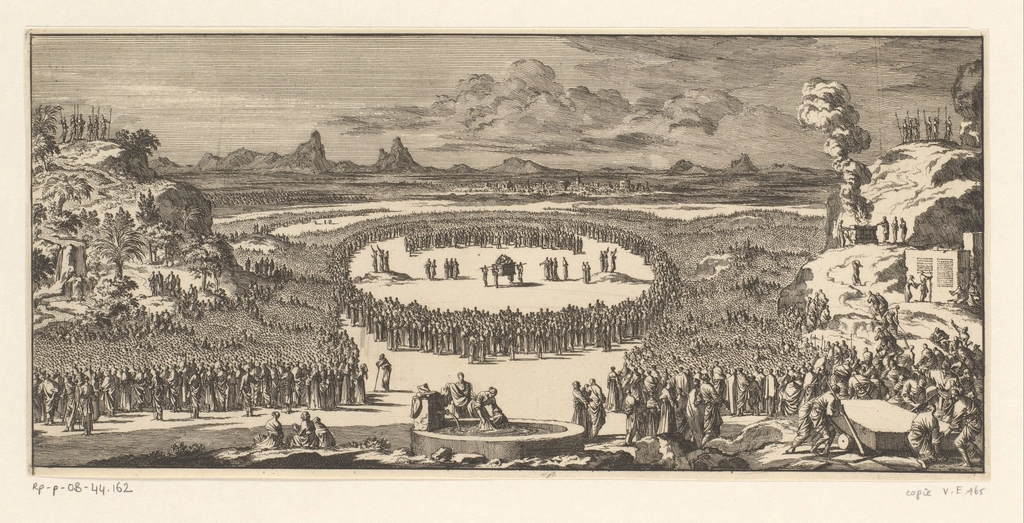
Moses could not enter the Promised Land. He thus directs Joshua, his successor as leader of the people of Israel. In effect, he says, “Once you have conquered a foothold in the land, go to Mt. Gerizim and Mt. Ebal. Set up stones brought from Jericho. Plaster them and write thereon the words of the law. Position half of the tribes on one mountain and half on the other. Announce blessing from Gerizim and curses from Ebal. On Ebal, build an altar of unhewn stones. To the God of Israel, sacrifice the blood of innocent animals to cover the sins of the guilty.”
Joshua accomplishes these directives, as recorded in Joshua 24:1, 25-26, and 32. 1
Of this relevance, however, Zertal had no inkling. His ancestors were East European immigrants who had lived under Soviet domination. He had grown up on a kibbutz. To him and many of his kin, biblical connections had little resonance. He was agnostic and clueless about scripture. 2 (Note that he was also an esteemed scholar and a wounded combat veteran. Hence, he walked with a cane.) 3 His academic training had cemented his conviction that the Bible was mythology. 4
That was about to change.
Exploring the mountain’s backside, he observed a peculiar mound. He did a quick survey. From this, he concluded that the place deserved serious investigation. 5
Later, his team removed a large covering of stones, revealing a baffling structure. What is this? Nothing about it resembled anything of Zertal’s experience.
A period of head-scratching wonder followed. Then, an under-associate suggested an explanation. “People have scoured this mountain for decades, looking for a structure. Their focus was on the side of Mt. Ebal facing its twin mountain, Mt. Gerizim. Convinced that it must be there, they ignored the back side where this site lies on a lip beyond the summit.”
““Was this what confused many people?” the understudy postulated. “Could this be Joshua’s Altar, the one that Moses in Deuteronomy 27 and 28 had commanded him to build!?” 6
Of this, Zertal, the agnostic, became convinced. 7
Now, I will stop the Harrison Ford-type narrative. Instead, I will suffice with a list of the things that supported his conviction. They are:
The site’s location offered a view of the eastern horizon. From the side of Mt. Ebal facing Mt. Gerizim, this was impossible. Both Exodus 27:13 and 2 Chronicles 5: 11-12 imply the same. The entrance to the Tabernacle and, later, to the Temple must face eastward.
A huge stone enclosure surrounds the altar site. It resembles a footprint and stands about a yard. Yet it equals over four football fields. 8 Within it is another “footprint” about 100 meters long. (About six such structures one finds leading up the Jordan Valley, culminating at Mt. Ebal. 9 Some suggest that the Hebrews of the conquest constructed these. They theorize that these symbolize God’s Mosaic promise. He would give them all the land within the parameters of the Promised Land on which their feet trod. If they keep His commandments.) 10
A long ramp rose to an altar site. 11 Stairs Moses’ instructions forbid.
The altar site consisted only of unhewn stones, field stones untouched by any iron tool. This Moses had directed. 12
Excavation revealed two potential altars. A large rectangular one encompasses a smaller circular one beneath at its center. Both contain bones of almost only kosher animals. (A small percentage belonged to creatures that may have climbed among the rocks. There they died. Such included turtles or snakes.) 13
Zertal dated pottery fragments only to Iron Age One and Bronze Age Two. Both are consistent with competing theories for the date of the Exodus and the Conquest. 14
Another scholar saw a photo of the Ebal site and noted that it mimics an ancient drawing of Jerusalem’s Second Temple altar.
These verisimilitudes convinced Zertal.
On announcing his findings, a tremor rumbled through the archaeological and theological worlds.
Yet, as we will see in the next post, it was only a tremor. It was not the epic seismic event necessary. The mythological Moses paradigm shook little. 15
Now a question: What other evidence might have elevated Zertal’s altar hypothesis?
Sean McDowell, Oldest Hebrew Writing? Mt. Ebal Curse Tablet (Revisited) m.youtube.com>watch, (5: 26-44), 11 May 2023. and Associates for Biblical Research, Cursed! The Mount Ebal Curse Tablet (Part One, Digging for Truth Episode 200), YouTube, (04:29; 05:21), May 1, 2023. ↩︎
Steve Law, patternsofevidence.com, Ancient Hebrew Writing on Tablet Discovered at Joshua’s Altar, paragraph 5, February 4, 2022 and Associates for Biblical Research, Cursed! The Mount Ebal Curse Tablet (Part One, Digging for Truth Episode 200), YouTube, (10:29), May 1, 2023. ↩︎
Associates for Biblical Research, Cursed! The Mount Ebal Curse Tablet (Part One, Digging for Truth Episode 200), YouTube, (12:08), May 1, 2023, and Adam Eliyahu Berkowitz, Skeptics of Ebal Curse Tablet Accuse Christian Researchers of “Seeing the Face of Jesus in a Grilled Cheese Sandwich”, israel365news.com, Archeology, paragraph 3, December 6, 2023; ↩︎
Steve Law, patternsofevidence.com, Ancient Hebrew Writing on Tablet Discovered at Joshua’s Altar, paragraph 23, February 4, 2022; and Associates for Biblical Research, CURSED! The Mount Ebal Curse Tablet (Part 4): Digging for Truth Episode 203, (11:30). ↩︎
Associates for Biblical Research, “ABR Researchers Discover the Oldest Known Proto-Hebrew Inscription Ever Found”, biblicarchaeology.org/current-events-list/, Youtube, (15:32), March 24, 2022. and Associates for Biblical Research, Cursed! The Mount Ebal Curse Tablet (Part Four, Digging for Truth Episode 200), YouTube, (11:25 and 12:48), May 1, 2023. ↩︎
Steve Law, patternsofevidence.com, Ancient Hebrew Writing on Tablet Discovered at Joshua’s Altar, paragraph 23, February 4, 2022. and (Deuteronomy 11:23-24); and (Joshua 1:3) ↩︎
Associates for Biblical Research, “ABR Researchers Discover the Oldest Known Proto-Hebrew Inscription Ever Found”, biblicarchaeology.org/current-events-list/, Youtube, (15:02), March 24, 2022. ↩︎
This is the third of ten history posts about the Curse Tablet. The following post reveals a startling turn of events. This is its setup.
Many scholars ignored, rejected, and even scoffed at Zertal’s postulate. The Hebrews of the Conquest could not have constructed Joshua’s Altar! Moses and Joshua were fictional beings; their exploits were mythological!
Since at least the eighteenth century, scholars have embraced these ideas. Jean Astruc (1684–1766), a prominent physician, was among the first. To his notions, others contributed.
The late 19th century gave birth to “The Documentary Hypothesis.” K. H. Graf and German scholar Julius Wellhausen were then its eminent protagonists. Eventually, their theories gained academic preeminence. 1
Both declared that the scriptures presented tensions of style and usage. To resolve these, they proposed elegant theories involving various late-date writers. These scribes authored strands of the Old Testament. Writers of the Third to Ninth Centuries B.C. authored the Torah.
Perceived linchpins fortified their ideas.
For example, the ancient materials use two different names for the Hebrew creator. These appeared in different texts but never together. This, they theorized, mandated different late-date authors. 1
Also, little evidence supported a phonetic alphabet in Moses’ era. Without it, one could not communicate the nuances of scripture. They thought that an early alphabetic script appeared much later. 2
Historic Harvard Tower Photo by Teju on Pexels.com
To show the sway that the Documentary Hypothesis has held, consider a statement. It is by Lawrence Stager (1943 to 2017)–Dorot Professor of the Archaeology of Israel, emeritus at NELC, Harvard University. Many considered him to be the modern dean of the documentary hypothesis. He announced 1 that Zertal discovering Joshua’s altar on Mt. Ebal would signal something. It is that he and the rest of the community of biblical scholars “… would need to go back to kindergarten!” 2
The gist was this: Those as learned as he would never need such. 3
Other elements, too, mellowed the shock of Zertal’s assertion. Again, for brevity, I use a list.
Factors working against Zertal’s discovery included:
• Mt. Ebal lay in Judea / Samaria. This area, also known as the West Bank, is a charged geopolitical environment. Since the 1980s, tensions between Palestinians and Israelis have surged from warm to hot. Today, under the Oslo Peace Accords, it falls within one of three designations. These are A, B, or C. Zertal’s site lies in B, one falling within Israeli military and Palestinian civil control. 1 Thus, permits for further archaeological excavations remain difficult to navigate. 2 Recent wars have increased the problem. 3
• In 1987, Zertal issued a preliminary Ebal excavation report. He, however, died in 2015 4 without publishing his final report. 5
• Furthermore, Zertal’s team had not finished excavating the small, round altar. This is the one most likely associated with an older period, i.e., that of Joshua. 6
• Over the last decade, Israel 365 News has issued alerts. These detail that “surreptitious actions by the Palestinian Authority (PA). have been destroying the archaeological site.” 7
Thus, the Documentary Hypothesis, although in different iterations, remains prevalent.
This is despite archaeological and scientific headwinds. A summary I detail below. 8
Shaken, but unbowed, the Documentary Hypothesis still holds sway.
Before his death, Zertal mused, “All we need now is an inscription!” 9
That brings us to the second archaeological find: the Curse Tablet.
Could this bludgeon the Documentary Hypothesis? Let us look closer. 10
Meanwhile, here is a question. What do you consider the Documentary Hypothesis’s strongest evidentiary support?
Greg A. King, The Documentary Hypothesis, Journal of the Adventist Theological Society, 12/2001, pages 23 and 24. ↩︎
Sean McDowell, Oldest Hebrew Writing? Mt. Ebal Curse Tablet (Revisited) m.youtube.com>watch, (35:23), 11 May 2023. and Associates for Biblical Research, Cursed! The Mount Ebal Curse Tablet (Part Three, Digging for Truth Episode 200), YouTube, (02:20), May 1, 2023. ↩︎
Associates for Biblical Research, “ABR Researchers Discover the Oldest Known Proto-Hebrew Inscription Ever Found”, biblicarchaeology.org/current-events-list/, Youtube, (44:35), March 24, 2022. and Associates for Biblical Research, Cursed! The Mount Ebal Curse Tablet (Part Two, Digging for Truth Episode 200), YouTube, (23:45), May 1, 2023. and One For Israel,The Curse from Mount Ebal that became an Archeological Blessing!, oneforisrael.org, paragraph 2, April 2, 2022. ↩︎
Associates for Biblical Research, Cursed! The Mount Ebal Curse Tablet (Part Three), Digging for Truth Episode 200, YouTube, (03:50), May 1, 2023. ↩︎
Sean McDowell, Oldest Hebrew Writing? Mt. Ebal Curse Tablet (Revisited) m.youtube.com>watch, (34:50), 11 May 2023. and Associates for Biblical Research, Cursed! The Mount Ebal Curse Tablet (Part Three, Digging for Truth Episode 200), YouTube, (04:10), May 1, 2023. ↩︎
Ariel David, “New Studies Debunk Controversial Biblical ‘Curse Tablet” from Mt. Ebal”, haaretz.com, paragraph 3, November 30, 2023; Sean McDowell, Oldest Hebrew Writing? Mt. Ebal Curse Tablet (Revisited) m.youtube.com>watch, (40:00-11), 11 May 2023; and Associates for Biblical Research, Cursed! The Mount Ebal Curse Tablet (Part One, Digging for Truth Episode 200), YouTube, (15:17), May 1, 2023. ↩︎
Adam Eliyahu Berkowitz, Skeptics of Ebal Curse Tablet Accuse Christian Researchers of “Seeing the Face of Jesus in a Grilled Cheese Sandwich”, israel365news.com, paragraph 13, December 6, 2023; and Steve Law, patternsofevidence.com, Ancient Hebrew Writing on Tablet Discovered at Joshua’s Altar, paragraph 9, February 4, 2022 ↩︎
Associates for Biblical Research, “ABR Researchers Discover the Oldest Known Proto-Hebrew Inscription Ever Found”, biblicarchaeology.org/current-events-list/, Youtube, (06:09), March 24, 2022. ↩︎
Associates for Biblical Research, Cursed! The Mount Ebal Curse Tablet (Part One, Digging for Truth Episode 200), YouTube, (14:00), May 1, 2023. ↩︎
Sean McDowell, Oldest Hebrew Writing? Mt. Ebal Curse Tablet (Revisited) m.youtube.com>watch, (22:14), 11 May 2023; and Associates for Biblical Research, “ABR Researchers Discover the Oldest Known Proto-Hebrew Inscription Ever Found”, biblicarchaeology.org/current-events-list/, Youtube, (14:52), March 24, 2022. ↩︎
Adam Eliyahu Berkowitz, Skeptics of Ebal Curse Tablet Accuse Christian Researchers of “Seeing the Face of Jesus in a Grilled Cheese Sandwich”, israel365news.com, Archeology, paragraph 13, December 6, 2023. ↩︎
For instance, how did fourth or third century authors accurately record in scripture these now archaeologically attested events of the 6th through the 10th century B.C.: -Close archaeological correlation between the biblical text and the destruction of Timri and the founding of Sumeria in the 9th Century B.C.; (Associates for Biblical Truth; King Omri: Digging for Truth Episode 105; (01:39), youtube.com, 27 September 2020.) -The discovery of the ancient palace of Omri, a 9th Century B.C. King of Israel, and his son Ahab; (Associates for Biblical Truth; King Omri: Digging for Truth Episode 105; (15:50), youtube.com, 27 September 2020.); -The Moabite Stone, also known as the Mesha Inscription:This stella describes the exploits of King Omri as seen through the eyes of an enemy; (Associates for Biblical Truth; King Omri: Digging for Truth Episode 105; (18:45), youtube.com, 27 September 2020; and (Curse Tablet: A Response (w/ Chris Rollston), Youtube, Sen McDowell, (38:28) June 2, 2023. -The Black Obelisk of Shalmaneser III also discussed Omri and a subsequent King of Israel, Jehu (Id. 41;24) and (Associates for Biblical Truth; King Omri: Digging for Truth Episode 105; (01:39), youtube.com, (20:15), 27 September 2020.) -The Tel Dan Inscription evidences that Judah’s royalty in the 9th Century B. C. considered itself a descendant of the House of David. It also likely refers to a conspiracy suggested in 1 Kings 19:15-18 between Hazael, King of Aram-Damascus, and Jehu. (CBN Israel Blog, Biblical Artifact: Tel Dan Inscription, Marc Turnage, https://cbnisrael.org, (paragraphs 1-5), 2021/10/26). -The 700 B.C. Deir Alla Plaster mentioning Baalam son of Beor a Seer, evidencing at least an ancient memory of the character portrayed in Numbers 22-24 (Curse Tablet: A Response (w/ Chris Rollston), Youtube, Sean McDowell, (42:47) June 2, 2023). Geomagnetic dating verifies an intricate biblical sequence of military campaigns of the Arameans, Assyrians, Babylonians, Edomites,th and Egyptians from around 930 B.C. to 586 B.C. (Israel 21C, Geomagnetic field dating confirms the Bible’s narrative, Marion Fischel, paragraph 1, October 26, 2022, Updated November 2, 2022, israel21c.org.
The Documentary Hypothesis must also account for such things as these: -The Silver Scrolls of Ketef Hinnom, 6th Century B.C., the earliest known Biblical text; and -Evidence of the use of an early alphabetic script in the Middle East extending beyond the 15th to even the 18th century B.C. (Curse Tablet: A Response (w/ Chris Rollston),(52:12 and 51:41) Youtube, Sen McDowell, June 2, 2023.
Regarding The Book of Daniel: Linguists found that the Hebrew of Daniel is earlier than that of the Second Century Dead Sea Scrolls
Plus they determined that its Aramaic ranges between 600 and 330 B.C. They reached that conclusion in assessing it against official documents of that earlier period as opposed to that of the second century B.C. (K.A. Kitchen, “The Aramaic of Daniel” in Notes on Some Problems in the Book of Daniel, ed. P.J. Wiseman, et al. (London: Tyndale, 1964). Online: https://biblicalstudies.org.uk/pdf/tp/notes-daniel/daniel_kitchen.pdf (Accessed Aug.11,2022).
The large number of fragments of the Book of Daniel found among the Dead Sea Scrolls signifies it canonization much earlier than the Second Century B.C. Also, supporting this is references to the Book of Daniel in other scrolls found at Qumran.(Randall Prie and H. Wayne House, Zondervan Handbook of Biblical Archaeology (Grand Rapids: Zondervan, 2017), p. 177-178; Gerhard Hasel, “New Light on the Book of Daniel from the Dead Sea Scrolls.” Associates for Biblical Research, July 31, 2021; and https://biblearchaeology.org/research/topics/ancient-manuscripts/3193-new-light-on-the-book-of-daniel-from-the-dead-sea-scrolls (Accessed Aug. 11, 2022).
There are other archaeological discoveries that disparage the idea that scribes could have written Daniel in the Second Century. These include evidence of specific knowledge about events and people that would likely have been available at that late time. Those discoveries are:
-The Nebuchadnezzar Stele; -The Nebo-Sarsekim Tablet; -Nebuchadnezzar’s Palace; -The Esagila (Temple of Marduk); -The Ishtar Gate and Processional Way; -Babylonian Chronicle 5; -The Nabonidus Cylinders; -The Nabonidus Chronicle; and -The Cyrus Cylinder. (Bible Archaeology Report, Ibid. ↩︎
Associates for Biblical Research, Cursed! The Mount Ebal Curse Tablet (Part Three, Digging for Truth Episode 200), YouTube, (08:19), May 1, 2023. ↩︎
Associates for Biblical Research, Cursed! The Mount Ebal Curse Tablet (Part Four, Digging for Truth Episode 200), YouTube, (05:00), May 1, 2023; and Associates for Biblical Research, “ABR Researchers Discover the Oldest Known Proto-Hebrew Inscription Ever Found”, biblicarchaeology.org/current-events-list/, Youtube, (31:41), March 24, 2022. ↩︎
In 2019, Scott Stripling’s team found a small lead object measuring about 2 x 2 centimeters. 1
Because of this tiny artifact, millions of people worldwide soon focused anew on Mt. Ebal.
This episode starts with Stripling obtaining a permit. His idea was to resift Zertal’s dump piles on Mt. Ebal. 2 Such had lain dormant since well before Zertal’s death.
His purpose was to assess the usefulness of an unheralded wet sifting technique. The process involved washing dry-sifted remains to reveal small, missed artifacts. 3
In doing so, he sought to make a point. That is the percentage of evidence that archaeologists miss through dry sifting. 4
On-site work, however, at Mt. Ebal presented geopolitical headaches.
Stripling, nonetheless, found a workaround.
Authorities allowed him to transport dump material away from the mountain. 2
There, his team re-dry-sifted. They followed this with wet sifting. 3
In doing this, Stripling expected to find mundane archaeological objects. He figured bullae, scarabs, or pottery fragments, but not pay dirt.
Yet the team’s wet-sifting expert, Frankie Snyder, discovered something in her tray. Recognizing what it was, 4 she announced, “Scott, you want to see this!” 5
For Stripling, the sensation was as if his heart jumped to his throat. 6 Instinctively, he cautioned, something like: “Whoa! Let’s not get ahead of ourselves here!” 7
Now, here are some questions. Did exploring a creek or mud hole as a kid make you aware of the value of wet sifting? Why do you think archaeologists adopted it so late?
Sean McDowell, Oldest Hebrew Writing? Mt. Ebal Curse Tablet (Revisited) m.youtube.com>watch, (03:39), 11 May 2023; and Steve Law, patternsofevidence.com, Ancient Hebrew Writing on Tablet Discovered at Joshua’s Altar, paragraph14 and 15, February 4, 2022. ↩︎