The Mt. Ebal Curse Tablet
Facts
History II
[Post eight of thirty-three]
I proceed here with the second of ten posts in our history. Remember, these are important.
In the 1980s, a University of Haifa archaeologist surveyed Mount Ebal. He was Professor Adam Zertal. 1The mountain rises next to today’s Nablus, ancient Shechem. 2

Shechem Sychar (Nablous) Ebal Gerizim
Archaic photo
J. Paul Getty Museum
Licensed under CC-CC0 1.0

That area drips with biblical relevance. For example, God pronounced the Abrahamic Covenant here. Jacob’s well and Joseph’s burial site are there. Here, Jesus interacted with the Woman at the Well. 3 Additionally, there is an ancient event pertinent to our story.

Travelers resting at Jacob’s Well
Early 19th century painting by
David Roberts

Visitors at Joseph’s tomb
Early 19th century painting by David Roberts

Christus en de Samaritaanse vrouw
by Rijksmuseum
Licensed under CC-CC0 1.0

Christ and the Samaritan Woman at the Well by Giuseppe Passeri (Passari) is licensed under CC-CC0 1.0
It developed something like this:
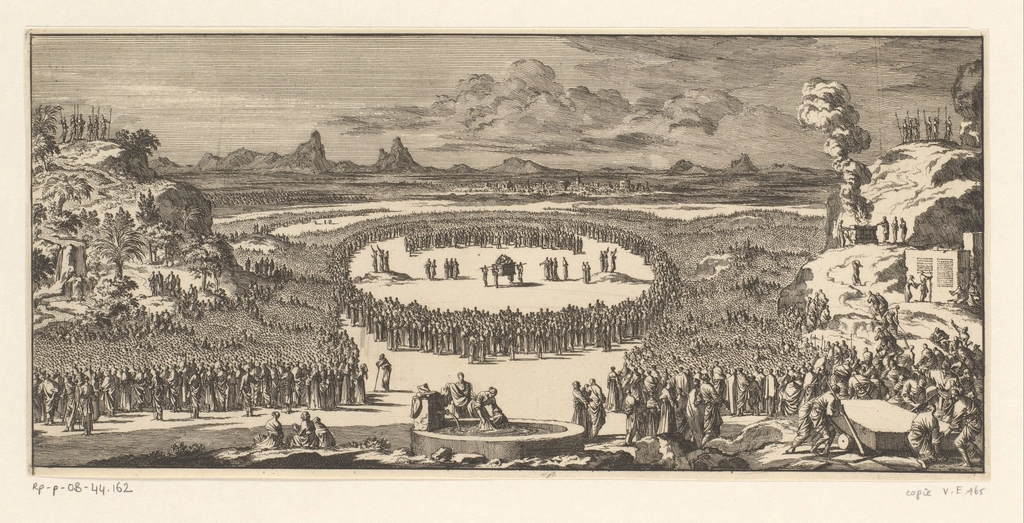
Moses could not enter the Promised Land. He thus directs Joshua, his successor as leader of the people of Israel. In effect, he says, “Once you have conquered a foothold in the land, go to Mt. Gerizim and Mt. Ebal. Set up stones brought from Jericho. Plaster them and write thereon the words of the law. Position half of the tribes on one mountain and half on the other. Announce blessing from Gerizim and curses from Ebal. On Ebal, build an altar of unhewn stones. To the God of Israel, sacrifice the blood of innocent animals to cover the sins of the guilty.” 4
Joshua accomplishes these directives, as recorded in Joshua 24:1, 25-26, and 32.
Of this relevance, however, Zertal had no inkling. His ancestors were East European immigrants who had lived under Soviet domination. He had grown up on a kibbutz. To him and many of his kin, biblical connections had little resonance. He was agnostic and clueless about scripture. 5 (Note that he was also an esteemed scholar and a wounded combat veteran. Hence, he walked with a cane.) His academic training had cemented his conviction that the Bible was mythology. 6
That was about to change.
Exploring the mountain’s backside, he observed a peculiar mound. He did a quick survey. From this, he concluded that the place deserved serious investigation.
Later, his team removed a large stone covering, revealing a baffling structure. What is this? Nothing about it resembled anything in Zertal’s experience. 7
A period of head-scratching wonder followed. Then, an under-associate suggested an explanation. “People have scoured this mountain for decades, looking for a structure. Their focus was on the side of Mt. Ebal facing its twin mountain, Mt. Gerizim. Convinced that it must be there, they ignored the back side where this site lies on a lip beyond the summit.”
“Was this what confused many people?” the understudy postulated. “Could this be Joshua’s Altar, the one that Moses in Deuteronomy 27 and 28, had commanded him to build!?” 8
Of this, Zertal, the agnostic, became convinced. 9
Now, I will stop the Harrison Ford-type narrative. Instead, I will suffice with a list of the things that supported his conviction. They are:
- The site’s location offered a view of the eastern horizon. From the side of Mt. Ebal facing Mt. Gerizim, this was impossible. Both Exodus 27:13 and 2 Chronicles 5: 11-12 imply the same. The entrance to the Tabernacle and, later, to the Temple must face eastward.
- A huge stone enclosure surrounds the altar site. It resembles a footprint and stands about a yard. Yet it stretches over four football fields. Within it is another “footprint” about 100 meters long. (About six such structures one finds leading up the Jordan Valley, culminating at Mt. Ebal. Some suggest that the Hebrews of the conquest constructed these. They theorize that these symbolize God’s Mosaic promise. He would give them all the land within the parameters of the Promised Land on which their feet trod. That is if they keep His commandments.) 10
- A long ramp rose to an altar site. Stairs Moses’ instructions forbid. 11
- The altar site consisted only of unhewn stones, field stones untouched by any iron tool. This Moses had directed. 12
- Excavation revealed two potential altars. A large rectangular one encompasses a smaller circular one beneath at its center. Both contain bones of almost only kosher animals. 13 (A small percentage belonged to creatures that may have climbed among the rocks. There they died. Such included turtles or snakes.)
- Zertal dated pottery fragments only to Iron Age One and Bronze Age Two. Both are consistent with competing theories for the date of the Exodus and the Conquest. 14
- Another scholar saw a photo of the Ebal site and noted that it mimics an ancient drawing of Jerusalem’s Second Temple altar.
These verisimilitudes convinced Zertal.
On announcing his findings, a tremor rumbled through the archaeological and theological worlds.
Yet, as we will see in the next post, it was only a tremor. It was not the epic seismic event necessary. The mythological Moses paradigm shook little.
Now a question: What other evidence might have elevated Zertal’s altar hypothesis?
Let me know in the comment section below.
Next post: “Zertal Rejected”
- Melanie Lidman, Academic article on controversial 3,200-year-old ‘curse tablet’ fails to sway experts, The Times of Israel,14 May 2023, paragraphs 1, 5, 38, and 40, https://www.timesofisrael.com/academic-article-on-controversial-3200-year-old-curse-tablet-fails-to-sway-experts/, (7 October 2024).
and
Steve Law, patternsofevidence.com, Ancient Hebrew Writing on Tablet Discovered at Joshua’s Altar, paragraph 3, February 4, 2022. ↩︎ - Id., paragraph 1. ↩︎
- Sean McDowell, Oldest Hebrew Writing? Mt. Ebal Curse Tablet (Revisited) m.youtube.com>watch, (5: 26-44), 11 May 2023.
and
Associates for Biblical Research, Cursed! The Mount Ebal Curse Tablet (Part One, Digging for Truth Episode 200), YouTube, (04:29; 05:21), May 1, 2023. ↩︎ - Chris & Jenifer Taylor, The Bible Journey, https://thebiblejourney.org/biblejourney2/27-the-israelites-move-into-canaan/joshua-builds-an-altar-at-mt-ebal/, paragraph 4, © 2024. ↩︎
- Associates for Biblical Research, YaHWeh Curse Tablet: A Tsunami from Mt. Ebal, https://www.youtube.com/watch?v=gU5njOpRCHQ&t=85s, (5:40-7:00) 1 November 2024. ↩︎
- Id. 6:15 ↩︎
- Steve Law, patternsofevidence.com, Ancient Hebrew Writing on Tablet Discovered at Joshua’s Altar, paragraph 5, February 4, 2022
and
Associates for Biblical Research, Cursed! The Mount Ebal Curse Tablet (Part One, Digging for Truth Episode 200), YouTube, (10:29), May 1, 2023. ↩︎ - Associates for Biblical Research, Cursed! The Mount Ebal Curse Tablet (Part One, Digging for Truth Episode 200), YouTube, (12:08), May 1, 2023, ↩︎
- Adam Eliyahu Berkowitz, Skeptics of Ebal Curse Tablet Accuse Christian Researchers of “Seeing the Face of Jesus in a Grilled Cheese Sandwich”, israel365news.com, Archeology, paragraph 3, December 6, 2023. ↩︎
- Associates for Biblical Research, “ABR Researchers Discover the Oldest Known Proto-Hebrew Inscription Ever Found”, biblicarchaeology.org/current-events-list/, Youtube, (15:32), March 24, 2022.
and
Associates for Biblical Research, Cursed! The Mount Ebal Curse Tablet (Part Four, Digging for Truth Episode 200), YouTube, (11:25 and 12:48), May 1, 2023. ↩︎ - Steve Law, patternsofevidence.com, Ancient Hebrew Writing on Tablet Discovered at Joshua’s Altar, paragraph 4, February 4, 2022. ↩︎
- Melanie Lidman, Academic article on controversial 3,200-year old ‘curse tablet’ fails to sway experts, The Times of Israel,14 May 2023, paragraph 38, https://www.timesofisrael.com/academic-article-on-controversial-3200-year-old-curse-tablet-fails-to-sway-experts/, (7 October 2024) ↩︎
- Associates for Biblical Research, “ABR Researchers Discover the Oldest Known Proto-Hebrew Inscription Ever Found”, biblicarchaeology.org/current-events-list/, Youtube, (14:37), March 24, 2022. ↩︎
- Sean McDowell, Oldest Hebrew Writing? Mt. Ebal Curse Tablet (Revisited) m.youtube.com>watch, (11:25), 11 May 2023. ↩︎

To view the memorandum from the beginning, click here.
For the composite footnotes, click here.
Leave a Reply