Why the intense scorn about Stripling’s pronouncement?
Accepted archaeological procedure discouraged reporting a find until after it had completed peer review by the appropriate scholarly community. This protocol Stripling admittedly violated.
About this he offered the explanation given in the previous post. In sum, he feared losing his intellectual stake in his find. He thus felt compelled, despite protocol, to release publicly what he had discovered about his artifact’s nature.
Unfortunately, this happened in the wake of another biblical archaeological scandal, one that caused heightened sensitivity about scholarly procedures.1
Israel Antiquities Authority had prematurely publicized their analysis of a Tel Lachish pottery sherd. The news release heralded it as the first found in Israel referencing King Darius the Great of Persia 2500 years ago.2
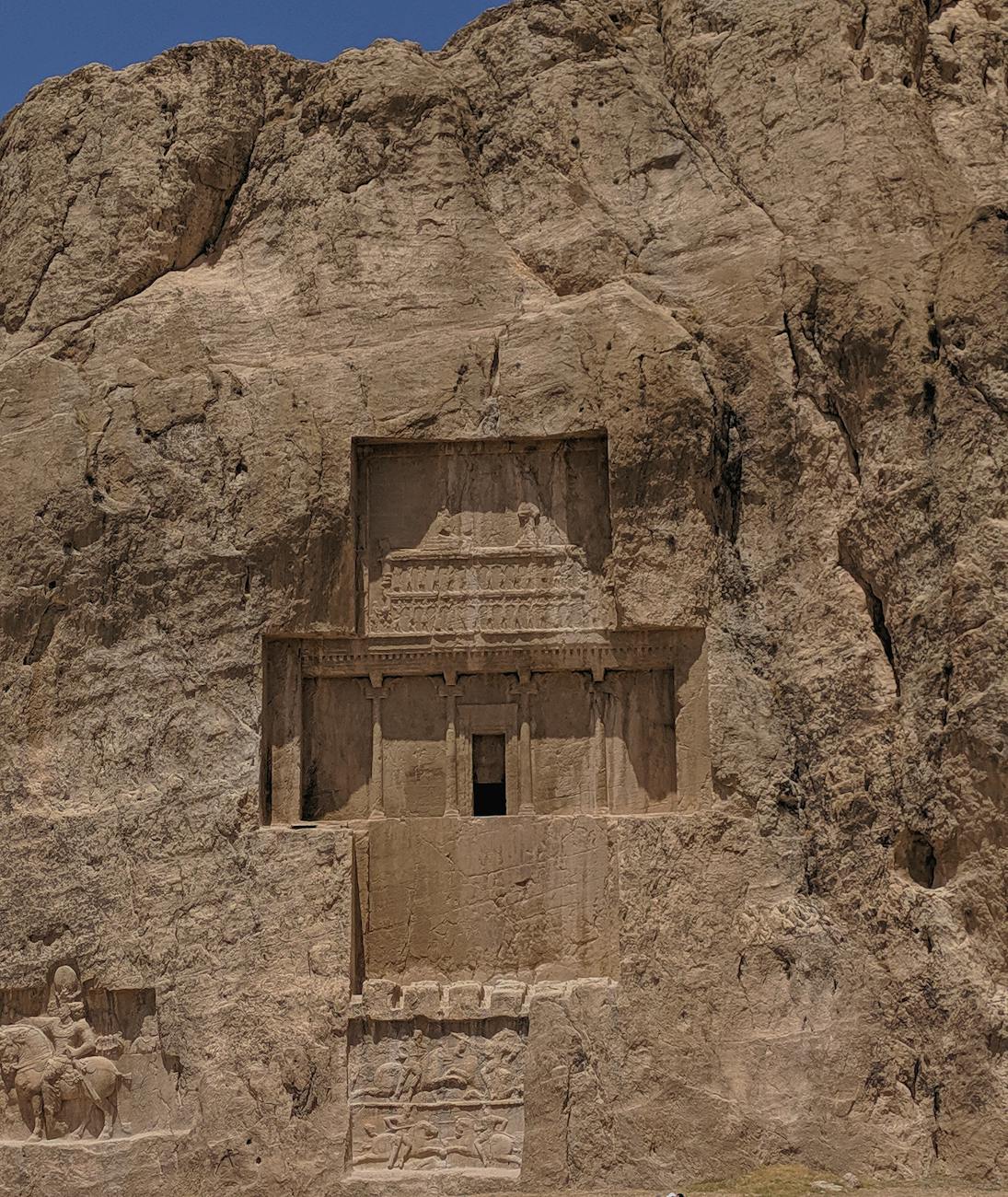
The tomb of Darius the Great (550 B.C. to 486 B.C.) at Naqsh-e-Rustam The site lies northwest of ancient Persepolis, 30 miles (50 km) northeast of modern Shiraz, Iran.
Photo by Nursel Kaya on Pexels.com Ruins of Persepolis, a city founded by Darius the Great
Shortly afterwards, however, a researcher specializing in ancient Aramaic confessed that she had written the inscription.
While visiting the site with her students, she had demonstrated the ancient script on a pottery sherd lying about. Once finishing her lesson, she had tossed it aside, not intending any malice.3
What she had demonstrated turned out to be quite accurate–accurate enough to fool many renowned scholars.
Great embarrassment ensued within several prestigious academic communities.
Contemporaneously into that setting Stripling’s dilemma unhappily landed.4
Many scholars were outraged. Stripling publicly declared a history challenging find underpinned by photos. Not only had he not navigated peer review. He had not released his photos for academic scrutiny. Without them scholars were handcuffed in vetting the allied fantastic claims.
The next step was to compile the data–archaeological, digital, photographic, and epigraphic into a paper and then submit that to a peer review journal.
Which journal should they petition?
They chose Heritage Science. Why? They wanted one esteemed especially by the scientific community. Interpretation of this archaeological find required complex computer and tomographic analysis in addition to archaeological and epigraphic expertise. A respected scientific journal they felt most appropriate.1
Stripling’s team wrote their paper and submitted it to the journal. It in turn approached three specialist. These it perceived of appropriate backgrounds to review the paper. They assessed its credibility, identified where it needed strengthening, and determined questions that needed answering, etc.
Eventually, Stripling received the reviewers’ initial verdicts.
Two of these gave glowing approval. The other reflected considerable disdain and, in fact, vaguely suggested possible criminality.
All three, however, praised the quality of the writing and scholarship. They all had numerous questions and requests for modifications or clarifications–in total seventy-two.
Stripling and his team responded.
Afterwards, the glowing remarks from the two previously favorable reviewers continued. They highly recommended that the journal publish the edited paper.
After receiving the Stripling team’s responses, the negativity of the dissenting panel member softened markedly. Likely this resulted from legal clarifications regarding documents from relevant authorities–Palestinian and Israeli. He or she, in fact, in the end recommended the paper’s publication. All three reviewers assessed the paper as warranting further examination by the scholarly community.2
(As an aside, Heritage Science has not released, as of this writing, the names of the peer reviewers they assigned.)
The journal decided to publish the Stripling team’s article.
That publication we soon investigate thoroughly.
But first we need to put events into some perspective.
After the press conference, twelve months passed. Then on 12 May 2023, three and a half years from the tablet’s discovery, Heritage Science finally published Stripling’s article.
How was this received?
Some were elated, some disappointed, others disgusted.
In succeeding posts I scrutinize the article, its photos, and various responses.
Here though I recall the context of these days. Significant currents darkened the times from the finding of the tablet through and beyond publication.
Of these three particularly warrant recounting.
Pandemic
In December 2019, as we have seen, the lead tablet landed in Frankie Synder’s wet-sifting tray.
In that same month ominous events brewed in another part of the world.
The Museum of the Center for Disease Control and Prevention (CDC) displays this December 12, 2019 log entry:
“A cluster of patients in China’s Hubei Province, in the city of Wuhan, begin to experience the symptoms of an atypical pneumonia-like illness that does not respond well to standard treatments.”
Subsequently, COVID-19 leads to a two year Stripling hiatus from work in Israel.
Local Perils
On January 24, 2023 JNS, Jewish News Syndicate, reported this protest by the Israel Defense Minister, Yoav Gallant:
“Israel will not allow Palestinians to damage a major archaeological site located deep in the biblical heartland of Samaria, one that is revered by millions of Jews and Christians as the location where Joshua built an altar.”
This statement he issued in response to a Palestinian news report about planned construction in the vicinity of the Ebal altar site.
In a letter to the Palestinian Authority Gallant further directed:
“…it has been clarified…to the Palestinian Authority that we will not allow any damage to the altar, which has been defined as an archaeological site of historic cultural and religious significance.”
Events past and present underscored the necessity of Gallant’s manifesto.These include:
In 2021 a Palestinian road crew damaged the outer “footprint” enclosing the Ebal altar.
In Nablus during the last two decades several alarming incidents transpired at the tomb alleged to be that of Joseph, son of Jacob, second in command to Egypt’s Pharaoh. This purported holy site, venerated by Jews and Christians, was defaced, fire bombed, and otherwise purposely damaged. (Note that the actual location of Joseph’s tomb near ancient Shechem is a matter of speculation rather than exact historical or archaeological evidence.)
Resultantly, heavily armed military units started escorting pilgrims to the area. This began after the Oslo Accords designated the region as “Area B”, one under the dual authority of the Palestinian civil government and the Israeli military.
From this last bullet one can readily perceive what might be the sentiments among some locals. Especially aggrieved likely would be those descending from ancestors who for generations have resided in the region.
Of what these Israeli military escorts consist I cannot relate. If, however, they resemble an American equivalent I envision vehicles armed with 50 calibers, 240 Bravos, 249 SAWS, or equivalent menacing weaponry. Infantrymen clad in full armor climbing to elevated positions with their M4’s acquitted with zeroed mechanical and electronic sights. A defensive cordon once established restricts entrance and exit of the area.
If some power not representing me executed such near my home, I can well imagine the caustic feelings that would swirl within!
On the other hand, one also can perceive the necessity of these escort measures.
The bottom line is this: Embitterment among some locals one must factor when evaluating the security of the Mt. Ebal altar.
October 7, 2023
During my life, little, if anything, equates the ghastly evil of Hamas’ cowardly massacre of innocents on this date.
Whether one labels Israel’s response “hard”, “harsh” or “brutal” is not the question. Hard, harsh and brutal can fall well within the acceptable context of the laws of war.
The real questions are whether war crimes have been perpetrated. World authorities appropriately should evaluate what lands fair and foul. Later individual soldiers, units, and leaders where appropriate should be held accountable.
Nevertheless, while there can be no excuse for violations of the law of war, one should not forget the horror which initially precipitated the resulting conflagration.
From it dominoes have since fallen, ones that have shaken much of the world.
For our purposes this we must remember: Mt. Ebal lies proximate to the eye of this tumult.
All of this having been noted, let us now bridge these troubled water.
In the next post I begin my review of the Stripling team’s Heritage Science article.
As already noted Heritage Science finally published the Stripling team’s peer reviewed article on 12 May 2023. That is twelve months after the press conference and almost three and a half years after the tablet’s discovery.
Much of the world, of course, breathlessly anticipated one feature.
Likely you also think, “Show us the photos, please!”
Before I do, however, there are four important observations to make.
Observation One
The article’s conclusion states the core of the Stripling team’s argument about the Curse Tablet. With it they poise a stake into the heart of much scholarly accepted history including that associated with the documentary hypothesis.
The other parts of the article’s body state facts and ideas considered. Only with the concluding core, however, does Stripling dig in his boots. It is there that he states what about the tablet emphatically belies the idea that Moses could not have authored the Torah.
The Stripling article, for example, credits team member Professor Gershon Galil, Director of the Institute of Biblical and Ancient History at the University of Haifa, with deciphering most of the interior tablet. His premises it fully elucidates.
Yet, note this crucial point.
The Stripling article’s conclusion leaves many, if not most, of Galil’s premises orphaned. His accounting of the number of inner tablet letters is neither adopted nor rejected. The same applies for his full chiasmus interpretation.
The article acknowledge many of Galil’s premises. It cites his increased letter count of forty declared at the press conference to forty-eight at publication. Consequently, it also acknowledges his slightly modified chiasmus interpretation.
Despite this, the article’s conclusion does not embrace these premises.
Instead, it concludes that the tablet’s inscription challenges history for greatly truncated reasons. Those reasons include these:
The tablet displays in proto-alphabetic script the word “YHW”, the name of the Hebrew God;
From this we know that a Hebrew inscribed the tablet sometime before 1250 B. C.;
Additionally, the tablet contains the word “ARWR” or “cursed”;
These tablet words recall events described in Deuteronomy and The Book of Joshua;
Resultantly, this artifact challenges long standing historical paradigm.1
The note immediately following the conclusion is telling. It addresses Galil’s allegiance to his premises. It announces that, in effect, he desires to “plant his intellectual flag” on those.2
A more conservative approach, however, Stripling’s conclusion adopted.
Following publication, Galil and Stripling amicably ended their team affiliation.
What are the consequences for our study?
For us Stripling has simplified our original question, “Is there anything to see here?”
Stripling’s team answers with a resounding, “Yes, see the two words on the inside of this artifact–the ancient Hebrew equivalents of “cursed” and “Yahweh”. They alone with the tablet’s ambiance challenge world history!”
Consequentially, that makes our photo study easier.
From Stripling’s perspective we can focus primarily on photos relevant to two words. The other words of Galil’s chiasmus while important are not crucial to Stripling’s conclusion.
Observation Two
Our purpose is not only to review the Stripling article and its photos. We seek also to study an allegedly refuting article.
That article considers closely the alleged Hebrew words for “cursed” and “Yahweh”.
Additionally, it makes relevant arguments involving two individual tablet characters and the Hebrew word for “You will die!” These I also include in our study.
Observation Three
In the proto-alphabetic era writing often traced a boustrophedon path. Then there was no standardized script order. Instead, letters tracked as oxen plow. They follow left to right, up to down, diagonally, etc. Another example may be the various paths that an inexperienced pre-teen might push a lawnmower over your yard or maybe someone much older quite inebriated.
Stripling, S., Galil, G., Kumpova, I. et al. “You are Cursed by the God YHW:” an early Hebrew inscription from Mt. Ebal. Herit Sci11, 105 (2023), paragraph 71. https://doi.org/10.1186/s40494-023-00920-9↩︎
From tomographic scans revealing an inside face of the tablet, we first assess the presence of an intimidating word. That is “ARWR” or “cursed”, one of the two words fundamental to Stripling’s conclusions.
In the Scientific Heritage article Gershon Galil identified this word six times on the inner tablet. Of these we will, for brevity, focus on only one.
The article’s Figure 7 shows Galil’s drawings of the tablet’s inner symbols. (Henceforth, click on underscored items to see referenced material.)
You see our word on the right annotated drawing. It is numbers 25 through 28.
“ARWR’s” proto-alphabetic spelling is “Aleph”, Resh”, “Wah”, and “Resh”.
“Resh” often resembles a rhombus. Sometimes, though, it has a tail making it resemble a kite.
“Waw” and “Resh” can be easily confused. But “Waw” replicates a mace, an ancient weapon consisting of a heavy object fastened to a handle used to bash an enemy’s skull, bones, and armor.
Importantly note one thing about the photos and drawings of Tables 2-9. These mirror the drawings of Figure 7. In other words, one must be viewed in a mirror to correspond with the other’s alignment. Otherwise they appear backwards.
Now see Table 10. It reveals several photos of the tablet’s “Outer B”, that is, the tablet’s bottom.
My beach towel’s Egyptian hieroglyphic immulates proto-alphabetic “Yod”.Photo by Pixabay on Pexels.com
Here is what they look like:
An angled arm symbolizes “Yod”. Picture it as running from above the elbow to the thumb and thence to the pointer finger. See Figure 7’s #11, at Table 5, (1 a and b).
Importantly, study, too,Table 10, photo # 3. The Stripling team argues that this depicts the bottom bulge of this “Yod”.
Do you agree?
If you do, this has major consequences–ones to which even Haughwout, the sceptic, agrees. It is this: mirror bulges on the bottom reflect something actually existing on the inner surface of the tablet. The object does not result from a photographic lighting or shading issue. It also nullifies the object resulting from a computer glitch.
That finishes my review of the two words which Stripling declares compel his conclusions–“ARWR” and “YHW.”
What did I tell you? That was not hard.
However, again, read these sections a couple of times. Let the photos really sink in.
With the following post I complete an initial dive into the tablet’s photos. There I look at a word and two other letters relevant to Haughwout’s arguments.
Later, however, l tread deeper into the words and symbols mentioned above as I evaluate Haughwout’s analysis.
I now aim at capturing relevant arguments of the numerous critics of Stripling’s article.
Yet, I discuss the work of only one, Mark S. Haughwout, a respected Hebrew scholar and instructor at the Indian Bible College, Flagstaff, Arizona.
There are a couple of reasons for this.
For one he does an admirable job of not only giving his thoughts but of summarizing the main views of other prominent voices.
The second reason is that his publisher, Heritage Science, the same publisher as Stripling’s article, is free and easily accessible online.
This of course makes a lay person’s review of his work feasible.
Before considering the body of Haughwout’s article, let us spend some time with his title–“Mt. Ebal curse tablet? A refutation of the claims regarding the so called Mt. Ebal curse tablet.”
A key word is “refutation”.
Merriam-Webster defines this as “the act or process of refuting”.
For the root word, “refute”, it gives these alternative definitions:
: to prove wrong by argument or evidence : show to be false or erroneous
: to deny the truth or accuracy of
The meaning of each differ markedly.
Which did Haughwout intend?
Does Haughwout prove Stripling’s claims false or does he simply deny their truth?
To underscore the vast difference in these ideas consider Matthew 9:5 NIV.
Which is easier: to say, ‘Your sins are forgiven,’ or to say, ‘Get up and walk’?
Matthew 9:5 NIV
Of course, the answer is the former.
Similarly, simply denying the truth of Stripling’s claims is one thing. Actually proving that they are wrong is another.
So which is it? How can we know?
By happenstance, Haughwout answers himself. His conclusion states: “The only substantiated claim that Stripling et al. can make at this time is that they have found a very old, small piece of folded lead on Mt. Ebal using wet sifting.”
By using the word “refutation” in his title Haughwout thus declares that he has disproved Stripling’s claims, not that he merely disputes them.
We thus perceive that Haughwout’s and Stripllng’s ideas are decidedly in opposition.
One alleges that the Ebal tablet depicts something profoundly important.
The other claims to have refuted, i. e. disproved, those contentions. Essentially he declares, “Currently this tablet presents nothing of consequence.”
One says, “Take notice world! This artifact likely challenges scholarly history.”
The other declares that he has shown otherwise. Thus scholarly communities and serious journalistic ones should largely ignore the claims about this artifact.
Esteemed professionals back each. A respected scientific journal published both. Peer reviewers vetted both.
The last post sets up our story’s tension. Stripling alleges that his artifact challenges scholarly world history. Haughwout counters that he has disproved such.
Henceforth, Stripling’s positions, Haughwout suggests, qualify in effect only for grocery aisle tabloid offerings of the latest Big Foot and Freddie Mercury sightings.
With Haughwout a sizable contingent of authors and professional commentators seem to agree.
This a quick online search confirms. Google “Mt. Ebal Curse Tablet”. There you soon encounter offerings such as these:
“New Studies Debunk Controversial Biblical ‘Curse Tablet’ from Mt. Ebal”;1
“New academic articles heap fresh doubt on Mount Ebal ‘curse tablet’ interpretation;”2
“Academic article on controversial 3,200 year-old ‘curse tablet fails to sway experts;”3
“Hook, Line, and Sinker: Mt. Ebal Curse Tablet Debunked?;”4
“Don’t Be Fooled by the Mount Ebal Curse Tablet.” 5
“The Mt. Ebal “inscription” is actually a Folding Lead Clasp.”6
Delve deeper into these and you encounter statements from scholarly professionals like these:
“This article is basically a text-book case of the Rorschach Test, and the authors of this article have projected upon a piece of lead the things they want it to say.” So advises Prof. Christopher Rollston, an expert in Northwest Semitic languages and the chair of the Department of Classical and Near Eastern Languages and Civilizations at George Washington University7;
“The images made it clear that there are no discernible letters on this piece of crumpled lead,” said Rollston. “And again, the authors’ drawing of the letters bears no real similarity to what is present in the images;”8
“One big nothingburger”, says Dr. Robert Cargill, as cited previously, a Bible scholar and professor at the University of Iowa.9
Articles and opinions pro and con are, of course, appropriate. The scholarly process thrives on such.
The scholarly world, however, should also desire to make an appropriate and wise decision on this matter
The question is whether such really operates here given the following factors:
A fully excavated altar site could yield other evidence regarding Stripling’s claims; and
There are competing interest in the “refutation” determination.
Considering these, how do we arrive at an appropriately wise answer?”
Melanie Lidman, Academic article on controversial 3,200 -year old ‘curse tablet’ fails to sway experts, The Times of Israel, 14 May 2023, paragraph 18, https://www.timesofisrael.com/ academic-article-on-controversial-3200-year-old-curse-tablet-fails-to-sway-experts/, (7 October 2024). ↩︎
That is for summary judgment—Federal Rule of Civil Procedure (FRCP) 56–Title 28 of the U.S. Code.
How does summary judgment work?
Consider an example.
Mark sues Sally in federal court for negligence involving a Louisiana car accident. Sally, a Michigan resident, asks the court for summary judgment. With her motion she attaches an affidavit stating that at the time of the wreck she was in Quebec.
By granting Sally’s motion a court could dismiss Mark’s case without him having the opportunity of a trial.
The U. S. Supreme Court recognized, however, that this litigation outcome raises due process issues. On the other hand, it also recognized that it must safeguard the trial process being overburdened by frivolous claims.
With Rule 56 the Supreme Court balances these competing interests. It authorizes the granting of Sally’s motion given certain conditions. These include in part:
Sally proves that no genuine dispute exists regarding the facts relevant to her claim;
The ruling court views the evidence in the light most favorable to Mark; and
That court states on the record the reasons for its decision.
How does this relate to our situation? This matter also requires a balancing of competing interest.
On one hand academics and scientists must maintain the trust of public, institutional and financial benefactors that their support is not wasted on frivolous pursuits.
On the other there is here the need to preserve potentially precious evidence.
Against the later Haughwout’s “refutation” has consequences. His alleged disproval of Stripling’s claims bolsters the idea that further excavation at Joshua’s Altar holds little promise of yielding meaningful results. Resultantly, excavation is unlikely to proceed. Especially this is so given the adverse regional realities. Furthermore, this delay exposes Joshua’s Altar to potential harm. This I have previously discussed in Post 16, Troubled Waters, Local Perils.
A balance thus is necessary.
Again, one side advocates for protecting academic and scientific support. They wish to insulate that from being diluted by outrageous notions. This underlies their desire to expose frivolous claims.
The other side clamors for safeguarding historical evidence. Here such may fundamentally affects how mankind views this world. Plus it is such which is potentially available for the the first time in millenniums and may not be again accessible for a thousand years or more.
Achieving a fair balance of both of these interest, I argue, serves mankind’s interest.
Therefore, before accepting Haughwout’s refutation claim the public should require that he meet a standard similar to that of summary judgment.
Accordingly I conclude that he as the one claiming the “refutation / disproval” should show that no genuine dispute exists regarding the facts relevant to his claim, i.e. that there is no genuine dispute regarding his material facts.
That translates into him proving the following: That a reasonable person could not disagree with these statements:
That the tablet does not contain proto-alphabetic script denoting the words “ARWR”–“cursed” and “YHW”–“Yahweh”, the Hebrew name for God; and
That a Hebrew of before 1250 B. C, did not inscribed the tablet?
The next four posts concentrate on these statements. Each respectively focuses on:
Does the tablet contains proto-alphabetic letters?;
Does it display the word “ARWR”?;
Does it reveal “YHW” as the name of God?; and
Did a Hebrew of prior to 1250 B. C. inscribe it?
After those discussions, I give my written judgment on Haughwout’s “refutation”.
We test here the first part of Haughwout’s material fact. That is whether the tablet contains proto-alphabetic letters.
To evaluate this I take these steps:
First I outline Haughwout’s position. Find this below the magenta banner.
Against it, I give push back. This you find below the yellow.
Lastly, I announce my findings below the purple banner.
No Letters
When Haughwout began to study the photos of Stripling’s article, he had an initial favorable impression. The top right corner indeed seemed to show several proto-alphabetic characters. Namely these were Teh, Meh, He, Teh and Aleph–five in total, respectively #’s 18, 19, 12, 20, and 21 of Figure 7.
For him the most impressive was Aleph #21. Best he felt it displayed the appropriate proto-alphabetic characteristics.
His opinion, however, soon changed.
On close review he noticed a number of crack lines commencing from the tablet’s edge to intersect with the character.
Is there an “Aleph”?
Photo by Jesu00fas Esteban San Josu00e9 on Pexels.com
Prominent were the two cracks that he deduced had over time created the “Ox’s” horns. (See here.)
Resultantly, this Aleph’s favorable status crumbled. He deduced it only the chance product of crack lines. No longer was it an exquisite inscription. It now presented a coincidental aberration with grotesquely proportioned horns. This disqualified it as a man-made proto-alphabetic letter.1
Disillusionment followed also for the other four likely script candidates. All he concluded as being mere happenstance cracks, scratches, and dents in the lead.
Some of the primary reasons for this were these:
First, he realized how small these characters were, ranging form .01 to .05 mm. The minimalist crack, scratch, or dent could replicate them; and
Photos of bulges on the tablet’s bottom (Table 10) failed to impress Haughwout. These Stripling had presented as negative proofs of inside characters. They too, Haughwout concluded, likely resulted from cracks, scratches and dents.
Haughwout thus finally surmised that his most favored of the tablet’s characters presented major existential problems. Doubly so this applied to the remainder.
Pushback on Haughwout’s Improbable Letters
I. Lovely Aleph
Haughwout notes that initially “Aleph, ” Figure 7, # 21 presented for him as a gorgeous proto-alphabetic inscription.
On this I agree.
Note its beauty! It satisfies the eye as an elegant calligraphy beginning a chapter of a medieval manuscript.
Haughwout, however, finds what he considers a fatal flaw–crack lines intersecting the horns.
These he concludes reveal the inscription to be nothing more than happenstance cracks, scratches, and dents. (See again Haughwout’s illustration.)
But Dr. Pieter van der Veens of Johannes Gutenberg University Mainz, one of Stripling’s team epigraphers and an expert in ancient Near Eastern languages and inscriptions, gives a plausible explanation. He suggests that yes there are crack lines emanating from the tablet’s edge. But likely the force of the stylus so close to that edge caused this.
In fact, along the tablet’s top this “Aleph” is among the closest.2
Note too that Haughwout’s drawing appears on a photo that poorly focuses this Aleph.”
On this clearer image you can see that the cracks do not intersect the horn tips smoothly and directly. On both horns there is a transition from the points where the aesthetically pleasing horns end and the apparent cracks intersect.
Both of the aesthetic horns are darker, wider and likely deeper.
Plus, at the intersection points the direction of the cracks deviate on both, but on one more pronounced than the other.
The above emphasizes the likelihood of an author having beautifully crafted his letter only to have time mar it with the imperfectly connecting cracks.
II. Tiny Letters
Haughwout also complains about many of the letters’ small sizes. Here the simple explanation is that the author had a small space with which to work. Plus, in that small space he had a serious message to convey–one not intended for human eyes but only for God.
Fortunately, though, they are indeed visible to man.
III. Bottom Bulges
Further, Haughwout apparently scoffs at the idea of negatives on the tablet’s bottom , “Outer B”, replicating inner tablet letters.
This evidence surely deserves less flippant appraisal.
Consider these examples:
Compare “He” of Figure 7’s, #3 and Table 3, (4 a and b) with Table 10, photo #2. This image I have designated “Dancing ‘He’”. Why? Notice that his arms and legs, seemingly in motion, occupy different levels. Nevertheless, the positive of the inner tablet and the negative of the tablet’s bottom mirror.
See, the first “Resh” in the word “ARWR”, at Figure 7’s #26 and Table 8, (2a & b). Compare it with the bottom bulge shown at Table 10, #8. Notice how they coincide. The positive inner image slants right.The bulge mirrors to the left.
Yet even faint mirroring reflections have an important ramification, one that Haughwout recognizes. He notes,”The reality is a dent on one side of a 0.4 mm thick piece of lead will of course appear on the opposite side.” Further he continues that this proves that the marks “on the inside are indeed there and are not x-ray anomalies.” In other words even where the mirroring images are faint, they prove that what is faintly depicted is indeed there. It is not some fluke produced by x-ray or photographic lightings or shadows.3
Several factors limit the possibility of these being the result of mere happenstance cracks, scratches, or dents.
Note that of the three, a dent seems most likely. Usually such one associates with sufficient downward force to cause an opposing bulge.
Nevertheless, Haughwout’s contention that a happenstance dent as opposed to a purposeful one caused by an inscriber’s stylus must account for the following:
First, the tablet was closed thus protecting the inner tablet from further damage.
Second, the tablet’s top,” Outer A,” does not have marks corresponding to these negatives. Only our inner tablet marks do.
Third, therefore, the force, possibly by a stylus, was likely applied before the tablet was closed.
Fourth, this closing likely occurred during the Late Bronze Age to Iron Age II– the era of proto-alphabetic writing.
Fifth, the act of closing was likely done purposefully by a human. Likely too that was done to conceal and protect a message hidden within.
All of the above amount to justifications for a reasonable person genuinely disputing this portion of the material fact addressed here. That is that the tablet does not reveals proto-alphabetic script.
This portion of Haughwout’s material fact thus fails to support his refutation claim.
Improbable Letter Finding
The evidence shows that there is a genuine dispute about Haughwout’s proposition here. In other words, a reasonable person can genuinely dispute the claim that there are no proto-alphabetic letters on the tablet.
Despite conceding that Figure 7’s #’s 18, 19, 12, 20, and 21 represent proto-alphabetic forms, Haughwout nevertheless concludes that only coincidental cracks and dents formed them.
Yet, a reasonable person could genuinely counter that:
“Lovely Aleph”, Figure 7, # 21, is likely a scribe’s work marred somewhat by incongruous intersecting cracks radiating from the nearby tablet edge.
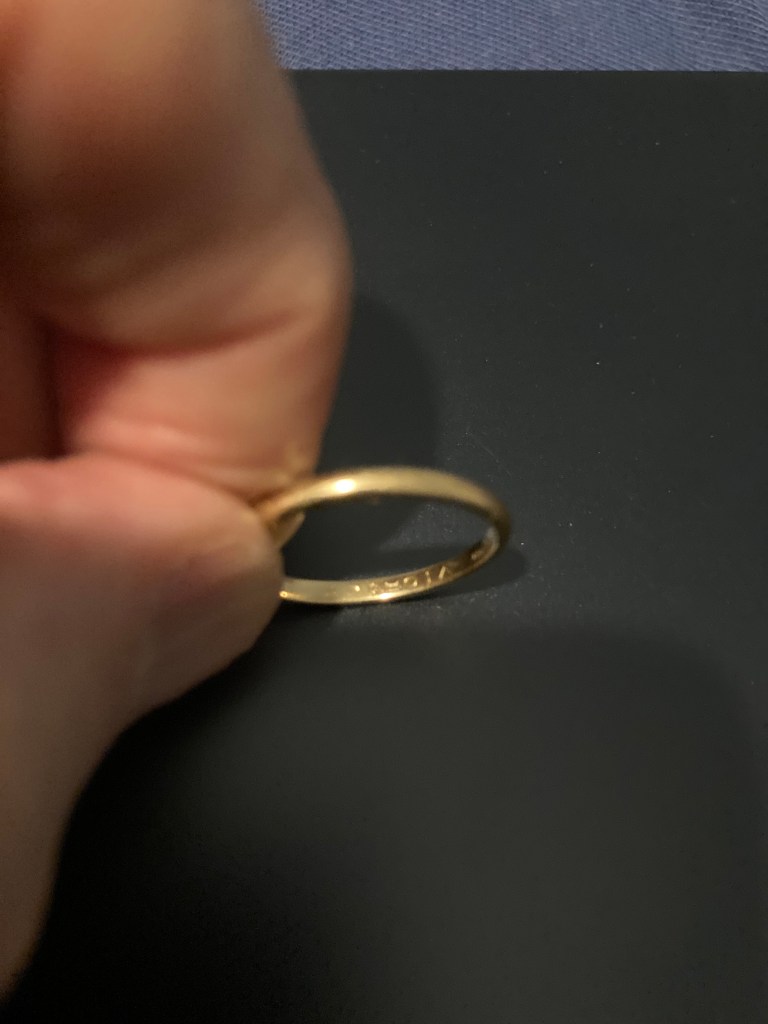
The fact that the letters are small is of little consequence. My wedding band has my wife’s name etched inside it. They are comparably as tiny but no less visible, real and meaningful.
The bottom negatives legitimately argue of man-made proto-alphabetic script inside the tablet.
Therefore, Haughwout’s improbable letter arguments do not support his “refutation” claim. Against this part of Stripling’s first material fact he has failed to satisfy our objective test. That is that a reasonable person could not genuinely dispute the absence of proto-alphabetic letters on the tablet.
Might another of his arguments fare better? Next up we will examine the first of his “Improbable word” criticisms. That is against “ARWR”–“You are Cursed!”
Next post: “ARWR?”
Haughwoout, M. S. Mt. Ebal curse tablet? A refutation of the claims regarding the so called Mt. Ebal curse tablet, Herit Sci 12, 70 (2024). htts://doi.org/101186/s40494-023-01130-z, paragraph 16. ↩︎















































 captivatingtwists.com