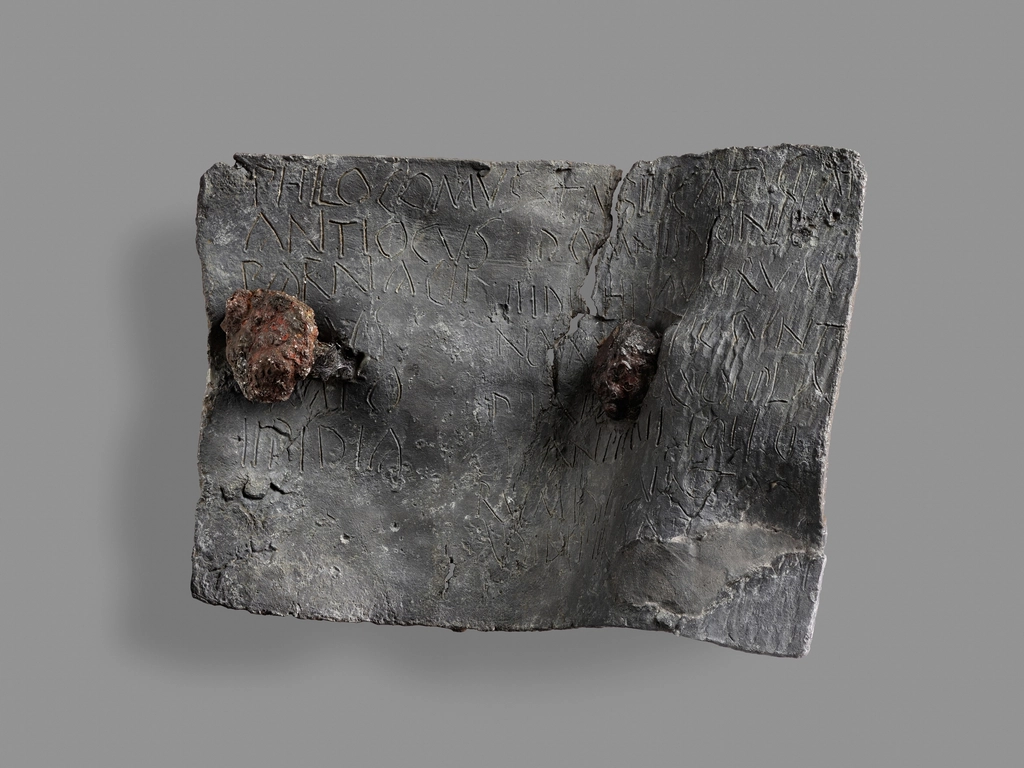
In 2019, Scott Stripling’s team found a small lead object measuring about 2 x 2 centimeters. Stripling is a professor at the Bible Seminary in Katy, Texas. There, he teaches biblical archaeology and church history
Because of this tiny artifact, millions of people worldwide soon focused anew on Mt. Ebal.
Note
This is the tenth post of my memorandum on the Curse Tablet. It is also the fourth of ten detailing the history of the tablet and the proposed Joshua’s Altar.
If you have accessed this post from other than captivatingtwists.com and wish to start the journey from the beginning, click here.
Otherwise, continue below.
This part of our story starts with Stripling obtaining a permit to resift Zertal’s dump piles on Mt Ebal. 1 Such had lain dormant since well before Zertal’s death.
His purpose was to assess the usefulness of an unheralded wet sifting technique. The process involved washing dry-sifted remains to reveal small, missed artifacts.
In doing so, he sought to make a point. That is the percentage of evidence that archaeologists miss through dry sifting.3
On-site work, however, at Mt. Ebal presented geopolitical headaches.
Stripling, nonetheless, found a workaround.
Authorities allowed him to transport dump material away from the mountain.1
There, his team re-dry sifted. They followed this with wet sifting. 2
In doing this, Stripling expected to find mundane archaeological objects. He figured bullae, scarabs, or pottery fragments, but not pay dirt.
Yet the team’s wet-sifting expert, Frankie Snyder, discovered something in her tray. Recognizing what it was, she announced in effect, “Scott, you want to see this!”4
For Stripling, the sensation was as if his heart jumped to his throat. Instinctively, he cautioned, something like: “Whoa! Let’s not get ahead of ourselves here!”5
Now, here are some questions. Did exploring around a creek or mud hole as a kid alert you to the value of wet sifting? Why do you think archaeologists have been so late in using it?
Let me know in the comment section below.
Thank you for engaging with this topic thus far!
Our next post, the fifth of our review of Curse Tablet history, I entitle: “A Defixio?”
I look forward to continuing with you there.
If you appreciate this type of analysis, please “subscribe”, “like”, and “share”.
To support this work, you can donate below. If so, thank you for the encouragement.
What landed in Snyder’s tray she identified as a defixio, an ancient curse tablet.1
Note
This is the eleventh post of my memorandum on the Curse Table. It is also the fifth of ten detailing the history of the tablet and the proposed Joshua’s Altar.
If you have accessed this post from other than captivatingtwists.com and wish to start the journey from the beginning, click here.
Otherwise, continue below.In Snyder’s analysis, Stripling and many of their experienced associates concurred. Why? These they had often seen. From the Greco-Roman world, they are common archaeological finds.2
In Snyder’s analysis, Stripling and many of their experienced associates concurred. Why? These they had often seen. From the Greco-Roman world, they are common archaeological finds.2
Still, they also recognized the irony. This they had found on Deuteronomy’s “Mountain of Curses!”
Stripling immediately recognized that at this site a defixio posed a problem. Zertal had dated the altar site from 1400 to 1250 B.C. This he had concluded from careful pottery analysis. But, Stripling knew that defixios dated to the Greek and Roman eras. That is the fourth and third centuries B. C. forward. A defixio seemed inappropriate by around a millennium.3
He, however, was aware of a possible precedent.
The Book of Job speaks of Job’s desire to write on lead with an iron pen (Job 19:24).
That book, many scholars peg as the oldest biblical text. One reason is that it does not allude to the Law of Moses.2
Stripling realized that glyphs adorned the tablet’s outside. Yet, he was most intrigued by what may lie within. There, as with other defixios, someone likely inscribed a curse.
Note
This is the twelfth post of my memorandum on the Mt. Ebal Curse Tablet. It is also the sixth of ten detailing the history of the tablet and the proposed Joshua’s Altar.
If you have accessed this post from other than captivatingtwists.com and wish to start the journey from the beginning, click here.
Otherwise, continue below.
Usually, this curse was of a trivial nature, often something like, “She stole my boyfriend, may all her hair fall out!”1
Stripling and a colleague, thus, attempted to open it. The lead of one corner, brittle with age, however, crumbled. Further efforts, they thus ceased.
The Hebrew University in Tel Aviv analyzed the lead fragments. The determination was that the lead originated from a mine in Lavrion, Greece.2
About that mine, historians and archaeologists accept a position. They have concluded that it, indeed, exported its lead to the Middle East. But it was from before the Late Bronze Age into Roman times.
Here, a curious historical anomaly deserves consideration.
In the Mediterranean world around the 12th century B. C., a dark age ensued. Then, the Late Bronze Age civilization imploded. Ancient exports plunged. European / Asian economic and cultural sophistication wilted. A mysterious disaster struck several advanced societies. These include the Hittite, Ugarite, Minoan, Mycenaean, Trojan, and Babylonian. 3 A definitive explanation for why scholars have yet to determine. 4
From this understanding, Stripling deduced a probability.
Someone in the thirteenth century B. C. or earlier likely imported the lead tablet. That is before the ancient dark age of 1200 to 1150 B. C.
The metallurgical analysis, thus, strengthened Stripling’s idea about the tablet’s date. This, however, was not something he considered yet concrete.
Still, Stripling perceived that he had exhausted the tablet’s plausible investigative analysis. It was time for greater focus on his many other pursuits.
Thinking thus, he sent an email to a colleague. With it he attached a tablet photo. Afterwards, in archaeological circles, this began to circulate.
Later, an unexpected opportunity for further investigation materialized.
Stripling read about a technological advancement. Researchers in Europe demonstrated how to peer through lead to discern written content. They were from the Institute of Theoretical and Applied Mechanics (Telc, Czech Republic).
Stripling and others made arrangements. Israeli authorities gave a colleague a license to courier the “defixio” to Prague.1
Time passed. The Institute at Telč, 152 km from the Czech capital, finished its analysis. They then forwarded their results.
The Telč team indeed perceived something within. An epigraphic expert there suggested proto-alphabetic letters. That is, ancient letters represented sounds rather than complete thoughts.
These initial revelations alone had profound meaning for Stripling. Now he had his most conclusive evidence for dating the tablet. It had to be Late Bronze Age or Early Iron Age I, that is, from as early as 1400 to as late as 1250 B.C.1
Why? This was the accepted period for the use of proto-alphabetic script.
No longer did the tablet present an anachronistic dilemma. It now matched Zertal’s pottery dates.
What else could this new evidence portend?
I probe this further in my next post!
But now here is a question. What do you think likely caused the Late Bronze Age civilizational collapse?
Let me know in the comments below.
Thank you for engaging with this topic thus far!
The next post, the seventh of our review of the Curse Tablet’s history, I entitle: “Staking a Claim”.
I look forward to continuing with you there.
If you appreciate this type of analysis, please “subscribe”, “like”, and “share”.
To support this work, you can donate below. If so, thank you for the encouragement.
The Czech Institute’s data continued to prove a font of revelation.
From the tomographic scans, Stripling’s epigraphers discerned words.
Note
This is the thirteenth post of my memorandum on the Mt. Ebal Curse Tablet. It is also the seventh of ten detailing the history of the table and the proposed Joshua’s Altar.
If you have accessed this post from other than captivatingtwists.com and wish to start the journey from the beginning, click here.
Otherwise, continue below.
These included “Yahweh” and “cursed”. Both recall Joshua’s ceremony of blessings and curses on Mt. Gerizim and Mt. Ebal.
Dr. Gershon Galil of the University of Haifa added further. He decoded a sophisticated parallelism, a chiasmus.
This literary device you will find throughout the Old and New Testaments. Consider, for example, Luke 4:16b-20 “The Favorable Year of the Lord”. Note below the parallel and inverse wordings with a central focus:
14 And Jesus returned to Galilee in the power of the Spirit, and news about Him spread through all the surrounding district. 15 And He began teaching in their synagogues and was praised by all. 16 And He came to Nazareth, where He had been brought up, and as was His custom,
He entered the synagogue on the Sabbath,
and stood up to read,
17 And the book of the prophet
Isaiah was handed to Him,
And He opened the book and
found the place
where it was written,
18 “The Spirit of the Lord is upon Me
Because He anointed Me to
preach the gospel to the poor.
He has sent Me to proclaim
release / to the captives,
And recovery of sight tothe blind,
To set free / those who
are oppressed,
19 To proclaim the
favorable year of the Lord”
20 And He closed the book,
gave it back to the attendant
and sat down
and the eyes of all in the synagogue were fixed on Him.
21 And He began to say to them, “Today this Scripture has been fulfilled in your hearing.”1
But life threw Stripling a curveball, mandating a different approach.
Speculation circulated about the tablet photo that Stripling had emailed earlier. The associate had forwarded it. Recipients began generating noise online. Some pondered the outer tablet’s glyphs. Could they be a script?
This alarmed Stripling. Others might lay academic claim to the tablet’s message, he thought. He thus deemed it necessary to go public. Otherwise, he risked forfeiting his claim as the lead 2 of the discovering team.
A press conference ensued in March 2022. At it, Stripling and his team announced the following:
The lead defixio found by his team contained archaic proto-alphabetic script;
From forty letters, the Hebrew name for God appears twice and the word “cursed” ten times;
The tablet dates to the late Bronze Age, making it two to four hundred years older than any other known Hebrew text.
A reading may be a chiasmus, a literary form employed in both the Old and New Testaments.
That proposed reading was:
Cursed, cursed, cursed-cursed by the God YHW You will die cursed. Cursed you will surely die. Cursed by YHW-cursed, cursed, cursed!
(Mt. Ebal “Curse Tablet” Full Press Conference, YouTube, Appian Media, March 29, 2022)
Afterwards, public elation and scorn followed.
Why scorn?
In our next post, entitled “A Firestorm”, I address this.
I look forward to continuing with you there.
Now here is a question. What is your favorite chiasmus, scriptural or otherwise?
Thank you for engaging with this topic thus far!
If you appreciate this type of analysis, please “subscribe”, “like”, and “share”.
To support this work, you can donate below. If so, thank you for the encouragement.
Why the intense scorn about Stripling’s pronouncement about the Curse Tablet?
The archaeological community acknowledged a procedure. It discouraged reporting a find until after it has completed peer review. This Stripling admitted to violating.
Note
This is the fourteenth post of my memorandum on the Mt. Ebal Curse Tablet. It is also the eighth of ten detailing the history of the tablet and the proposed Joshua’s Altar.
If you have accessed this post from other than captivatingtwists.com and wish to start the journey from the beginning, click here.
Otherwise, proceed below.
About this infraction, Stripling explained that he had feared losing his intellectual stake. He thus felt compelled, despite protocol, to release what he had.
Unfortunately, this happened in the wake of another archaeology embarrassment. This had heightened sensitivity about procedures.1
The Israel Antiquities Authority had publicized its analysis of a Tel Lachish sherd. Their news release heralded it as a first. No written reference in Israel before had mentioned Darius the Great. This Persian King lived about 2500 years ago.2
The tomb of Darius the Great (550 B.C. to 486 B.C.) at Naqsh-e-Rustam The site lies northwest of ancient Persepolis, 30 miles (50 km) northeast of modern Shiraz, Iran.
Photo by Nursel Kaya on Pexels.com Ruins of Persepolis, a city founded by Darius the Great
Shortly afterwards, however, a researcher specializing in ancient Aramaic confessed. She had written the inscription.
While visiting the site with her students, she had demonstrated the ancient script on a sherd. On finishing her lesson, she had tossed it aside, not intending any malice.1
What she had demonstrated turned out to be accurate. So much so that it fools many renowned scholars.
Mortification ensued across prestigious academic communities.
Into that setting, Stripling’s dilemma landed.2
This outraged many scholars. He had declared a history-challenging find underpinned by photos. Not only had he not navigated peer review. He had not released his photos for academic scrutiny. This handicapped their vetting of the allied fantastic claims.
A firestorm had been lit!
Now here are some questions. Is the protocol of not releasing information about a find until after peer review a good policy? Why or why not?
Let me know in the comments.
Thank you for engaging with this topic thus far!
The next post, the ninth of our review of the Curse Tablet’s history, I entitle “Peer Review”.
I look forward to continuing with you there.
If you appreciate this type of analysis, please “subscribe”, “like”, and “share”.
To support this work, you can donate below. If so, thank you for the encouragement.
Despite the brouhaha about his Mt. Ebal Curse Tablet press conference, Stripling pressed on.
The next step was to compile the data — archaeological, digital, photographic, and epigraphic. They would then submit a paper to a peer-reviewed journal.
Note
This is the fifteenth post of my memorandum on the Mt. Ebal Curse Tablet. It is also the ninth of ten detailing the history of the table and the proposed Joshua’s Altar.
If you have accessed this post from other than captivatingtwists.com and wish to start the journey from the beginning, click here.
Otherwise, continue below.
Which journal did Stripling petition?
He chose Heritage Science. Why? He wanted one esteemed especially by the scientific community. The interpretation of this find required complex computer and tomographic analysis. Also, it required archaeological and epigraphic expertise. A respected scientific journal, he felt, was most appropriate.1
After Stripling’s team submitted their completed paper, the journal approached three specialists. These it determined to have appropriate backgrounds to test the material.
The three then assessed the presentation’s credibility and identified where it needed strengthening. They then drafted questions, etc.
Stripling welcomed the reviewers’ initial verdicts and questions.
Two of these gave glowing approval. The other reflected considerable disdain and, in fact, suggested possible criminality.
All three, however, praised the quality of the writing and scholarship. They all had many questions. Seventy-two requests for modifications or clarifications followed.
To these, Stripling and his team responded.
Afterwards, the glowing remarks from the two favorable reviewers continued. They recommended that the journal publish the edited paper.
After receiving the Stripling team’s responses, the dissenting panel member’s negativity softened. Likely this resulted from legal clarifications by relevant authorities–Palestinian and Israeli. He or she recommended the paper’s publication. 1
(Note that Heritage Science has not released the names of the peer reviewers.)
The journal decided to publish the Stripling team’s article.
That publication I will soon examine.
In the next post, however, I will put the events of these days into perspective. Following that, I will return to Stripling’s article.
Here is a question. Many archaeologist claim that their primary goal is not excavation, but publication. Why might they say this?
Let me know below in “comments”.
Thank you for engaging with this topic thus far!
The next post, the tenth of our review of the Curse Tablet’s history, I entitle: “Troubled Waters”.
I look forward to continuing with you there.
If you appreciate this type of analysis, please “subscribe”, “like”, and “share”.
To support this work, you can donate below. If so, thank you for the encouragement.
After the press conference, twelve months passed. Then, on 12 May 2023, three and a half years from the Mt. Ebal Curse Tablet’s discovery, Heritage Science finally published Stripling’s article.
How was that Heritage Science article received?
Some people expressed elation, some disappointment, and others disgust.
In succeeding posts, I scrutinize the article, its photos, and various responses.
Here, though, I recall the context of these days. Significant currents darkened the times. That is from the retrieval of the tablet through and beyond publication.
Of these, three particularly warrant recounting.
Note
This is the sixteenth post of my memorandum on the Mt. Ebal Curse Tablet. It is also the tenth of ten detailing the history of the table and the proposed Joshua’s Altar.
If you have accessed this post from other than captivatingtwists.com and wish to start the journey from the beginning, click here.
Otherwise, continue below.
Pandemic
In December 2019, as we have seen, the lead tablet landed in Frankie Synder’s wet-sifting tray.
In that same month, ominous events brewed in another part of the world.
The date is December 12, 2019. The Center for Disease Control and Prevention records this diary entry:
“A cluster of patients in China’s Hubei Province, in the city of Wuhan, begin to experience the symptoms of an atypical pneumonia-like illness that does not respond well to standard treatments.”
Afterwards, COVID-19 led to a two-year hiatus from Stripling’s work in Israel.
Local Perils
On January 24, 2023, JNS, Jewish News Syndicate, reported an Israeli official’s protest. The Israel Defense Minister, Yoav Gallant, communicated:
“Israel will not allow Palestinians to damage a major archaeological site located deep in the biblical heartland of Samaria, one that is revered by millions of Jews and Christians as the location where Joshua built an altar.”
This, he issued in response to a Palestinian news report. That regarded planned construction in the vicinity of the Ebal altar site.
In a letter to the Palestinian Authority, Gallant further directed:
“…it has been clarified…to the Palestinian Authority that we will not allow any damage to the altar, which has been defined as an archaeological site of historic, cultural and religious significance.”
Past and present events underscored the necessity of Gallant’s manifesto. These include:
In 2021, a Palestinian road crew damaged the outer “footprint” enclosing the Ebal altar.
During recent decades, alarming incidents have occurred in Nablus. This included the alleged tomb of Joseph being fire-bombed. (Note that the actual location of Joseph’s tomb is a matter of speculation.)
Now, armed military units escort pilgrims to the area. This began after the Oslo Accords. Those designated the region as “Area B”. Authority there rested with the Palestinian civil government and the Israeli military.
From this last bullet, one can sense what locals might feel. Many descend from generations of local residents. This would especially agrieve them.
Of what these Israeli military escorts consist, I cannot relate. Of what, however, an American equal would consist, I can envision. Vehicles arrive armed with 50 caliber machine guns, 240 Bravos, or 249 SAWS. Infantrymen clad in full armor climb to elevated positions. A defensive cordon restricts unvetted civilians from entering the area.
If some foreign power executed such near my home, I can imagine my caustic feelings!
One can also perceive the necessity of these escort measures.
Thus, factor local embitterment when evaluating the security of the Mt. Ebal altar site.
October 7, 2023
Little, if anything, equates the ghastly evil of Hamas’s massacre of innocents on this date.
Whether one labels Israel’s response “hard”, “harsh,” or “brutal” is not the question. Hard, harsh, and brutal can fall well within the acceptable context of the laws of war.
The real question is whether Israel has perpetrated war crimes. World authorities should test what lands fair and foul. Later, individual soldiers, units, and leaders, where appropriate, should give an account.
Even so, two things can be true. There can be no excuse for violations of the law of war. One should also not forget the horror which precipitated the resulting conflagration.
From it, dominoes have since fallen, ones that have shaken much of the world.
For our purposes, we must remember this: Mt. Ebal lies proximate to the eye of this tumult.
This noted, let us now bridge these troubled waters.
In the next post, I begin my review of the Stripling team’s Heritage Science article.
Now for some questions. Do you remember first hearing about COVID-19? Are you aware that in 1918, a similar flu likely originated near Ft Riley, Kansas? That one, in short order, killed between twenty and a hundred million people worldwide. Plus, it likely hastened the end of World War I and confounded the tensions leading to World War II.
Let me know in “comments”.
Thank you for engaging with this topic thus far!
The next post, entitled “Stripling’s Article”, introduces our Curse Tablet’s photo study.
I look forward to continuing with you there.
If you appreciate this type of analysis, please “subscribe”, “like”, and “share”.
To support this work, you can donate below. If so, thank you for the encouragement.
Heritage Science finally published its article about the Mt. Ebal Curse Tablet on 12 May 2023. Since Stripling’s press conference, twelve months had passed. Since the tablet’s discovery, it had been three and a half years.
Much of the world, of course, anticipated one feature.
The article’s body states the ideas Stripling’s team considered. Only with the conclusion, however, does Stripling dig in his boots. There, he states what about the tablet belies the idea that Moses could not have authored the Torah.
The article, for example, credits team member Professor Gershon Galil. He is Director of the Institute of Biblical and Ancient History at the University of Haifa. It was he who deciphered most of the tablet’s interior face.
Gallil’s premises the article elucidates. It cites his increased letter count. From the forty declared at the press conference, he went to forty-eight at publication. The article also acknowledges his modified chiasmus.
Yet, note a crucial point. The article’s conclusion leaves many, if not most, of Galil’s premises orphaned. Many are not embraced there. For example, it neither adopts nor rejects his accounting of tablet letters. The same applies to his full chiasmus interpretation.
Instead, it concludes that the tablet’s inscription challenges history for truncated reasons. Those include:
The tablet displays in proto-alphabetic script the word “YHW”, the name of the Hebrew God;
From this we know that a Hebrew inscribed the tablet sometime before 1250 B. C.;
Additionally, the tablet contains the word “ARWR” or “cursed”;
These tablet words recall events described in Deuteronomy and The Book of Joshua;
Thus, this artifact challenges the historical paradigm.1
The note immediately following the conclusion is telling. It addresses Galil’s allegiance to his premises. It announces that, in effect, he desires to “plant his intellectual flag” on those.1
A more conservative approach, however, Stripling adopted.
Following publication, note that Galil and Stripling ended their affiliation on amicable terms.
What are the consequences for our study?
For us, Stripling has simplified our original question, “Is there anything to see here?”
Stripling’s team answers with a resounding, “Yes!” They point to the two words inside this artifact. There you find the ancient Hebrew ‘cursed’ and ‘Yahweh’. They alone with the tablet’s setting challenge world history!
This makes our photo study easier.
From Stripling’s perspective, we can focus on photos relevant to two words. The other words of Galil’s chiasmus are an important conjecture. But they are not crucial to Stripling’s conclusion.
Observation Two
Our purpose is not only to review the Stripling article and its photos. We also seek to study an article that attempts to refute Stripling’s case.
That article considers the alleged Hebrew words for “cursed” and “Yahweh”.
Additionally, it makes other relevant arguments. These involve two individual tablet characters and the Hebrew word for “You will die!”
I also include these in our study.
Observation Three
In the proto-alphabetic era, writing at times traced a boustrophedon path. Then there was no standardized script. Instead, letters tracked as oxen plow. Consider how an inexperienced pre-teen might push a lawnmower over your yard. or someone older, inebriated.
With these four observations, I conclude my remarks pre-photo study.
Photos!
Ready now for some tomographic scans?
“Cursed! “, our next post declares.
Still ready?
Until then, here are some questions. Which aspects of early writing likely took the longest to standardize? Who most likely prompted or enforced such standardizations?
Let me know below in “comments”.
Thank you for engaging with this topic thus far!
The next post examines an “ARWR” photo.
I look forward to continuing with you there.
If you appreciate this type of analysis, please “subscribe”, “like”, and “share”.
To support this work, you can donate below. If so, thank you for the encouragement.
Our photo study of the Mt. Ebal Curse Tablet begins.
From tomographic scans, we first assess the presence of an intimidating word. That is “ARWR” or “cursed”. This is one of the two words fundamental to Stripling’s conclusions.
Note
This is the eighteenth post of my memorandum on the Mt. Ebal Curse Tablet. It is also the second of my photo study.
If you have accessed this post from other than captivatingtwists.com and wish to start the journey from the beginning, click here.
Otherwise, continue below.
“ARWR” Gershon Galil identified six times on the tablet’s inner face. Of these, we will focus on only one.
(Afterwards, click on underscores to link photos, charts, etc.)
Figure 7 of Stripling’s article shows Galil’s drawings of the tablet’s inner symbols.
You see our word on the annotated drawing. It is numbers 25 through 28.
Galil argues that”ARWR’s” proto-alphabetic spelling consisted of four letters. They are”Aleph”; “Resh”; “Wah”; and “Resh”.
“Resh” often resembles a rhombus. Sometimes, though, it has a tail, making it resemble a kite.
“One can confuse Waw” and “Resh”. But “Waw” replicates a mace, an ancient weapon consisting of a heavy object fastened to a handle. A combatant used it to bash an enemy’s skull, bones, and armor.
Note that the photos of Tables 2-9 mirror drawings in Figure 7. In other words, you must view one in a mirror for them to correspond. Otherwise, they appear backwards.
Now see Table 10. It reveals several photos of “Outer B”, the tablet’s bottom.